Helping design and engineering professionals discover, evaluate and specify technologies and processes that shorten the design cycle and enable success.



Cut Retrieval-Augmented Generation (RAG) Hallucinations by 50%
Most teams hit the same wall with enterprise AI: LLMs that hallucinate, pipelines that don’t scale, and infrastructure that’s harder to design than the models themselves.

What Is Intelligent BOM Management? A Guide to Smarter Product Development
Learn how intelligent Bill of Materials (BOM) management helps teams collaborate, reduce errors, and bring innovative products to market faster with cloud-based PLM tools.
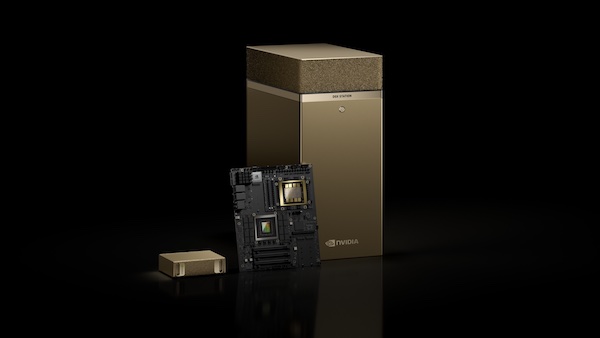
NVIDIA announced its new NVIDIA DGX personal AI supercomputers powered by the NVIDIA Grace Blackwell platform at GTC earlier this year. DGX Spark (formerly Project DIGITS) and DGX Station, a new high-performance NVIDIA Grace Blackwell desktop supercomputer in a tower form factor powered by the NVIDIA Blackwell Ultra platform, will allow AI developers, researchers, data scientists and students to "prototype, fine-tune and inference large models on desktops. Users can run these models locally or deploy them on NVIDIA DGX Cloud or any other accelerated cloud or data center infrastructure," the company says.
DGX Station is expected to be available from manufacturing partners like ASUS, BOXX, Dell, HP, Lambda and Supermicro later this year.
“AI has transformed every layer of the computing stack. It stands to reason a new class of computers would emerge — designed for AI-native developers and to run AI-native applications,” said Jensen Huang, founder and CEO of NVIDIA. “With these new DGX personal AI computers, AI can span from cloud services to desktop and edge applications.”
According to the company, DGX Spark is the world’s smallest AI supercomputer. It is built on the NVIDIA GB10 Grace Blackwell Superchip, optimized for a desktop form factor. GB10 features an NVIDIA Blackwell GPU with fifth-generation Tensor Cores and FP4 support, delivering up to 1,000 trillion operations per second of AI compute for fine-tuning and inference with the latest AI reasoning models, including the NVIDIA Cosmos Reason world foundation model and NVIDIA GR00T N1 robot foundation model.
NVIDIA’s full-stack AI platform enables DGX Spark users to move their models from their desktops to DGX Cloud or any accelerated cloud or data center infrastructure with virtually no code changes, the company says.
NVIDIA DGX Station brings data-center-level performance to desktops for AI development. The first desktop system to be built with the NVIDIA GB300 Grace Blackwell Ultra Desktop Superchip, DGX Station features 784GB of coherent memory space to accelerate large-scale training and inferencing workloads. The GB300 Desktop Superchip features an NVIDIA Blackwell Ultra GPU with latest-generation Tensor Cores and FP4 precision — connected to a high-performance NVIDIA Grace CPU via NVLink-C2C.


Since its founding in 1993, NVIDIA (NASDAQ: NVDA) has been a pioneer in accelerated computing. The company’s invention of the GPU in 1999 sparked the growth of the PC gaming market, redefined computer graphics, ignited the era of modern AI and…
Cut Retrieval-Augmented Generation (RAG) Hallucinations by 50%
Most teams hit the same wall with enterprise AI: LLMs that hallucinate, pipelines that don’t scale, and infrastructure that’s harder to design than the models themselves.

Brian Albright is the editorial director of Digital Engineering.
Contact him at [email protected].

Join over 90,000 engineering professionals who get fresh engineering news as soon as it is published.






About Us · Contact Us · Editorial Team · Advertising · Privacy Policy · Subscriber Services · © 2026 Digital Engineering 24/7 · Peerless Media