Helping design and engineering professionals discover, evaluate and specify technologies and processes that shorten the design cycle and enable success.


Alert!
Digital Engineering ceased publication on July 1, 2026. This website remains available as an archive of engineering content.
For inquiries or information, please email [email protected].

Cut Retrieval-Augmented Generation (RAG) Hallucinations by 50%
Most teams hit the same wall with enterprise AI: LLMs that hallucinate, pipelines that don’t scale, and infrastructure that’s harder to design than the models themselves.

What Is Intelligent BOM Management? A Guide to Smarter Product Development
Learn how intelligent Bill of Materials (BOM) management helps teams collaborate, reduce errors, and bring innovative products to market faster with cloud-based PLM tools.
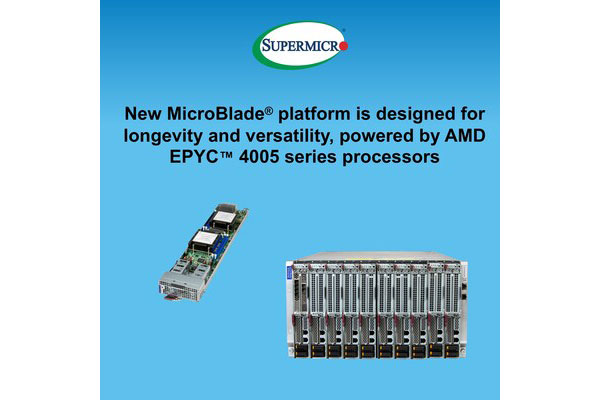
Supermicro, Inc. has launched a high-density blade server platform powered by the latest AMD EPYC 4005 series processors. The solution is designed with a flexible, density-optimized blade architecture. By including the latest AMD EPYC 4005 series processors, along with previous versions, the system provides scalability, allowing organizations to expand and upgrade, according to Supermicro.
"Our flexible blade architecture enables customers to mix different node types with different CPUs within a single enclosure and can incorporate up to 320 server nodes in a standard 48U rack," says Charles Liang, president and CEO of Supermicro.
The new 6U system supports up to 40 nodes in a single enclosure, delivering compute density, energy efficiency, and cost effectiveness for scale-out and multi-tenant environments. The platform is optimized for high-density workloads, including:
Each node supports a single AMD EPYC 4005 series processor with two DDR5 ECC UDIMM slots operating at up to 5600 MT/s, along with two PCIe Gen5 E1.S SSDs and one M.2 SSD per node. Integrated networking features dual-port 25GbE via Broadcom BCM57414, with advanced security and manageability including TPM 2.0, signed firmware, hardware root of trust, IPMI 2.0, KVM over IP, and Redfish API support. The new MicroBlade system uniquely enables flexible mix-and-match configurations across single-wide and double-wide nodes. There is connectivity with two integrated 25G Ethernet switches with 100G uplinks in the back of the enclosure.
The MicroBlade chassis management module (CMM) provides total remote control of individual server blades, power supplies, cooling fans, and networking switches remotely. System administrators can control the maximum power consumption per server through power capping and manage the power allocation in the MicroBlade CMM for each blade server. Remote power control capabilities to reboot and/or reset the server are available as well as remote access to the BIOS configuration and operating system console information via SOL (Serial over LAN) or embedded KVM capabilities. Because the controller is a separate processor, all monitoring and control functions operate flawlessly regardless of CPU operation or system power-on status.
For more details: https://www.supermicro.com/en/Aplus/MicroBlade/module/MBA-315R-1DE12.php
Sources: Press materials received from the company and additional information gleaned from the company’s website.


DE's editors contribute news and new product announcements to Digital Engineering. Press releases may be sent to them via [email protected].
Follow DE






About Us · Contact Us · Editorial Team · Advertising · Privacy Policy · Subscriber Services · © 2026 Digital Engineering 24/7 · Peerless Media