Helping design and engineering professionals discover, evaluate and specify technologies and processes that shorten the design cycle and enable success.


Alert!
Digital Engineering ceased publication on July 1, 2026. This website remains available as an archive of engineering content.
For inquiries or information, please email [email protected].

Digital Engineering April 2026
In the latest issue of Digital Engineering, we take a look at the latest innovations in design for additive manufacturing, including the use of natural language inputs, social media cosplayers, and AI integration. The issue also includes a feature…

January Special Focus Issue: Design for Additive
In this Special Focus Issue of Digital Engineering, learn about the latest advancements in design for additive manufacturing, including new software tools, additive in automotive, custom medical devices, and more.
Rapid Ready has covered a number of different ways AM is used by the military and by defense contractors that provide supply and support. That is just the tip of the iceberg. Today we’ll look at a few examples of how the U.S. military is deploying AM.
Unmanned aerial vehicles (UAV) are becoming a more integral part of the Air Force’s strategy for combat and reconnaissance. The obvious benefit of using a UAV is the ability to project force at a distance without placing military personnel in the way of direct harm. 3D printers are starting to be used to manufacture UAVs, but that isn’t the only application for the technology.
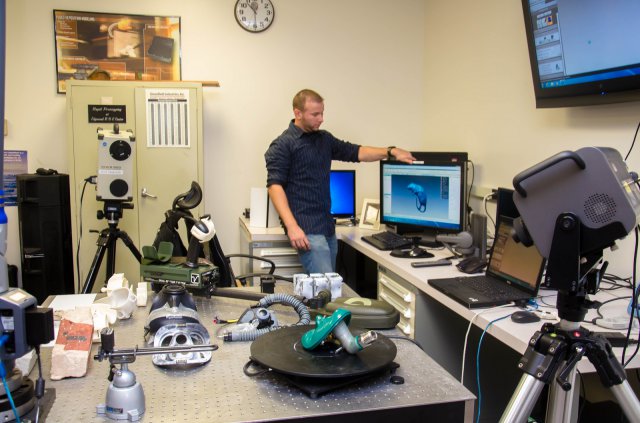
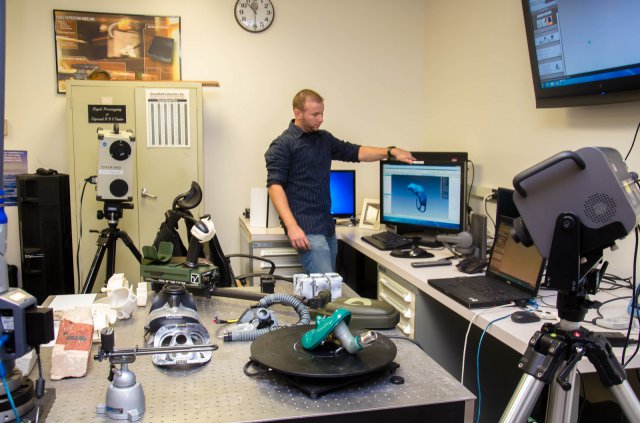
At Sheppard Air Force Base in Wichita, TX, the Trainer Development Flight (TDF) uses four Stratasys AM systems to manufacture a number of training products. Unlike many businesses, TDF creates more end-use materials than prototypes.
“Because most of our projects are either one-of-a-kind or very low volume, conventional methods become very expensive,” says Mitchell Weatherly, chief of the TDF. “Only about 10% of our work is for prototyping, and 90% is production.”
The Air Force training facility has put AM to work by building mock UAVs for repair training purposes. Each mock-up is full size and requires nearly perfect detail to give Air Force technicians what amounts to hands-on training in conducting repairs. TDF estimates they have already saved more than $800,000 by employing 3D printed materials.
The Army has its very own AM lab at the Aberdeen Proving Ground in Maryland, where researchers are constantly seeking out ways to improve Army capabilities, or just to make life a little easier for its soldiers. Recently, the lab was asked to develop an easier way to carry a Mine Hound, which is a bulky handheld sensor used to detect improvised explosive devices.
“They [The Army Research Lab] wanted something that would cradle the handle so it's putting more weight on the Soldiers' vest and back as opposed to just their forearm,” said Rapid Technologies Branch Chief Rick Moore. The research team came up with some ideas and immediately began to print prototypes.
“The fact that we could do this many designs and print them out and have them in their hands in one week gave them the option to choose between what works best for their application,” Moore said. “This is a good example of how we use the technology every day.”
Another interesting development in the military’s use of AM and associated technology is a new plan to 3D scan soldiers before deployment. The scans would then be used to fabricate a prosthetic in the event a soldier lost a limb during service. Along those same lines, Walter Reed National Military Medical Center, Bethesda, MD, has put in an order for an Objet Connex 500 to provide a variety of different medical services. From the contract, Walter Reed wants the AM system for:
Its ability to fabricate pre-surgical physical models from DICOM CT and MR Scanner images as well as guides, templates, custom implants, rehabilitation devices, anatomical models with segmented anatomical features, tubes of different physical properties for flow models, various other projects for Graduate Medical Education (GME) and research applications …
Below you’ll find a video about the Aberdeen Proving Ground.
Sources: FedBizOpps, Stratasys, U.S. Army


John Newman is a Digital Engineering contributor who focuses on 3D printing. Contact him via [email protected] and read his posts on Rapid Ready Technology.
Follow DE






About Us · Contact Us · Editorial Team · Advertising · Privacy Policy · Subscriber Services · © 2026 Digital Engineering 24/7 · Peerless Media