Helping design and engineering professionals discover, evaluate and specify technologies and processes that shorten the design cycle and enable success.



Design & Simulation Software Guide 2025
In this Special Issue, Digital Engineering presents its second annual guide to design and simulation software vendors.

Design & Simulation Software Guide
In this Special Issue, Digital Engineering presents its inaugural guide to design and simulation software vendors, including listings for CAD, CAM, simulation, generative design, PLM, rendering and visualization, design for additive manufacturing,…
Software vendors have been touting the benefits of digital twin technology for years, but adoption has still been relatively slow. It can be challenging to build a true digital twin given limitations on data availability, compute resources, and siloed information and workflows.
Recently, though, the use of artificial intelligence (AI) and machine learning (ML) has been incorporated into digital twin solutions. AI can make model building and simulation faster and easier. Several major design and engineering software providers have made important announcements around their digital twin tools, most involving partnerships with NVIDIA.
Dassault Systèmes, for example, is combining its Virtual Twin technologies with NVIDIA AI infrastructure, open models and accelerated software libraries to create “science-validated Industry World Models,” and NVIDIA is adopting Dassault Systèmes model-based systems engineering (MBSE) to design AI factories. At the recent 3DEXPERIENCE World event, the companies said that this infrastructure will power Dassault Systèmes’ industrial Virtual Twins using NVIDIA open models and libraries, unlocking new opportunities across biology, materials science, engineering and manufacturing.
Siemens Digital Industries Software announced its Digital Twin Composer, which the company describes as “the orchestration tool that pulls all the pieces of a digital twin together—CAD, configuration, simulation results, and sometimes live operational data—into one interactive experience.” The tool can build industrial metaverse environments at scale, thanks to an integration with NVIDIA Omniverse. Siemens provides the engineering backbone (product data, lifecycle context, and the simulation workflows), while NVIDIA provides the real-time GPU engine for acceleration and high-end visualization with Omniverse. According to Siemens, “Together, you can take Siemens-managed data and experience it in a real-time, photorealistic, interactive environment—and run faster simulations or AI-driven analysis where it makes sense.”
Synopsys (which has acquired Ansys) announced a multiyear collaboration that includes NVIDIA CUDA-accelerated computing, agentic and physical AI, and Omniverse digital twins “to achieve simulation speed and scale previously unattainable through traditional CPU computing—opening new market opportunities across engineering,” the company said. According to a press release, the partnership will enable “the next generation of virtual design, testing and validation through the use of highly accurate and sophisticated digital twins for industries such as semiconductor, robotics, aerospace, automotive, energy, industrial, healthcare and beyond.”

Packaging company Krones used tools from Ansys and NVIDIA Omniverse to create a digital twin of their factory floor. Image courtesy of Synopsys.
To find out more, Digital Engineering spoke to Dr. Ales Alajbegovic, Global Program Manager, Industrial Metaverse, at Siemens Digital Industries Software, and Sameer Kher, Senior Director of R&D Engineering, Systems and Digital Twins at Synopsys.
DE: How does more AI change digital twins?
Alajbegovic, Siemens: AI makes digital twins more than a “digital copy.” It turns them into something that can predict and recommend—what’s likely to fail, what design option is best, what process setting reduces scrap, and so on. It also raises the bar on data quality and governance, because you need to know what data and model versions you’re using and whether the AI is still accurate over time.
Kher, Synopsys: When you think of how we are using AI with customers to build digital twins, AI can help us incorporate data in ways that makes them better or more accurate, and improve their ability to evolve over time. With machine learning techniques, those capabilities keep expanding.
Then moving backward, there are techniques for reduced order models (ROMs), where we extract faster models out of complex physics. There are a lot of different techniques here that get lumped under reduced order modeling or surrogate modeling. We are taking high-fidelity models and converting them into things that run faster.
There are agentic workflows that can look through examples and documentation to automate and create models for you. You can use these techniques to create models faster. A lot of companies will start from database models, but that is limited. Alternatively, if companies want to use physics and simulation to build models, that can be complicated. The new AI techniques lower the barrier to building out these models.
DE: What are some examples of industrial AI inside a digital twin?
Alajbegovic, Siemens: Some examples of what industrial AI inside a digital twin offers include AI “fast simulation” models that approximate physics so engineers can explore more options quickly; predicting quality issues before production (scrap risk, tolerance problems, defect likelihood); predictive maintenance and reliability forecasts for equipment; AI optimization of schedules, line balancing, and process recipes—tested in the twin before changing the real factory; and Vision AI for inspection, tied back to root cause and design changes
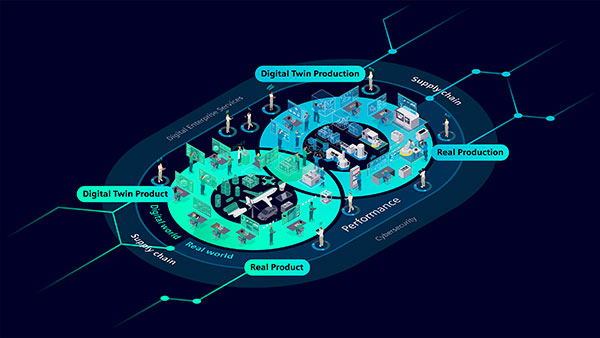
The digital twin in action: Bridging the gap between digital innovation and real-world execution across the entire product lifecycle. Image courtesy of Siemens.
Kher, Synopsys: We see usage across a lot of industries, especially in process manufacturing. Today, use cases tend to be where there is sufficient value to justify the effort. That usually means heavy, expensive equipment that causes a significant financial burden when it goes down. The bar is high enough that it’s worthwhile to build models and create ROMs, and then deploy them. It is time intensive, and you need the right expertise.
With AI lowering the barrier, you will have use cases that aren’t as super critical that can benefit from digital twins, because it will be easier to create and deploy models. By lowering the barrier, AI will compress the process for designing, testing and validating new designs and products. You can try more things and get a more optimal model at the end. Everything you create there will feed into the digital twin when the machine is operating.
DE: What are some key challenges of using AI and digital twins?
Kher, Synopsys: All the different platforms users have to deal with. That can be an organizational challenge, because digital twins really span across different departments. You need to have executives with a mandate to work across those silos.
The platforms are also still very heterogeneous and there is not a lot of standardization. Connecting different platforms is not trivial. Security and vulnerability are concerns as well. Engineering organizations tend to not be very sophisticated from an IT perspective, and that tends to slow things down.
DE: Where do AI and digital twins go next? What will these use cases and solutions look like in a few years?
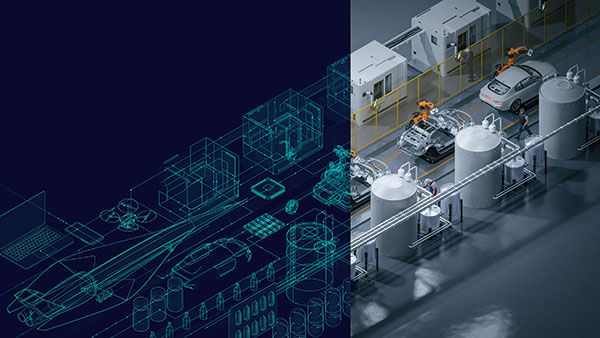
From digital blueprint to physical reality: Witnessing the seamless integration of design and manufacturing in the age of Industry 4.0. Image courtesy of Siemens.
Alajbegovic, Siemens: Digital twins have become the place where you test decisions safely, and AI becomes the layer that helps you decide faster and better. Over time, you’ll see more closed-loop improvement: real-world data updates the twin, AI finds better options, simulation validates them, and governed workflows push improvements back into design, manufacturing, and operations. AI will enable digital twins to be connected with the real twins in product and factory operations.
Kher, Synopsys: We will see users in newer areas of manufacturing like semiconductors, along with aerospace and defense. They are interested in creating models that can propagate uncertainty and determine maintenance needs on the fly. Automotive also presents some opportunities in terms of how cars are being used or fleet management, but that market probably needs a little bit more runway before it is broadly used. DE


Simcenter™ software, from Siemens Digital Industries Software, uniquely combines system simulation, 3D CAE and test to help you predict performance across all critical attributes earlier and throughout the entire product lifecycle. By combining…
Making the Case for Artificial Intelligence and Machine Learning in Engineering
In this paper, Siemens Digital Industries Software and Digital Engineering will provide an overview of how AI/ML-enabled software can improve design workflows, while also addressing common questions and concerns around implementing this technology in an engineering organization.

Brian Albright is the editorial director of Digital Engineering.
Contact him at [email protected].

Join over 90,000 engineering professionals who get fresh engineering news as soon as it is published.






About Us · Contact Us · Editorial Team · Advertising · Privacy Policy · Subscriber Services · © 2026 Digital Engineering 24/7 · Peerless Media