Helping design and engineering professionals discover, evaluate and specify technologies and processes that shorten the design cycle and enable success.


Alert!
Digital Engineering ceased publication on July 1, 2026. This website remains available as an archive of engineering content.
For inquiries or information, please email [email protected].

Digital Engineering April 2026
In the latest issue of Digital Engineering, we take a look at the latest innovations in design for additive manufacturing, including the use of natural language inputs, social media cosplayers, and AI integration. The issue also includes a feature…

January Special Focus Issue: Design for Additive
In this Special Focus Issue of Digital Engineering, learn about the latest advancements in design for additive manufacturing, including new software tools, additive in automotive, custom medical devices, and more.
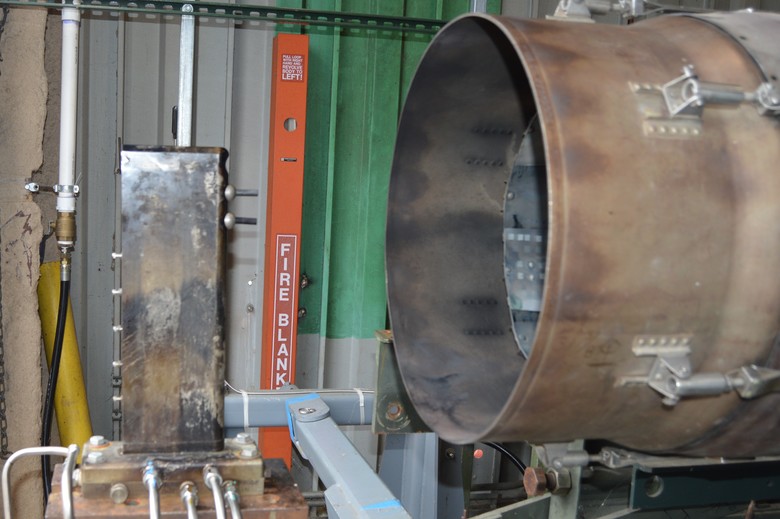 A sample of 3D-printed silicon oxycarbide material being tested by the Air Force. The material can withstand high temperatures. Image: Air Force
The Air Force Research Laboratory Aerospace Systems Directorate has entered into a cooperative research and development/material transfer agreement with HRL Laboratories to test silicon oxycarbide (SiOC) materials for additive manufacturing. These types of printed ceramic components could potentially help enable future hypersonic aircraft.
The HRL materials are produced using a pre-ceramic resin. After the parts are fabricated, they are heat treated to convert them to a fully ceramic state. The Air Force became interested because of the ability of the finished components to withstand the types of high temperatures the materials can tolerate.
“If a material can withstand those temperatures – roughly 3,200° Fahrenheit – it could be used for hypersonic aircraft engine components like struts or flame holders,” said Jamie Szmodis, a hypersonic research engineer with the Aerospace Systems Directorate.
The material transfer agreement establishes a collaborative relationship between the Air Force team and HRL in which test results can be shared.
The Air Force received five thermocouple radiation shields and 15 sample cylinders manufactured from the SiOC resin. Scientists from the AFRL Materials and Manufacturing Directorate, Structural Materials Division, Composite Branch, conducted materials analysis and heat treatments. The Aerospace Systems Directorate, Aerospace Vehicle Division, Structural Validation Branch scientists performed mechanical analysis focusing on thermal expansion analysis at temperatures ranging from 500° to 3,500°F. The Arnold Engineering Development Complex’s Propulsion Research Facility performed analysis of the material’s characteristics in a high-enthalpy instrumentation test facility.
The Air Force provided its final report to HRL in March.
“The extreme temperature testing that AFRL performed revealed the limits of our new material and challenged us to improve it,” said Dr. Tobias Schaedler, a senior scientist from HRL.
Hypersonic aircraft would be able to achieve speeds in excess of Mach 5 (currently supersonic planes fly at Mach 1, or 768 mph). Boeing recently made investments in hypersonic technology
Source: U.S. Air Force


Brian Albright is the editorial director of Digital Engineering.
Contact him at [email protected].






About Us · Contact Us · Editorial Team · Advertising · Privacy Policy · Subscriber Services · © 2026 Digital Engineering 24/7 · Peerless Media