Helping design and engineering professionals discover, evaluate and specify technologies and processes that shorten the design cycle and enable success.


Alert!
Digital Engineering ceased publication on July 1, 2026. This website remains available as an archive of engineering content.
For inquiries or information, please email [email protected].

Digital Engineering April 2026
In the latest issue of Digital Engineering, we take a look at the latest innovations in design for additive manufacturing, including the use of natural language inputs, social media cosplayers, and AI integration. The issue also includes a feature…

January Special Focus Issue: Design for Additive
In this Special Focus Issue of Digital Engineering, learn about the latest advancements in design for additive manufacturing, including new software tools, additive in automotive, custom medical devices, and more.

Leading 3D printing companies and universities will share in more than $3 million in research funding via America Makes and the Air Force Research Laboratory (AFRL).
In December, America Makes announced the awardees of the three AFRL-funded Special Topic Project Calls. Along with the National Center for Defense Manufacturing and Machining (NCDMM), the organization will award more than $2.12 million in funding to the projects, with $998,000 in matching funds from the project teams.
The three special topic project calls focus on closed-loop process control, open source protocols, and non-destructive evaluation (NDE) of complex structures.
3D Systems, the University of Delaware Center for Composite Manufacturing, Sandia National Laboratory, and Lockheed Martin were awarded funding for the "Powder Bed Fusion of Thermoplastics Closed-Loop Process Control" project. The team will work toward including a predictive modeling schema into a closed-loop hardware/software integrated engineered system to control process parameters in-situ.
The University of Texas at Austin and Harvest/Stratasys are the second awardees of the closed-loop project, and their project will "address the need to rapidly advance the use of closed-loop process control for powder bed fusion (PBF) of thermoplastics. The project aims to take this AM technology to a level where very repeatable and certifiable process results can be obtained through the demonstration of feedback control in PBF for improved part quality and performance predictability, while reducing sensitivity to variations in build conditions across different machines and even within a single build process."
The second project area, "Open Source Process Control for Powder Bed Additive Manufacturing Research," also had two groups of awardees. The first, led by GE Global Research along with GE Aviation's Additive Development Center and the Lawrence Livermore National Laboratory, will develop open-source protocols and machine controllers for powder bed fusion additive manufacturing (PBFAM) on metal additive machines.
The second team will be led by Pennsylvania State University along with Honeywell International, Northrop Grumman, and 3D Systems, and will develop an open, layered protocol for PBFAM.
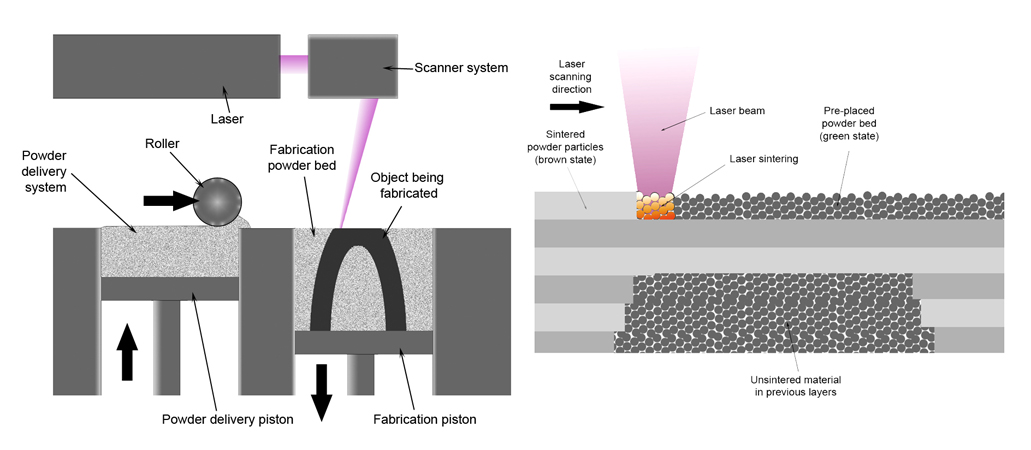
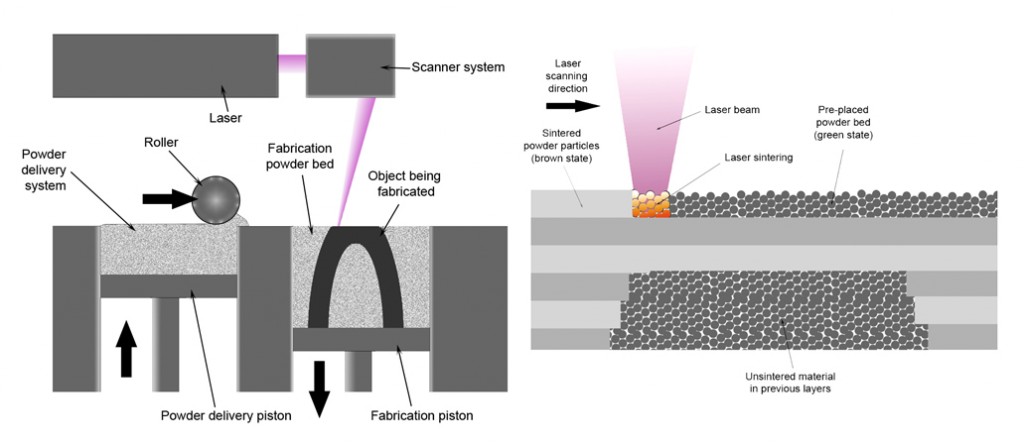 An example of a current powder bed fusion technique can be seen in this selective laser melting system schematic by Materialgeeza. Licensed under CC BY-SA 3.0 via Wikimedia Commons.
EWI is the sole awardee for the "Non-Destructive Evaluation of Complex Metallic Additive Manufactured Structures." That project will focus on NDE techniques for inspecting components made form titanium and nickel-based alloys using direct metal laser melting and electron beam melting.
Source: America Makes


Brian Albright is the editorial director of Digital Engineering.
Contact him at [email protected].

Join over 90,000 engineering professionals who get fresh engineering news as soon as it is published.






About Us · Contact Us · Editorial Team · Advertising · Privacy Policy · Subscriber Services · © 2026 Digital Engineering 24/7 · Peerless Media
