Helping design and engineering professionals discover, evaluate and specify technologies and processes that shorten the design cycle and enable success.


Alert!
Digital Engineering ceased publication on July 1, 2026. This website remains available as an archive of engineering content.
For inquiries or information, please email [email protected].

Digital Engineering April 2026
In the latest issue of Digital Engineering, we take a look at the latest innovations in design for additive manufacturing, including the use of natural language inputs, social media cosplayers, and AI integration. The issue also includes a feature…

January Special Focus Issue: Design for Additive
In this Special Focus Issue of Digital Engineering, learn about the latest advancements in design for additive manufacturing, including new software tools, additive in automotive, custom medical devices, and more.
A new partnership between American Process and Oak Ridge National Laboratory (ORNL) offers the potential to bridge the gap between the fine detail offered by resin and the durability of plastic. The partnership was formed to conduct research on a new material for use in AM called nanocellulose. The new material is expected to be strong, lightweight, inexpensive and environmentally friendly.
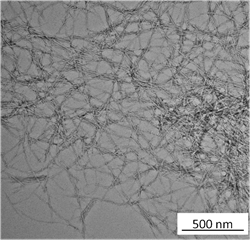 These tiny strands of cellulose could be the key to stronger AM parts. Courtesy of American Process.
“This new eco-material can both substitute and enhance the performance of petroleum-based plastics in an environmentally friendly and market competitive way,” said Theodora Retsina, CEO at American Process. “Carbon fibers are extremely strong and light but expensive to produce … Nanocellulose has even lower weight than carbon fibers and is just as strong. With our manufacturing breakthrough, nanocellulose is a fraction of the price of carbon fibers."
Cellulose, you may remember from biology class, is a naturally occurring organic material generally found in tree trunks. By itself, cellulose is a strong natural material, thanks to densely cluttered hydrogen bonds. Nanocellulose is derived from wood and its natural durability is improved upon in the production process making it as tough as Kevlar.
“Cellulose is the most abundant natural organic material on Earth and it’s renewable and compostable,” added Retsina. “We didn’t invent nanocellulose, we made it less expensive, more thermally stable at high temperatures, and gave it functionality to blend with hydrophobic polymers – thereby enabling market applications and opening the road to commercial production.”
The partnership was estblished to create a new nanocellulose resin for use in AM systems. The new material has a large number of potential applications, including replacing carbon fiber parts in cars with stronger, lighter and less expensive parts. According to American Process, the price for the new material should be on par with existing polymers, and it could begin shipping as early as the fourth quarter of this year.
Below you’ll find a video about nanocellulose.
Source: PRWeb


John Newman is a Digital Engineering contributor who focuses on 3D printing. Contact him via [email protected] and read his posts on Rapid Ready Technology.
Follow DE






About Us · Contact Us · Editorial Team · Advertising · Privacy Policy · Subscriber Services · © 2026 Digital Engineering 24/7 · Peerless Media