Helping design and engineering professionals discover, evaluate and specify technologies and processes that shorten the design cycle and enable success.


Alert!
Digital Engineering ceased publication on July 1, 2026. This website remains available as an archive of engineering content.
For inquiries or information, please email [email protected].

Digital Engineering April 2026
In the latest issue of Digital Engineering, we take a look at the latest innovations in design for additive manufacturing, including the use of natural language inputs, social media cosplayers, and AI integration. The issue also includes a feature…

January Special Focus Issue: Design for Additive
In this Special Focus Issue of Digital Engineering, learn about the latest advancements in design for additive manufacturing, including new software tools, additive in automotive, custom medical devices, and more.
AMIE (Additive Manufacturing Integrated Energy) is one of ORNL’s recent projects, which combines additive manufacturing (AM) with alternative energy to showcase new possibilities for a green future. It showcases the manner in which bidirectional energy can power both a small house and a personal vehicle.
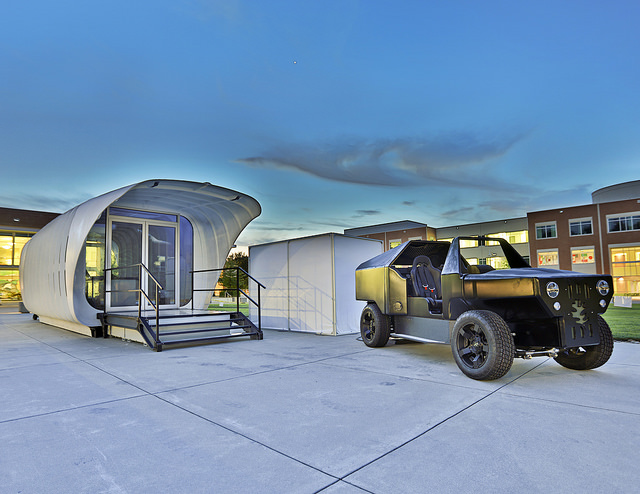 The AMIE demonstration showcases the possibility for a greener tomorrow thanks to 3D printing and alternative energy. Courtesy of ORNL.
The demonstration house, which is just large enough at 38x12x13 ft. to appeal to people eager to live in a cargo container, is generally powered by gathering solar energy from panels installed on its roof. Excess energy is stored in a battery located under the house.
The green vehicle designed to go along with the house is a hybrid that uses both electricity and natural gas. When not in use ferrying its owners around, the vehicle parks over a wireless induction pad. Unlike most induction pads, this one works in two directions. The car can draw energy from the house’s battery reserves when it’s low on juice, or the car can act like an additional energy source for the house by switching on and generating power.
“Working together, we designed a building that innovates construction and building practices and a vehicle with a long enough range to serve as a primary power source,” said ORNL’s Roderick Jackson, who led the AMIE demonstration project. “Our integrated system allows you to get multiple uses out of your vehicle.”
AM enters the picture in the construction and prototyping phases. Both the car and the house were built using ORNL’s Big Area Additive Manufacturing (BAAM) process, which has previously been put to use building a Shelby Cobra and is the same technology used to create the Strati. Think of BAAM as an oversized Fused Deposition Modeling system and you’re on the right track. The main difference between BAAM and other extrusion-based 3D printers is that layer thickness for BAAM is measured in inches, rather than micrometers.
The BAAM process is able to (relatively) quickly build large objects with far less waste than is produced with traditional manufacturing processes. It is accurate enough to following exacting digital designs, and the plastic parts produced by the system can be worked and machined following a build. Much excess waste can even be ground up and reused.
AMIE offers a glimpse into the possibilities of tomorrow, where 3D printed houses and cars work together to offer a greener future. The technologies being developed by ORNL will be used to, literally, shape our world. Below you’ll find a video about the AMIE project.
Source: ORNL


John Newman is a Digital Engineering contributor who focuses on 3D printing. Contact him via [email protected] and read his posts on Rapid Ready Technology.
Follow DE






About Us · Contact Us · Editorial Team · Advertising · Privacy Policy · Subscriber Services · © 2026 Digital Engineering 24/7 · Peerless Media