Helping design and engineering professionals discover, evaluate and specify technologies and processes that shorten the design cycle and enable success.


Alert!
Digital Engineering ceased publication on July 1, 2026. This website remains available as an archive of engineering content.
For inquiries or information, please email [email protected].

Digital Engineering April 2026
In the latest issue of Digital Engineering, we take a look at the latest innovations in design for additive manufacturing, including the use of natural language inputs, social media cosplayers, and AI integration. The issue also includes a feature…

January Special Focus Issue: Design for Additive
In this Special Focus Issue of Digital Engineering, learn about the latest advancements in design for additive manufacturing, including new software tools, additive in automotive, custom medical devices, and more.
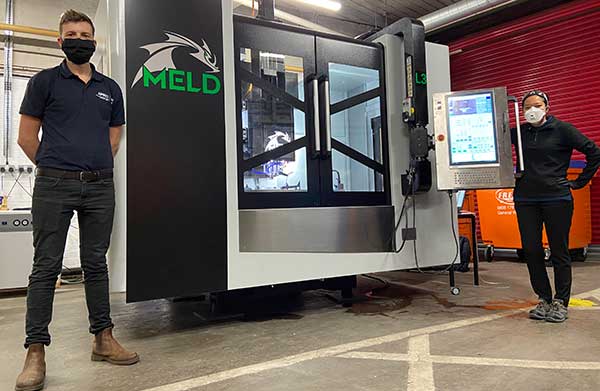
The Advanced Manufacturing Research Centre (AMRC) has installed a MELD metal additive manufacturing machine. The AMRC selected MELD’s newest model machine, the L3. The L3 model offers 14.2 cubic ft. or 0.4 cubic meters with a table size for printing new or fixturing repair parts that measures 51x23-in. (129.5x58.4 cm).
The University of Sheffield AMRC is a research and innovation institution with more than 120 industrial partners who include Boeing, Rolls-Royce, McLaren, BAE Systems and Airbus. The University of Sheffield is a part of the larger AMRC group, which is a cluster of centers for industry-focused research and development of technologies used in manufacturing sectors.
"Unlike traditional additive manufacturing, MELD is a solid-state process which means the negative aspects of processing with high temperatures are removed and there is a step change in some of the limitations, such as scalability, residual stress and speed," says AMRC North West Technical Fellow Ian Brooks.
Installation at the AMRC North West facility in Preston, UK and operator training for technical staff was provided by RAM Engineering and Tooling LTD, based in Scotland.
AMRC’s collaborative R&D teams de-risk innovation for industry, enabling step-changes in productivity and performance, and leading manufacturing towards a smarter, more sustainable and resilient future. The AMRC is part of the High Value Manufacturing Catapult, the national network of leading manufacturing and process research centres, and is a model for collaborative research involving universities, government and industry worldwide. Headquartered on the Advanced Manufacturing Park and Sheffield Business Park in South Yorkshire, the AMRC is expanding across the North with dedicated applied research centres in North Wales and North West England bringing innovation to manufacturing.
MELD Manufacturing Corporation delivers machines and services using their MELD process for creating and repairing metal components using off the shelf material in open air. MELD does not melt the metal and prints fully dense parts.
Sources: Press materials received from the company and additional information gleaned from the company’s website.


DE's editors contribute news and new product announcements to Digital Engineering. Press releases may be sent to them via [email protected].
Follow DE






About Us · Contact Us · Editorial Team · Advertising · Privacy Policy · Subscriber Services · © 2026 Digital Engineering 24/7 · Peerless Media