Helping design and engineering professionals discover, evaluate and specify technologies and processes that shorten the design cycle and enable success.


Alert!
Digital Engineering ceased publication on July 1, 2026. This website remains available as an archive of engineering content.
For inquiries or information, please email [email protected].

Digital Engineering April 2026
In the latest issue of Digital Engineering, we take a look at the latest innovations in design for additive manufacturing, including the use of natural language inputs, social media cosplayers, and AI integration. The issue also includes a feature…

January Special Focus Issue: Design for Additive
In this Special Focus Issue of Digital Engineering, learn about the latest advancements in design for additive manufacturing, including new software tools, additive in automotive, custom medical devices, and more.
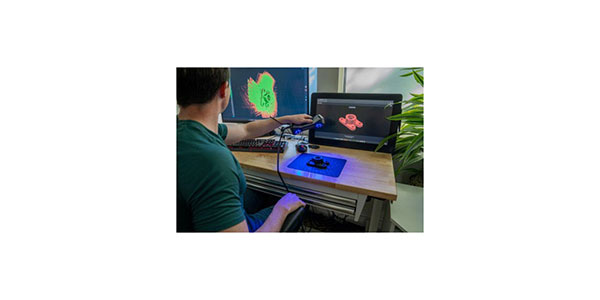
Backflip AI has unveiled a new 3D AI foundation model that accelerates how manufacturing plants are repaired and improved to prevent costly downtime. The new technology enables anyone to automatically create 3D models of replacement parts from 3D scan data, which can be quickly manufactured via conventional means like CNC machining or 3D printing.
The company also announced two new tools powered by this AI model: A plug-in for SOLIDWORKS that translates 3D scan data into fully-featured parts in SOLIDWORKS’ native file format, and a web app that converts 3D scans into parametric CAD files.
When a part unexpectedly breaks in a manufacturing plant and brings down a production line, a maintenance team has to quickly spring into action to get things running again. If the team doesn’t have a replacement they often have to build a part from scratch, requiring someone to manually measure the part and design a digital 3D CAD model; physically manufacture that part at an internal or external machine shop; and install the replacement and restart the production line, according to Backflip AI.
Each of the aforementioned steps can take hours. Backflip’s new tools allow manufacturers to short circuit the first step in that process in minutes, the company claims.
Backflip’s developments reduce the technical barriers to entry for designers, engineers, and technicians to recreate 3D models of parts that they don’t have CAD files for. The tools also make 3D scanning easier, according to Backflip AI.
“3D scanners map the surface of an object with incredible precision, quickly generating millions of data points, but they produce micro surface textures that can’t be manufactured with traditional tools. Our technology automatically converts these intricate surfaces into clean geometries designed for existing 3D CAD and manufacturing software,” notes Greg Mark, Backflip CEO and co-founder.
Backflip’s SOLIDWORKS plug-in shows each step in the process used to build a part’s geometry and generates a native feature history that users can modify. This enables CAD designers to fine tune the generated 3D model. For new users, walking through the design process helps them understand how the part was created.
The new AI model was trained on Backflip’s synthetic 3D data set of over 100 million unique 3D geometries.
“These new developments are the result of Backflip’s continued R&D investments in neural representation of 3D data," says Backflip Head of AI Logan Ford. "We’ve paired state-of-the-art AI/ML techniques with the team’s deep background in manufacturing to create a really powerful technology foundation.”
Backflip’s two new tools will be available to interested users soon, who can sign up for the 3D scan-to-CAD waitlist on Backflip’s website.
Sources: Press materials received from the company and additional information gleaned from the company’s website.


DE's editors contribute news and new product announcements to Digital Engineering. Press releases may be sent to them via [email protected].
Follow DE






About Us · Contact Us · Editorial Team · Advertising · Privacy Policy · Subscriber Services · © 2026 Digital Engineering 24/7 · Peerless Media