Helping design and engineering professionals discover, evaluate and specify technologies and processes that shorten the design cycle and enable success.


Sponsored

Digital Engineering April 2026
In the latest issue of Digital Engineering, we take a look at the latest innovations in design for additive manufacturing, including the use of natural language inputs, social media cosplayers, and AI integration. The issue also includes a feature…

January Special Focus Issue: Design for Additive
In this Special Focus Issue of Digital Engineering, learn about the latest advancements in design for additive manufacturing, including new software tools, additive in automotive, custom medical devices, and more.
Lao Tsu said, “A journey of one thousand miles starts with a single step”. He could have easily been talking about additive manufacturing (AM ) or 3D printing. But how do you take that first step? This is the question that faces many companies as they contemplate adding additive manufacturing to their stable of manufacturing technologies. However, there are ways that you can begin the additive manufacturing journey without risking mission-critical projects or company profits.
At Siemens we work with companies across the globe to help them achieve their additive manufacturing goals and we have identified a multitude of low-risk ways that companies getting started with additive can use to quickly realize their goals without sacrificing their production schedule or quality.
The initial stages of the additive manufacturing journey are all about knowledge acquisition. Companies with little experience using additive manufacturing need to quickly get up-to-speed on the intricacies of the process so that they can begin understanding what it will take to capitalize upon the potential of 3D printing.
As we assist businesses moving through their additive manufacturing journey, one consistent method we see companies adopting for knowledge acquisition is the gathering of a team of experts within the organization into a “center of competence” to begin collaboration on a company-wide additive manufacturing strategy.
Businesses who execute well on AM knowledge acquisition identify appropriate stakeholders to be involved in these efforts. Individuals chosen for these groups usually tend to be designers, analysts, production engineers, and managers who are excited about technology and who are hungry to learn new skills and techniques.
These teams usually set objectives for the acquisition of additive manufacturing knowledge across the organization, and they also identify potential projects that can be used as catalysts for additive manufacturing knowledge acquisition.
One way we see companies rapidly acquiring additive manufacturing knowledge is by encouraging experimentation. Many companies foster an experimentation mindset by investing in multiple low-cost desktop printers to be placed in divisions or offices across their operation. Having 3D printing equipment readily at hand lowers the barriers to knowledge acquisition by allowing employees to experiment in a low-cost way with designing and printing parts. Desktop printers tend to have low initial acquisition costs and the materials used in desktop printing are relatively inexpensive
One downside of desktop printing is that the material selection is mostly limited to the polymer family and the print technologies are most always planar. This means that acquiring knowledge about metal printing or multi-axis printing will need to be accomplished in other, usually much more expensive ways. However, for organizations who are still at the beginning stages of their additive journey, desktop printing is an excellent way to acquire basic printing knowledge fast.
Experimentation can be further promoted by mounting “print-a-thon” competitions where designers in an organization pair with production engineers to compete by designing and printing parts according to a set of initial requirements. This is similar to the “hackathon” model used at many software companies.
Teams are given a problem to solve and are encouraged to use new design tools and methods as they collaborate to design, engineer, and print parts that solve the problem. Rewards are often given for participation, design creativity, use of new design and production tools, final part quality, and overall solution to the problem. This is, in effect, “gamifying” the acquisition of 3D printing knowledge within the organization and has been proven to be effective in many of the organizations we have worked with.
As the 3D printing experience within an organization grows, we often see the use of additive expand beyond simple experimentation. Here, we move from pure knowledge acquisition into areas where low-risk printing can be used to further the business goals of the organization.
Prototyping is, of course, the traditional use case for 3D printing. Physical prototypes allow a company to iterate quickly on the design of a part, to check fit within a wider assembly of parts, and to refine ergonomics for parts with a human interface.
In the past, such prototyping accomplished with traditional manufacturing required levels of investment in tooling similar to that of actual production parts. With additive manufacturing, this is no longer the case. Those same desktop printers that were initially used for knowledge acquisition can here be used for rapidly iterating through low-cost protypes of actual products.
Furthermore, this is the time when we often see companies begin to print manufacturing aids and even occasionally replacement parts for equipment. Manufacturing jigs and fixtures can often be produced faster and at lower cost when printed than when manufactured using traditional methods. Meanwhile, many companies have found that printing temporary replacement parts for equipment used in the field allows them to maintain production volume while permanent replacement parts are acquired. Use cases like these are low-risk and allow companies to gain even more printing experience without risking center-of-target production or efficiency.

Regardless of how your company chooses to begin its additive manufacturing journey, the most important thing is to take that first step. Start an AM center of competence, pepper your organization with desktop printers, then design and print some prototypes, manufacturing aids or replacement parts for a machine in your shop.
At Siemens, we’re ready to help you in your additive manufacturing journey, whether you are on day one, or year ten. Our comprehensive software solutions are helping companies at the very beginning of their additive journeys just as they are helping other companies to expand their printing to full-scale production. Our goal at Siemens is to help you efficiently gain the knowledge you need today to print the products of tomorrow.

Ashley Eckhoff has multiple degrees in engineering and has worked at Siemens for over 20 years. His current role as a member of the Siemens Software Additive Manufacturing Program brings him into constant contact with the companies and people making additive manufacturing an indispensable production technology for the 21st century.


Simcenter™ software, from Siemens Digital Industries Software, uniquely combines system simulation, 3D CAE and test to help you predict performance across all critical attributes earlier and throughout the entire product lifecycle. By combining…
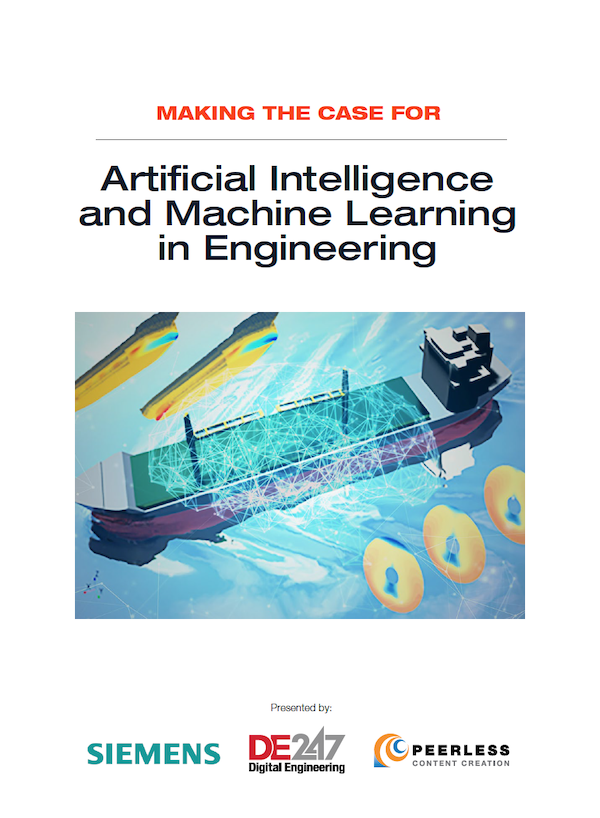
Making the Case for Artificial Intelligence and Machine Learning in Engineering
In this paper, Siemens Digital Industries Software and Digital Engineering will provide an overview of how AI/ML-enabled software can improve design workflows, while also addressing common questions and concerns around implementing this technology in an engineering organization.

Join over 90,000 engineering professionals who get fresh engineering news as soon as it is published.






About Us · Contact Us · Editorial Team · Advertising · Privacy Policy · Subscriber Services · © 2026 Digital Engineering 24/7 · Peerless Media