Helping design and engineering professionals discover, evaluate and specify technologies and processes that shorten the design cycle and enable success.



Digital Engineering April 2026
In the latest issue of Digital Engineering, we take a look at the latest innovations in design for additive manufacturing, including the use of natural language inputs, social media cosplayers, and AI integration. The issue also includes a feature…

January Special Focus Issue: Design for Additive
In this Special Focus Issue of Digital Engineering, learn about the latest advancements in design for additive manufacturing, including new software tools, additive in automotive, custom medical devices, and more.
3D printing can be a much more efficient production process than other types of manufacturing, but it also generates plenty of waste. Botched prints, leftover filament and other scraps can quickly add up.
The campus at the University of California, Berkeley, has embraced the technology, and there are more than 100 3D printers on campus. But 3D printing also generates around 600 pounds of trash annually. Much of that waste comes from discarded prototypes or failed prints generated by novice makers.
While Berkeley students do use a lot of bio-based PLA, which is theoretically compostable, most waste management companies don’t give the material enough time to decompose before being taken to a landfill.
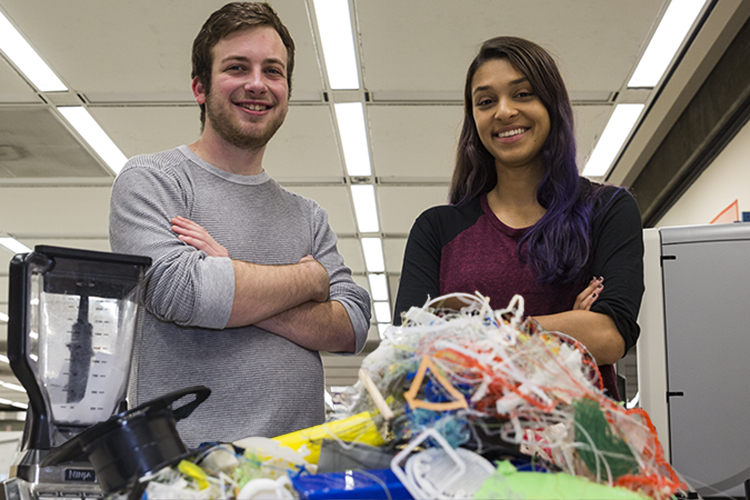
Mechanical engineering student Nicole Panditi and environmental sciences major Scott Silva have come up with a potential solution. Working through the Student Environmental Resource Center, Silva, Panditi, and Ph.D. student Michel Clemon have launched the 3D Printer Filament Reclamation Project. They are creating a system that grinds up and melts printer plastic to make new spools of filament that can then be re-used in campus printers.
Right now the group is using a decidedly low-tech method for grinding up the plastic to recycle – an electric blender. They launched a successful crowdsourcing campaign to raise funds for an industrial plastics grinder and other equipment.
Once fully implemented, the program would allow the campus to recycle all of its 3D plastic waste on campus.
“It’s my personal goal to reduce inefficiencies in 3D printing so that the tech industry can reach its full beneficial potential without being haunted by mountains of ugly waste,” Panditi said.
The students have been advised by Cal Zero Waste, the recycling operation at Berkeley. “The idea is that the plastics would never have to leave campus,” said Cal Zero’s manager Lin King. “We would provide Berkeley-produced recycled filament and any discarded items would be sent right back to us.”
Source: UC Berkeley


Brian Albright is the editorial director of Digital Engineering.
Contact him at [email protected].

Join over 90,000 engineering professionals who get fresh engineering news as soon as it is published.






About Us · Contact Us · Editorial Team · Advertising · Privacy Policy · Subscriber Services · © 2026 Digital Engineering 24/7 · Peerless Media