Helping design and engineering professionals discover, evaluate and specify technologies and processes that shorten the design cycle and enable success.


Alert!
Digital Engineering ceased publication on July 1, 2026. This website remains available as an archive of engineering content.
For inquiries or information, please email [email protected].


Digital Engineering April 2026
In the latest issue of Digital Engineering, we take a look at the latest innovations in design for additive manufacturing, including the use of natural language inputs, social media cosplayers, and AI integration. The issue also includes a feature…

January Special Focus Issue: Design for Additive
In this Special Focus Issue of Digital Engineering, learn about the latest advancements in design for additive manufacturing, including new software tools, additive in automotive, custom medical devices, and more.
Researchers at UC Berkeley in cooperation with Taiwan’s National Chiao Tung University have been hard at work developing practical applications for 3D printed electronic circuits and wireless sensors. The result of the team’s first foray into this area of applications is a smart cap, produced by AM, which is capable of reporting the freshness of milk.
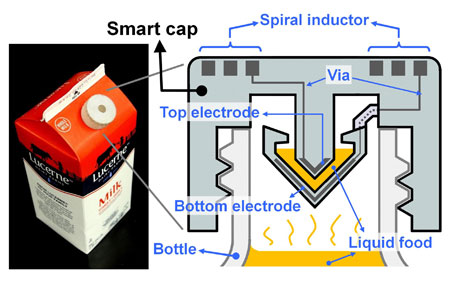 UC Berkeley engineers created a ‘smart cap’ using 3D-printed plastic with embedded electronics to wirelessly monitor the freshness of milk. Courtesy of Sung-Yueh Wu.
While that may not seem very exciting at first glance, consider applying the same technology to a broader amount of food. Consumers could guarantee food safety and freshness simply by scanning the output of a smart label with a phone.
“This 3D-printing technology could eventually make electronic circuits cheap enough to be added to packaging to provide food safety alerts for consumers,” said senior author Liwei Lin, a professor of mechanical engineering and co-director of the Berkeley Sensor and Actuator Center. “You could imagine a scenario where you can use your cellphone to check the freshness of food while it’s still on the store shelves.”
The same idea could be put to monitoring other, more hazardous materials as well. That scenario would result in safer working conditions for the people assigned to monitor those same hazardous materials. Rather than opening a container or withdrawing a sample that could be spilled, workers could just scan sensors already at work inside the container.
Researchers built the smart cap through what amounts to lost wax casting. A part was printed using wax and polymers, with the wax being removed after printing was completed. The research team then filled the empty spaces within the parts with silver, which was left to cure. The end result was a series of electrical components.
Full details of the research team’s work were published in the online journal Microsystems and Nanoengineering under the title “3D-printed microelectronics for integrated circuitry and passive wireless sensors.”
Below you’ll find a video discussing food freshness to hold you over until those smart labels show up.
Source: UC Berkeley


John Newman is a Digital Engineering contributor who focuses on 3D printing. Contact him via [email protected] and read his posts on Rapid Ready Technology.
Follow DE






About Us · Contact Us · Editorial Team · Advertising · Privacy Policy · Subscriber Services · © 2026 Digital Engineering 24/7 · Peerless Media