Helping design and engineering professionals discover, evaluate and specify technologies and processes that shorten the design cycle and enable success.


Alert!
Digital Engineering ceased publication on July 1, 2026. This website remains available as an archive of engineering content.
For inquiries or information, please email [email protected].

Digital Engineering April 2026
In the latest issue of Digital Engineering, we take a look at the latest innovations in design for additive manufacturing, including the use of natural language inputs, social media cosplayers, and AI integration. The issue also includes a feature…

January Special Focus Issue: Design for Additive
In this Special Focus Issue of Digital Engineering, learn about the latest advancements in design for additive manufacturing, including new software tools, additive in automotive, custom medical devices, and more.
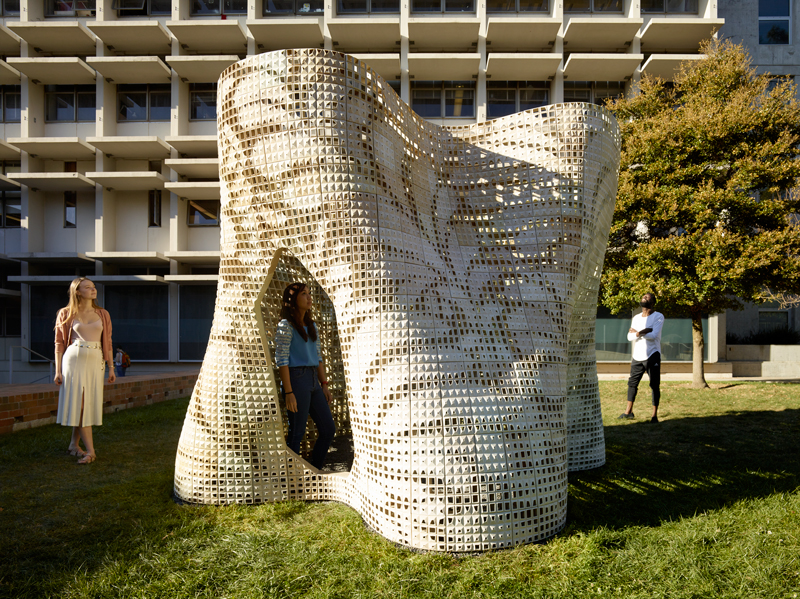
In short, times have changed and it seems virtually inevitable that some company or another will begin to use AM for construction purposes. Emerging Objects may have developed a different, and realistic, method of producing 3D-printed structures.
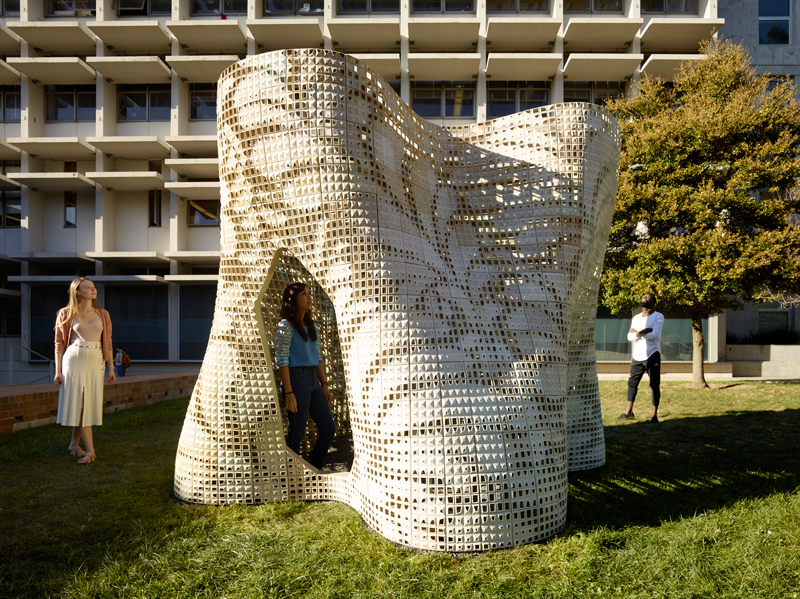 The 3D-printed Bloom pavilion is functional and elegant. Courtesy of Emerging Objects.
Emerging Objects is an interesting group that we’ve featured a number of different times on Rapid Ready. Its founders come from academia, and the company exists to probe the boundaries of what is possible with 3D printing. It then takes that information and passes it along to its clients.
The basic idea behind 3D-printed architecture is that a building can be erected far more quickly using AM technologies than by standard labor. The difficult part of that is the 3D printer. To print a house on-site at speed requires the use of a massive 3D printer, like that designed by the aforementioned Dini. Winsun has rejected that model and instead prints parts that are transported to the construction site and quickly fit together.
Emerging Object has split the two ideas by producing 3D-printed bricks using a special material. From the website:
“Each block is printed using a farm of 11 powder 3D printers with a special cement composite formulation comprised chiefly of iron oxide-free Portland cement. … 3D printed cement requires no formwork and produces no waste and the support material can be reused to produce more blocks. Coupled with Portland cement is an ecologically derived UV-resistant polymer that reduces the greenhouse gas emissions from production of resins by 50% over conventional petroleum based epoxies that uses plant-based materials that do not compete with food sources or displace food-based agriculture.”
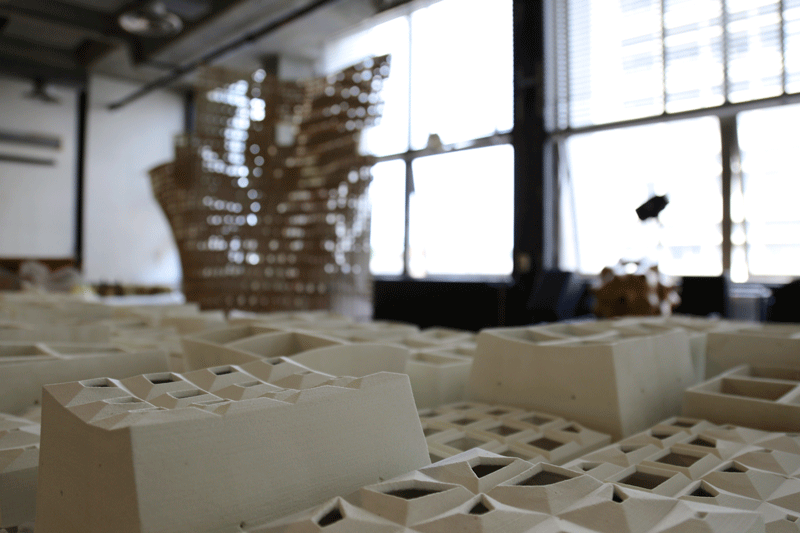 The 3D-printed bricks used to build Bloom. Courtesy of Emerging Objects.
The company tested the process by building an attractive outdoor sculpture/pavilion named Bloom. The object reaches 9 ft. in height and has around a 12 x 12 ft. footprint. It was built using a total of 840 of Emerging Objects 3D-printed bricks.
The bricks are light enough they can be transported to the construction site and handled with ease. The bricks can also be produced in quantity, given the use of enough 3D printers. According to Emerging Objects, 11 AM systems could produce 30 bricks each day, which would provide enough building materials to reproduce Bloom in 28 days.
Below you’ll find a video about the potential for mixing AM with a different type of brick.
Sources: Gizmag, Emerging Objects


John Newman is a Digital Engineering contributor who focuses on 3D printing. Contact him via [email protected] and read his posts on Rapid Ready Technology.
Follow DE
Join over 90,000 engineering professionals who get fresh engineering news as soon as it is published.






About Us · Contact Us · Editorial Team · Advertising · Privacy Policy · Subscriber Services · © 2026 Digital Engineering 24/7 · Peerless Media