Helping design and engineering professionals discover, evaluate and specify technologies and processes that shorten the design cycle and enable success.


Alert!
Digital Engineering ceased publication on July 1, 2026. This website remains available as an archive of engineering content.
For inquiries or information, please email [email protected].
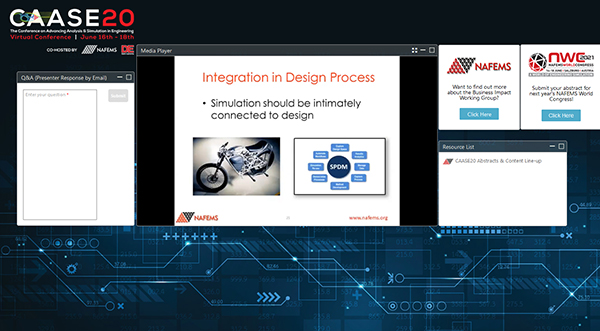
In his presentation at CAASE20 Virtual, Day One, Roger Keene, a consultant and former Dassault Systemes executive, discusses "How to Justify Increasing the use of Engineering Simulation in Your Company During and After COVID-19."
He attributes underusing of simulation to the lack of expertise, computational needs, and poor communication to the executives, among others.
"On expertise, today you still need somebody with significant training and experience," he noted. Using simulation to solve turbulence issues, unstable behaviors, and hourglassing, for example, is not common knowledge among general designers and engineers.
In times of crisis, companies tend to retreat, adopting cautious spendthrift strategies to weather the storm. Keene thinks they may be missing an opportunity with this mindset.
"Simulation lends itself to working from home, in a way that physical testing doesn't. For that reason, now might be a good time to justify additional investment in simulation," he reasoned. "I'd argue, the way we operate will be different in the long term, until we discover a vaccine and the whole society can return to normal ... Hence, the use of simulation for your company to function during this period, may easily be justified."
WebMD, the popular site for general medical information, points out, "Even when researchers find a vaccine that works against the new coronavirus, it could be 12 to 18 months at best before it’s ready for the public."
IMFBlog, run by the International Monetary Funds, calls the virus-driven lockdown impact "the worst economic downturn since the depression."
The post predicts, "Assuming the pandemic fades in the second half of 2020 and that policy actions taken around the world are effective in preventing widespread firm bankruptcies, extended job losses, and system-wide financial strains, we project global growth in 2021 to rebound to 5.8%. This recovery in 2021 is only partial as the level of economic activity is projected to remain below the level we had projected for 2021, before the virus hit. The cumulative loss to global GDP over 2020 and 2021 from the pandemic crisis could be around 9 trillion dollars, greater than the economies of Japan and Germany, combined."
It may seem counterintuitive to increase R&D investment in such an environment, but Keene pointed out that's precisely when you should increase R&D to "leapfrog over competitors in the recovery phase."
The right approach, as he sees is, is "not just to cut costs equally everywhere and furlough or layoff everybody, but to continue to invest in R&D and technology."
Keene is part of the NAFEMS Business Impact Working Group (BIWG), which aims to "demonstrate, document, and communicate the business value of Engineering Simulation, particularly for small and medium businesses," as outlined in the group's homepage. Group members include representatives from P&G, Dyson, Whirlopool, Airbus, Adidas, and other recognizable brands.
For more on his talk and CAASE20, cohosted by DE, visit the event homepage here.


NAFEMS is the International Association for the Engineering Modelling, Analysis and Simulation Community. We focus on the practical application of numerical engineering simulation techniques such as the Finite Element Method for Structural…

Simulation Focus: Conference on Advancing Analysis and Simulation in Engineering (CAASE) Preview
The CAASE18 (Conference on Advancing Analysis and Simulation in Engineering) kicking off June 5-7, 2018 on the south shore of Lake Erie in Cleveland, OH plans to take the engineering analysis community by storm. The event is expected to play host to potentially 500 attendees from nearly 250 companies while delivering a wealth of educational opportunities covering all facets of engineering analysis and simulation.

Kenneth Wong is Digital Engineering's resident blogger and senior editor. Email him at [email protected] or share your thoughts or suggestions at digitaleng.news/facebook.
Follow DE






About Us · Contact Us · Editorial Team · Advertising · Privacy Policy · Subscriber Services · © 2026 Digital Engineering 24/7 · Peerless Media