Helping design and engineering professionals discover, evaluate and specify technologies and processes that shorten the design cycle and enable success.



May 2026 Special Focus: Artificial Intelligence in Design and Simulation
In this Special Focus Issue, learn about the latest developments in the integration of artificial intelligence into engineering workflows.

Design & Simulation Software Guide 2025
In this Special Issue, Digital Engineering presents its second annual guide to design and simulation software vendors.
As Thanksgiving approached and many got ready to fly home for their once-a-year family gathering, Matthias Laurich, part of RAND Simulation's Electronics Team, decided to see if a handheld microwave emitter could be used to cook a turkey.
The device he had in mind was quite different from a typical household microwave oven you might use to warm up your leftover meals or cook a pie. A handheld microwave emitter sends high-powered, concentrated beams directed at a target. In fact, some military branches are exploring its use as a weapon.
Laurich didn't do a real-world experiment. For a start, to build the kind of device he needed, he would need to disassemble a perfectly fine microwave oven to get access to the antenna, and it's highly unlikely he could put it back into working order afterward.
Instead, he opted for a Finite Element Analysis (FEA) in Ansys simulation software. At the end of his simulation, he concluded, "In theory, you could do it, but I wouldn't recommend it."
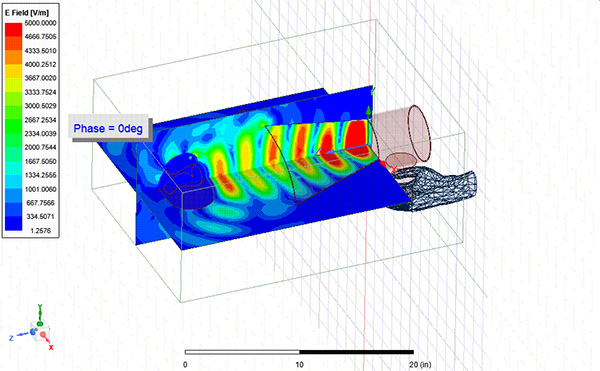
Laurich is familiar with simulating microwave energy since RAND Simulation works with customers who use industrial microwave devices. He used the Antenna Design Toolkit within Ansys HFSS to create a digital mockup of his device--an emitter with a cone-shaped cover to direct the energy. For assigning material properties to the turkey, he delved into the ITIS database, a tissue model database maintained by the nonprofit Research on Information Technologies in Society (IT'IS). He then specified the input operating frequency of 2.4GHz, 500W power for the microwave port, and let the software do some number crunching.
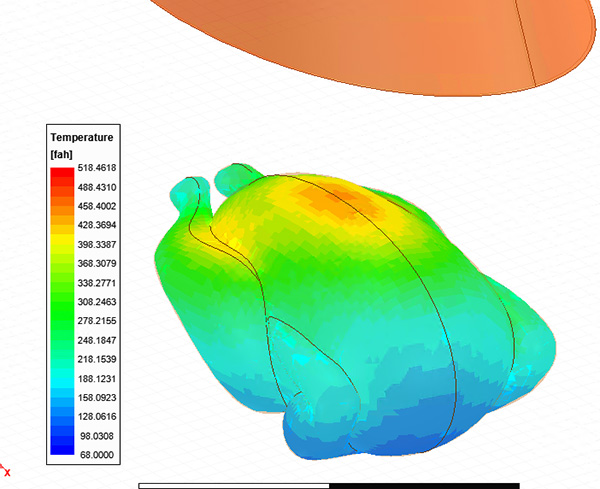
In the blog post detailing his experiment, Laurich wrote, "The results of our 500W simulation show that the turkey breast will reach a temperature over 500 degrees Fahrenheit! A bit overdone for my taste. We also see that the underside of the turkey is still raw!"
Through iteration, he found out he should reduce the power level to 300W and position the cone directly above the turkey for a more even cooking. The results also surprised him. "I didn't think we could provide a uniform radiance of penetration into the tissue with that kind of device," he noted.
Laurich has never done FEA to understand how you might use a household microwave oven to cook a bird of a more modest size, but he is tempted to look into it, just for fun.
RAND Simulation has also done an experiment to see if you an cook a turkey simply by shooting it out of a high-powered canon to make it travel at supersonic Mach speed--at constant speed ranging from 500m/s to 600m/s.
For his real Thanksgiving meal, Laurich said he'd skip the simulation and leave the cooking to his uncle. "He'll probably deep-fry it," said Laurich. After all, his uncle--the designated cook--can rely on his real-world experience instead of FEA.


Kenneth Wong is Digital Engineering's resident blogger and senior editor. Email him at [email protected] or share your thoughts or suggestions at digitaleng.news/facebook.
Follow DE
Join over 90,000 engineering professionals who get fresh engineering news as soon as it is published.






About Us · Contact Us · Editorial Team · Advertising · Privacy Policy · Subscriber Services · © 2026 Digital Engineering 24/7 · Peerless Media