Helping design and engineering professionals discover, evaluate and specify technologies and processes that shorten the design cycle and enable success.


Alert!
Digital Engineering ceased publication on July 1, 2026. This website remains available as an archive of engineering content.
For inquiries or information, please email [email protected].


May 2026 Special Focus: Artificial Intelligence in Design and Simulation
In this Special Focus Issue, learn about the latest developments in the integration of artificial intelligence into engineering workflows.

Design & Simulation Software Guide 2025
In this Special Issue, Digital Engineering presents its second annual guide to design and simulation software vendors.
Altair HyperWorks is a design and simulation platform from Altair that is part of a suite of computer-aided engineering software. Using computational science, high-performance computing (HPC), and artificial intelligence (AI), Altair HyperWorks 2025.1 features advancements in AI-powered engineering and optimization, mechanical and electronics systems design, and simulation-driven design.
This release integrates finite element analysis software alongside multiphysics and material simulation. With a connected digital thread linking every phase of development and cloud scalability driving collaboration, Altair HyperWorks enables teams to streamline processes, and design for sustainability, Altair reports.
“Altair HyperWorks 2025 builds on four decades of Altair’s expertise in simulation, design, and optimization,” says James R. Scapa, founder and chief executive officer, Altair. “By integrating advanced simulation technologies with AI and machine learning, automation, open architecture, and a connected digital thread, the platform accelerates design processes, fosters scalable cloud collaboration, and empowers teams to deliver smarter, faster, and more sustainable solutions. It is yet another leap in our vision of democratized computational intelligence.”
Altair taps into AI-powered engineering, machine learning, and optimization capabilities. Physics prediction models powered by new transformer architectures deliver accurate simulations, even with limited or incomplete data, according to Altair.
The new Altair DSim SaaS solution allows semiconductor designers to run unlimited simulations with a pay-as-you-go mode. The Altair One cloud innovation gateway enhances collaboration, providing instant access to simulation applications, data, and HPC resources, Altair reports.
New automation capabilities, including Python APIs, eliminate repetitive tasks, streamline data queries, and simplify report generation, according to Altair. The platform’s customization options allow users to tailor simulations to unique applications, Ansys explains.
Recent updates simplify managing thermal, electromagnetic, and power interactions in electronics design. ECAD meshing improvements speed up cooling and durability analysis, while enhanced electromagnetic-thermal coupling provides better system performance predictions, according to Ansys.
Altair Inspire offers designer-friendly computational physics for structural, fluid, and motion analysis, alongside manufacturability and optimization workflows. Altair CoPilot Beta—an intelligent AI-assistant embedded within Inspire—provides on-demand guidance, Q&A, and workflow support.
For more product highlights, click here.
Sources: Press materials received from the company and additional information gleaned from the company’s website.


Altair transforms design and decision making by applying simulation, machine learning, and optimization throughout product lifecycles. Altair offers software in five categories related to Computer Aided Engineering (CAE) and High Performance…
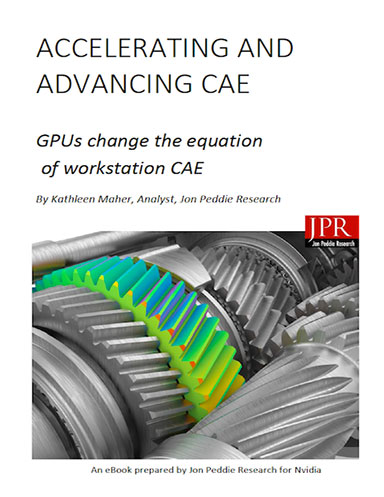
Accelerating and Advancing CAE
GPUs are changing the nature of engineering simulation, according to a new ebook from Jon Peddie Research (JPR). It explains how GPU acceleration is improving CAE workflows.

DE's editors contribute news and new product announcements to Digital Engineering. Press releases may be sent to them via [email protected].
Follow DE






About Us · Contact Us · Editorial Team · Advertising · Privacy Policy · Subscriber Services · © 2026 Digital Engineering 24/7 · Peerless Media