Helping design and engineering professionals discover, evaluate and specify technologies and processes that shorten the design cycle and enable success.


May 2026 Special Focus: Artificial Intelligence in Design and Simulation
In this Special Focus Issue, learn about the latest developments in the integration of artificial intelligence into engineering workflows.

April 2026 Special Focus Issue: Generative Design
In this Special Focus Issue, Digital Engineering takes a look at how generative design solutions can be used across different types of design problems and with a variety of manufacturing approaches to accelerate design space exploration, and…
 The Bionic Aircraft project is designed to minimize resource use across the complete aircraft life-cycle. Consortium members from six European countries are applying 3D printing to the challenge. This project has received funding from the European Union’s Horizon 2020 research and innovation programme under grant agreement No 690689. Image courtesy Bionic Aircraft Consortium.
Based on Dassault Systèmes CATIA CAD software, this will be no ordinary CAD design package. CENIT is one of 10 EU partners working to develop technologies, tools and concepts to enhance the resource efficiency of aviation for the entire lifecycle of an aircraft. Key to this achievement will be light-weighting of components. The strategy is to draw upon the possibilities found by using new materials, additive layered manufacturing (ALM or just AM) and bionic design that mimics cellular structures and bone growth. CENIT’s assigned task is to radically simplify the design process.
Project goals are:
With a budget of almost 8 million euros ($9.91M US), the program has been broken into 10 work projects that encompass bionic design, materials and processes, quality assurance and repair/recycling. CENIT’s work covers three subtopics: development of a toolset for automated bionic design, development of a toolset for automated generation of AM-part support structures, and support for numerically controlled and robotics programming.
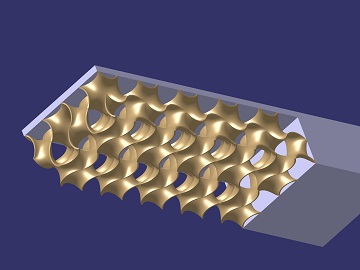
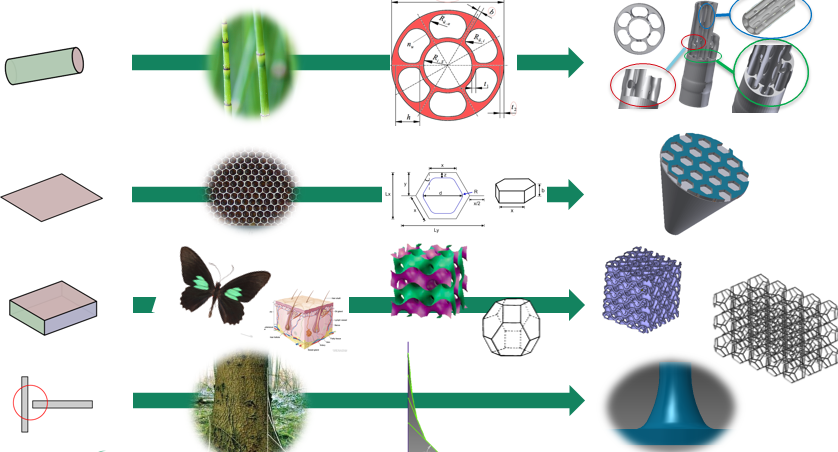 Structures from nature serve as inspiration for 3D CAD model features, as CENIT develops an automated bionic-design toolbox. The work is geared to additive manufacturing of aircraft and supports the Bionic Aircraft project. Image courtesy CENIT.
CENIT is creating a CATIA-based CAD catalog of parametrically defined bionic features. “This provides an automated toolbox to support the cost- and time-intensive manual interpretation and design of topologically optimized components in CAD,” says Jochen Michael, CENIT project manager. “The parameterization of features also lets the designers adjust geometries more easily,” for additional efficiency and quality.
By the time the Bionic Aircraft project concludes in August 2019, CENIT expects to have developed a CAD catalog of 10 to 15 bionic features. Examples include smooth transitions between features (perpendicular or near so) using fillet connections based on tree-trunk-to-root configurations, and beams or rods with multiple internal channels that mimic the internal structure of bend-resistant grass stalks.
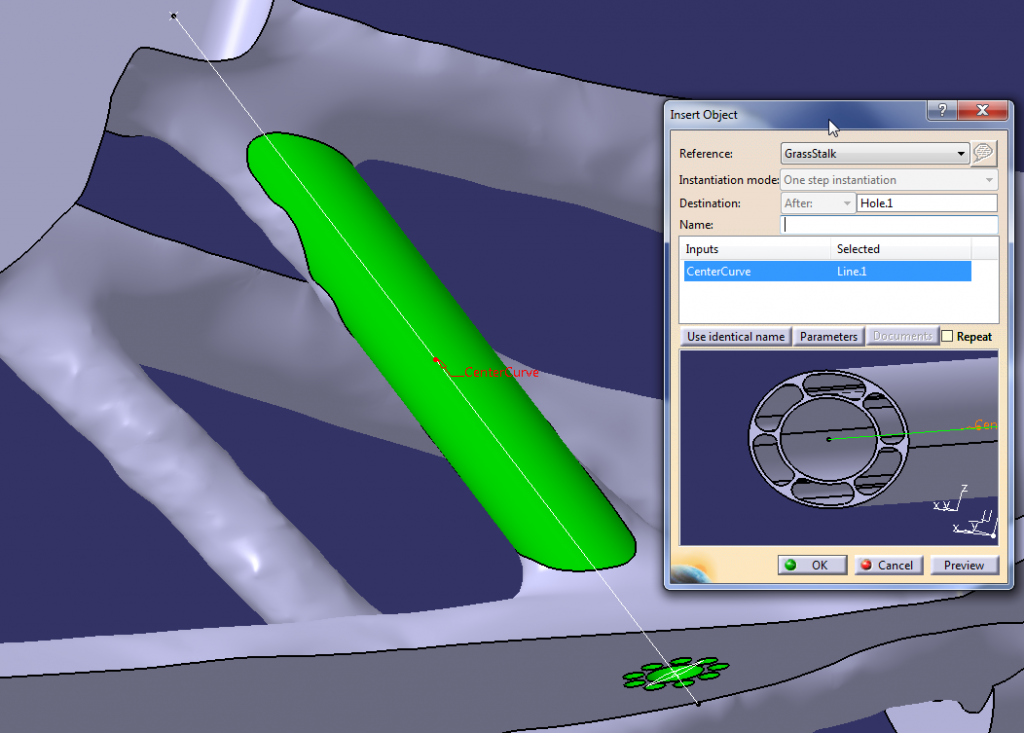 Example of automatically incorporating bionic features into aircraft structural design. CENIT is creating a catalog of such features, integrated with CATIA CAD software. Image courtesy CENIT.
Small design changes like this have already proven to significantly reduce the risk of component failure. These improvements will be adaptable to existing CAD models with just a mouse click. To date, no CAD program offers such bionically optimized features.
Collaborating with the Fraunhofer-Institut für Additive Produktionstechnologie (IAPT), CENIT is defining and automating the generation of these often-complex support designs. Important considerations include tensile strength, powder consumption, support style (such as graded lattices), removability of support structures and the surface quality of the part after post-processing. The team is also defining values for the many possible AM build parameters, as tailored to the new aluminum alloys.
 Concept for metal AM support structure design. (Image courtesy CENIT)
To further simplify the entire design process and avoid any data-loss through translation between packages, all features and tools will be available through a direct CATIA interface. CENIT is working with Aconity GmbH on this development.
The Bionic Aircraft consortium members will meet for a project review in Brussels, Belgium on 18 April 2018. For further information contact the project coordinator, Philipp Imgrund of IAPT.
Airbus Operations GmbH (Germany)
CENIT AG (Germany)
Enlyte LTD (UK)
Fraunhofer-Institut für Additive Produktionstechnologie IAPT (Germany)
Hexagon Metrology (Italy)
Hexagon Technical Center (Switzerland)
Technical University of Hamburg/Institute of Laser- and System-Technology (Germany)
tecnalia (Spain)
Tekna Plasma Europe (France)


Pamela Waterman worked as Digital Engineering's contributing editor for two decades. Contact her via DE-Editors@ digitaleng.news.
Follow DE
Join over 90,000 engineering professionals who get fresh engineering news as soon as it is published.






About Us · Contact Us · Editorial Team · Advertising · Privacy Policy · Subscriber Services · © 2026 Digital Engineering 24/7 · Peerless Media