Helping design and engineering professionals discover, evaluate and specify technologies and processes that shorten the design cycle and enable success.


Alert!
Digital Engineering ceased publication on July 1, 2026. This website remains available as an archive of engineering content.
For inquiries or information, please email [email protected].

Digital Engineering April 2026
In the latest issue of Digital Engineering, we take a look at the latest innovations in design for additive manufacturing, including the use of natural language inputs, social media cosplayers, and AI integration. The issue also includes a feature…

January Special Focus Issue: Design for Additive
In this Special Focus Issue of Digital Engineering, learn about the latest advancements in design for additive manufacturing, including new software tools, additive in automotive, custom medical devices, and more.
IDTechEx has conducted a comprehensive analysis of the thermal interface materials industry and have a market report on the industry: Thermal Interface Materials 2020-2030: Forecasts, Technologies, Opportunities. This includes a detailed review of numerous industries and a review of the key players and material considerations.
Enhanced through-plane conductivity is becoming a key market pull in numerous sectors. The incumbent materials, such as ceramic filled silicone resins, still have markets to expand into (the most notable of which being lithium-ion batteries for electric vehicles) but are also under threat in more demanding areas.
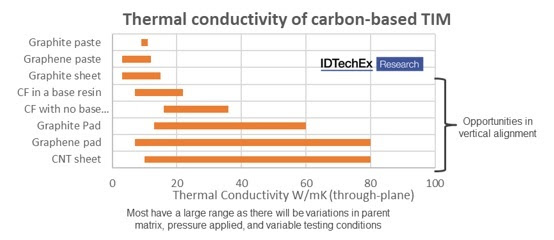
Many are turning to advanced carbon for higher conductivity either as a conductive filler in a polymer matrix or standalone. This includes graphite, pitch-based carbon fiber, carbon nanotubes and graphene. One of the most notable examples is the adoption of carbon fiber in the Samsung Galaxy Note9. IDTechEx has been informed that carbon fiber based TIM is also in use for power electronic devices in electric vehicles, a variety of military applications, high-performance computing and more.
Graphite through to graphene as sheets, pastes or vertically aligned in pads have all received much attention. All report significant conductivity improvements and show current and future promise in LEDs, consumer electronics, base stations and more.
One challenge of using advanced carbons is that they are electrically conductive. Ceramics are preferred for this. There are trends to more spherical or flake like particles where appropriate, but concerning emerging material there is more interest around boron nitride nanostructures. Boron nitride nanotubes (BNNT) or nanosheets (BNNS) are starting to become commercial.
BNNTs have a wide variation in property and cost with still a limited number of players, but many are progressing from the lab to pilot plants and even full-scale production. Most cite TIM as a key target market with already some promising results and interest from significant industries.
The market report provides a view of all these advanced materials as well as incumbents such as phase change materials (PCM), thermal greases and more. The report gives 50 forecast lines on key sectors, providing a comprehensive overview and outlook for this industry.
To find out more about the report, Thermal Interface Materials 2020-2030: Forecasts, technologies, Opportunities, click here.
Sources: Press materials received from the company and additional information gleaned from the company’s website.


DE's editors contribute news and new product announcements to Digital Engineering. Press releases may be sent to them via [email protected].
Follow DE






About Us · Contact Us · Editorial Team · Advertising · Privacy Policy · Subscriber Services · © 2026 Digital Engineering 24/7 · Peerless Media