Helping design and engineering professionals discover, evaluate and specify technologies and processes that shorten the design cycle and enable success.


Alert!
Digital Engineering ceased publication on July 1, 2026. This website remains available as an archive of engineering content.
For inquiries or information, please email [email protected].

Design & Simulation Software Guide 2025
In this Special Issue, Digital Engineering presents its second annual guide to design and simulation software vendors.

Design & Simulation Software Guide
In this Special Issue, Digital Engineering presents its inaugural guide to design and simulation software vendors, including listings for CAD, CAM, simulation, generative design, PLM, rendering and visualization, design for additive manufacturing,…
Many folks in the product lifecycle management (PLM) world will tell you that moving legacy databases beyond “documents” (paper, Mylar and scans) is a no-brainer, provided that organizations follow the precepts of Model-Based Systems Engineering (MBSE).

Experts in enterprise-class software in U.S. government agencies realize it’s not that easy. These are the people who deal with data and systems engineering practices dating back to the dawn of computing in the 1940s.
The CIMdata PLM Road Map 2019 conference in suburban Washington, D.C., offered a go-slow dose of reality in upgrading basic systems engineering development operations to MBSE in its central role in digital transformation. Government agencies’ problems include dealing with so-called legacy data and resistance to change.
During my presentation at the conference, I noted the consequences within the ongoing disruption of the PLM ecosystem. Practitioners must expand their scope, rethink strategies and capabilities, and embrace the fundamental shifts in PLM requirements and implementations.
Expanding scope may not be enough, however. Business models—the digital enterprise and its positioning, platform strategies, solution offerings—may all have to respond to disruptions including:
We used to say innovate or die; now we say transform or die. Despite the challenges, the PLM market continues to grow, up 9.4% in 2018.
Speakers from the National Institute of Standards and Technology (NIST), NASA and the Department of Defense (DOD) reinforced and added to my observations.
NIST often encounters confusion between hype and reality in the digital transformation of manufacturing, especially in success stories about very large enterprises. Small to medium-sized enterprises must be more cautious when going digital; they cannot afford to slow down or disrupt their production processes, NIST believes.
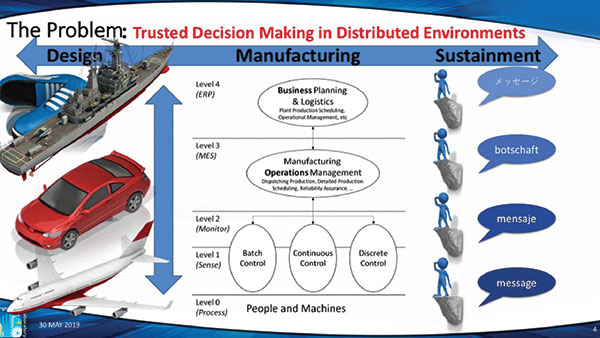
Speaking for NIST was Dr. Thomas Hedberg Jr., P.E., research mechanical engineer. He highlighted the problem of trusted decision making in distributed environments. He noted concerns about the information disconnects among original equipment manufacturers (OEMs) and systems integrators in decentralized manufacturing.
Hedberg pointed out that many small to mid-sized companies (SMBs) cannot afford to completely redesign their manufacturing systems. They need to leverage the capabilities in which they have already invested while adding appropriate new technologies.
Helping them do this is a key NIST goal of its Model-Based Enterprise (MBE) efforts. A significant resource of that effort is NIST’s Smart Manufacturing Systems Test Bed.
“The caution among SMBs should not be misunderstood as a lack of strategic alignment” with digital transformation, Hedberg said. “Technology alone cannot solve these challenges, nor is technology the hardest challenge to address.” The most difficult, he noted, are the human and sociotechnical aspects.
NASA is investigating use of MBSE to supplement or replace elements of its traditional systems engineering approach. Speaking for NASA was Kurt Woodham, a systems engineer at the NASA Langley Research Center in Hampton, VA. MBSE “allows the systems engineer to better focus on engineering the system—understanding technical priorities, risks and opportunities,” he explained.
Challenges in NASA’s move to MBSE from document-based systems engineering include:
The DOD homed in on fundamental questions: What does authoritative data look like? How do we even know if data is authoritative and/or part of the authoritative source of truth? In dealing with legacy data, how do we describe what we do?
The DOD presentation was by Philomena “Phil” Zimmerman, deputy assistant secretary of defense for systems engineering. In her role as the DOD’s technology chief, she pointed out that technology is transforming the battlespace and “we need to change both what we do and how we do it.”
The worldwide proliferation of knowledge and technology erodes historic U.S. advantages, she added, while “our near-peers” are increasing their rate of investment in military R&D. “We cannot expect success fighting tomorrow’s conflicts with yesterday’s weapons or equipment,” Zimmerman pointed out.
This means getting capabilities to warfighters faster with new acquisition pathways and concepts of operation. The DOD itself must be reformed for greater performance and affordability, she continued. “The current bureaucratic approach, centered on exacting thoroughness and minimizing risk above all else, is proving to be increasingly unresponsive” to warfighters’ needs.
Peter A. Bilello is president and CEO of CIMdata Inc. in Ann Arbor, MI. Send email about this commentary to [email protected].






About Us · Contact Us · Editorial Team · Advertising · Privacy Policy · Subscriber Services · © 2026 Digital Engineering 24/7 · Peerless Media