Helping design and engineering professionals discover, evaluate and specify technologies and processes that shorten the design cycle and enable success.



Digital Engineering September 2025
In the September issue of Digital Engineering, we look at trends in engineering education, how engineering schools are handling DfAM, the limitations of ROMs, VR engineering workflows, reports from the Paris Air Show and Hexagon LIVE, and more.
How Pinnacle Series Helps AEC Firms Attract, Train, and Retain Top Talent
Discover how AEC firms use Pinnacle Series to solve hiring challenges, upskill employees, and reduce turnover with personalized learning, skill assessments, and role-based training.
There are plenty of unexplored industries, and even more unexplored and developed applications within those industries that can and will use unmanned air systems. The global unmanned aerial vehicle (UAV) market is anticipated to reach 4.7 million units by the end of 2020.
Mark Pilling is the competition director and is a program manager and senior systems analyst at SAIC Inc. He provided an overview of the Student Unmanned Air System (SUAS) design competition, along with Phillip Tischler, who spoke about interoperability.
Digital Engineering: Can you provide an overview of the SUAS design competition?
Pilling: The AUVSI SUAS Competition is designed to foster interest in unmanned aerial systems, stimulate interest in UAS technologies and careers, and to engage students in a challenging UAS mission. The competition requires students to design, integrate, report on and demonstrate a UAS capable of autonomous flight and navigation, remote sensing via on-board payload sensors and execution of a specific set of tasks. The competition has been held annually since 2003.
The competition has three major elements: the Technical Design Paper, the Flight Readiness Review Presentation and the Mission Demonstration. The paper details the team’s UAS design. The presentation details the team’s testing and preparedness for the competition. The demonstration simulates a mission in which the UAS and team is evaluated. The mission consists of autonomous flight, obstacle avoidance, object detection and air delivery.
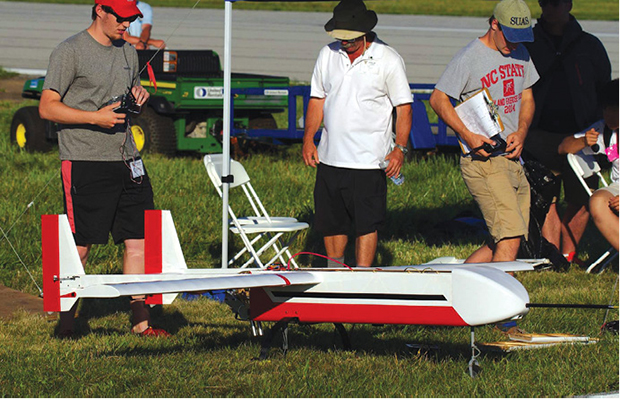 The AUVSI SUAS competition requires students to design, integrate, report on and demonstrate an unmanned air system capable of autonomous flight and navigation, remote sensing and execution of specific tasks.
The SUAS competition is for undergraduate students. Our 16th annual SUS competition had 71 schools register: (36) domestic universities/colleges; (32) international universities and (3) high schools.
DE: Can you tell us about the mission?
Tischler: The Interoperability System is a network and web server that teams should interact with during the mission. This system provides mission details and receives mission deliverables. The system provides automatic evaluation for scoring and is available to teams for testing.
DE: What is it about SUAS that you think interests the participants?
Pilling: Thousands of students have participated over the years. [There has been] interest in unmanned operations, systems engineering, teamwork and careers.
DE: Does your organization team with industry sponsors who might have a particular stance on adopting innovation that is linked to the program?
Pilling: Yes, we have industry sponsors for our competition. Visit our SUAS website and see the Sponsors tab.
DE: Anything else you’d like to tell us about the event?
Pilling: Although every team has the same set of rules, it’s interesting to see how each team approaches the challenge differently.


Jim Romeo is a freelance writer based in Chesapeake, VA. Send e-mail about this article to [email protected].
Follow DE
Join over 90,000 engineering professionals who get fresh engineering news as soon as it is published.






About Us · Contact Us · Editorial Team · Advertising · Privacy Policy · Subscriber Services · © 2026 Digital Engineering 24/7 · Peerless Media