Helping design and engineering professionals discover, evaluate and specify technologies and processes that shorten the design cycle and enable success.


Alert!
Digital Engineering ceased publication on July 1, 2026. This website remains available as an archive of engineering content.
For inquiries or information, please email [email protected].

Digital Engineering April 2026
In the latest issue of Digital Engineering, we take a look at the latest innovations in design for additive manufacturing, including the use of natural language inputs, social media cosplayers, and AI integration. The issue also includes a feature…

January Special Focus Issue: Design for Additive
In this Special Focus Issue of Digital Engineering, learn about the latest advancements in design for additive manufacturing, including new software tools, additive in automotive, custom medical devices, and more.
Desktop Metal has qualified a 100% recycled nickel-based superalloy processed with technology from Continuum Powders, a producer of sustainable metal powders.
The nickel-based superalloy, Mar-M247, is used for applications requiring high strength at elevated temperatures of up to about 1000°C, according to Desktop Metal.
Continuum’s 100% re-atomized Mar-M247 powder is now listed as R&D Qualified in Desktop Metal’s binder jet 3D printing portfolio, which includes about 40 metals and ceramics.
“We see a bright future for high-quality, sustainable powder options for our additive manufacturing technologies,” says Ric Fulop, CEO of Desktop Metal. “Having a qualified 100% reclaimed metal powder from Continuum Powders is just a first step in what we hope is a long line of recycled, eco-conscious materials that offer a significant return on investment.”
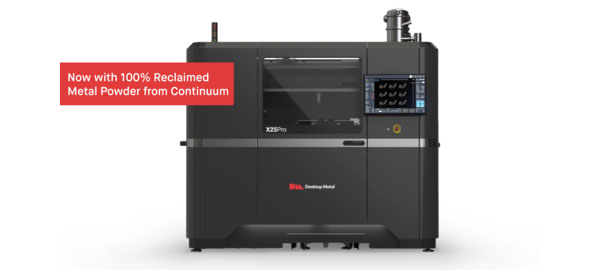
As with all of Desktop Metal’s R&D qualified materials, Continuum’s recycled Mar-M247 received thorough evaluation and rigorous testing to determine that it met all of the material property requirements of the same alloy from conventional metal powder production, according to Desktop Metal. The new material is qualified for use on Desktop Metal’s X25Pro binder jet 3D printer platform, which uses Triple Advanced Compaction Technology (ACT).
“The fact that we’re seeing reclaimed metal powders validated by Desktop Metal, along with other leading AM OEMs, signals that these materials are now a proven resource for manufacturers,” says Continuum Powders’ CEO Rob Higby. “Use of recycled powders can shorten supply chains, reduce costs and support corporate goals for carbon footprint reduction.”
Continuum Powders is a portfolio company of Ara Partners, a private equity firm specializing in industrial decarbonization investments. Desktop Metal joins Velo3D, Renishaw, and other leaders in the additive manufacturing space who are qualifying 100% reclaimed materials with Continuum Powders.
Because Desktop Metal binder jet technology can 3D print most powders, the company reports that it has a tiered material qualification system for metals to signify the varying levels of material property results produced by itsr technology:
Learn more at desktopmetal.com/materials.
Sources: Press materials received from the company and additional information gleaned from the company’s website.


Desktop Metal was started to address a problem—how to make metal 3D printing accessible for engineering teams. In 2013, CEO Ric Fulop began collaborating with world-leading experts in materials science, engineering, and 3D printing. Their work…

DE's editors contribute news and new product announcements to Digital Engineering. Press releases may be sent to them via [email protected].
Follow DE






About Us · Contact Us · Editorial Team · Advertising · Privacy Policy · Subscriber Services · © 2026 Digital Engineering 24/7 · Peerless Media