Helping design and engineering professionals discover, evaluate and specify technologies and processes that shorten the design cycle and enable success.


Alert!
Digital Engineering ceased publication on July 1, 2026. This website remains available as an archive of engineering content.
For inquiries or information, please email [email protected].

Digital Engineering April 2026
In the latest issue of Digital Engineering, we take a look at the latest innovations in design for additive manufacturing, including the use of natural language inputs, social media cosplayers, and AI integration. The issue also includes a feature…

January Special Focus Issue: Design for Additive
In this Special Focus Issue of Digital Engineering, learn about the latest advancements in design for additive manufacturing, including new software tools, additive in automotive, custom medical devices, and more.
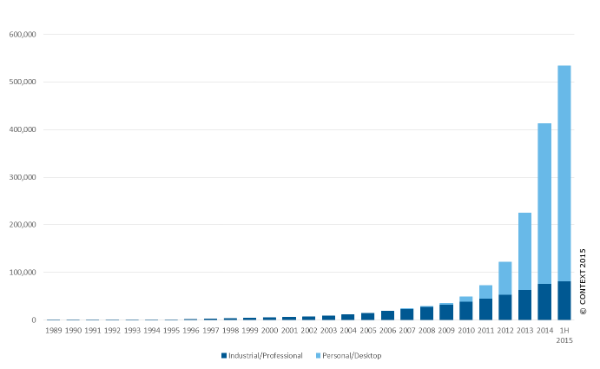
According to CONTEXT, 95% of the 173,962 printers shipped were personal/desktop printers priced below $5,000. That segment saw 38% year-on-year growth, compared to a 3% decline in shipments of industrial/professional printers.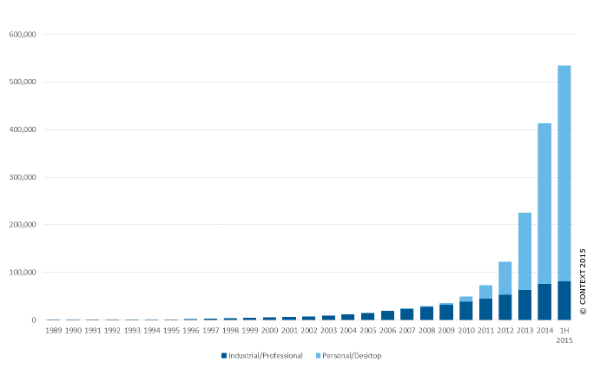
Earlier this year, the company reported that the global 3D printer industry had shipped 500,000 units since the 1980s.
Taiwan's XYZprinting holds 17% of the global market in the desktop space, the top slot previously held by MakerBot. 3D Systems holds the second largest share of the personal/desktop space (12%), followed by Stratasys, Ultimaker, and M3D, which all hold 9%, respectively, says the research firm.
According to CONTEXT:
The market continues to be characterized by regional brand dominance and the ability of start-ups to gain share quickly via various crowdsourced efforts. The influence of start-ups is evidenced by the progress of US-based M3D and its highly successful Kickstarter effort showing strong demand remaining in this segment. Meanwhile, the recent announcement from 3D Systems of its refocus away from its $999 consumer-focused printer gives further indication that demand in the Desktop/Personal segment is not coming from at-home consumers.
"While not quite yet resonating with general consumers, desktop 3D printers remain an important gateway technology for the evolution of the 3D printing industry," said Chris Connery, vice president for global analysis at CONTEXT. "Today's young engineers, students and hobbyists need to become exposed to the concepts necessary to allow them to properly design products for an additive manufacturing environment and low-cost, entry level personal 3D printers allow for this learning to take place more rapidly."
In the industrial/professional space, Stratasys leads the market with a 49% share, followed by 3D Systems (22%), envisionTEC (10%), EOS (4%) and Mcor Technologies (3%), according to CONTEXT's research.
Over at Zacks, analysts took note that 3D printing stocks were strong even amid a poorly performing market. 3D Systems was up 13.2%, while Voxeljet was up 10.7% and Stratasys was up by 4.6%.
Source: CONTEXT


Brian Albright is the editorial director of Digital Engineering.
Contact him at [email protected].






About Us · Contact Us · Editorial Team · Advertising · Privacy Policy · Subscriber Services · © 2026 Digital Engineering 24/7 · Peerless Media