Helping design and engineering professionals discover, evaluate and specify technologies and processes that shorten the design cycle and enable success.


Alert!
Digital Engineering ceased publication on July 1, 2026. This website remains available as an archive of engineering content.
For inquiries or information, please email [email protected].

May 2026 Special Focus: Artificial Intelligence in Design and Simulation
In this Special Focus Issue, learn about the latest developments in the integration of artificial intelligence into engineering workflows.

Design & Simulation Software Guide 2025
In this Special Issue, Digital Engineering presents its second annual guide to design and simulation software vendors.
There are some significant new capabilities in the latest version of both Siemens Simcenter MAGNET and Simcenter Motorsolve 2019.1. This includes a new electromagnetic and vibro-acoustics link among many others.
In a faulty machine, the mechanical vibrations due to electromagnetic forces can be quite catastrophic. This can lead to damage, frequent servicing or total failure. The noise produced during operation can range from a minor irritation to a potential safety concern if too loud. As a result, it is important to perform linked electromagnetics and vibro-acoustics analysis early and at multiple stages of the design process.
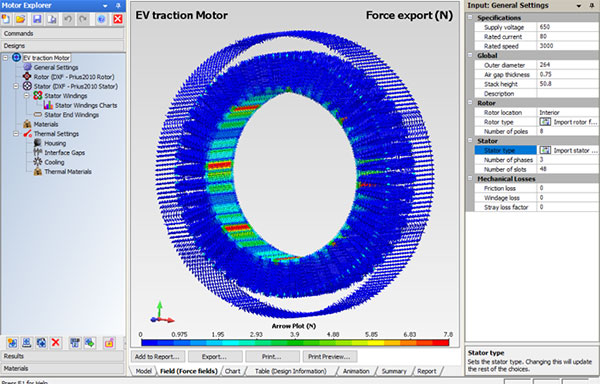
To address this need, with both Simcenter MAGNET and Simcenter Motorsolve 2019.1, there are new options to account for the electromagnetically-induced acoustic noise and vibration. The exported nodal force and force density fields from either software tool can be used as the load for structural and vibro-acoustic simulations, such as with Simcenter 3D. Simcenter Motorsolve uses smart 2.5D technology to generate a 3D nodal force mesh model based on 2D simulations, significantly accelerating analysis with accurate results.
With Simcenter MAGNET, the 3D simulations allow for a detailed analysis of problems like power transformers and final design verification of electric machines.
In Simcenter MAGNET 2019.1, a generalized electromagnetic force calculation method makes it possible to compute nodal force and force density on the surfaces of all types of components (i.e., ferromagnetic materials, permanent magnets and current carrying conductors). And this includes the case when the surfaces of components are touching.
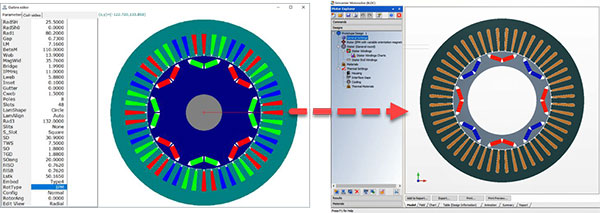
It is also possible to compute the net forces on individual components whether they are touching other components or not. And ito probe further, a virtual cut can be introduced creating a section of a component for which the net forces can be examined, such as a stator tooth tip.
Simcenter SPEED PC-BDC models can be seamlessly imported into Simcenter Motorsolve software for higher-resolution finite element simulations. In other words, perform further exploration of motor performance and design alternatives using nonlinear transient with motion analysis that allows local identification of saturated regions.
Accelerating product development with simulations requires material models, which can solve real physics. Improvements in accuracy, convergence and the speed of solutions in material property modeling are all part of this new release:
In addition to all these improvements, there are new interior permanent magnet motor templates in Simcenter Motorsolve 2019.1 for variable orientation magnets and embedded variable orientation magnets.
Sources: Press materials received from the company and additional information gleaned from the company’s website.


Simcenter™ software, from Siemens Digital Industries Software, uniquely combines system simulation, 3D CAE and test to help you predict performance across all critical attributes earlier and throughout the entire product lifecycle. By combining…
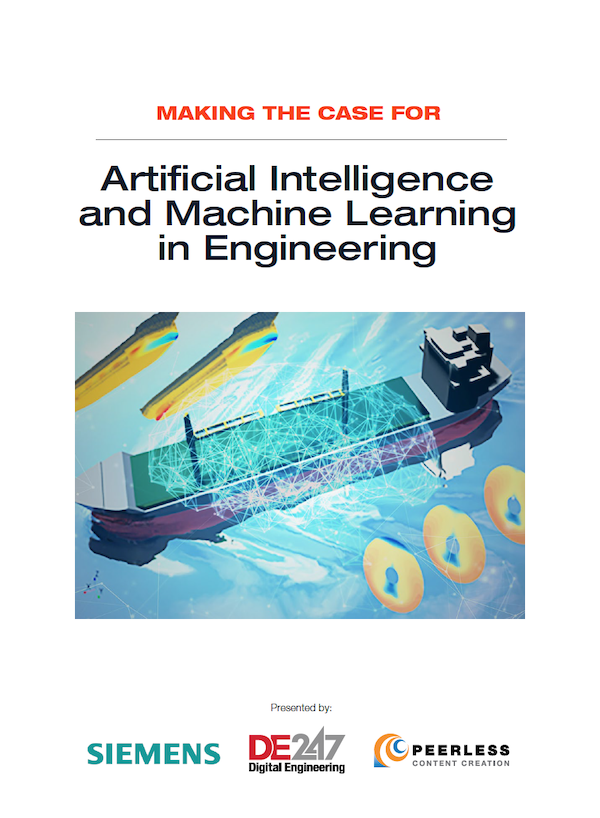
Making the Case for Artificial Intelligence and Machine Learning in Engineering
In this paper, Siemens Digital Industries Software and Digital Engineering will provide an overview of how AI/ML-enabled software can improve design workflows, while also addressing common questions and concerns around implementing this technology in an engineering organization.

DE's editors contribute news and new product announcements to Digital Engineering. Press releases may be sent to them via [email protected].
Follow DE






About Us · Contact Us · Editorial Team · Advertising · Privacy Policy · Subscriber Services · © 2026 Digital Engineering 24/7 · Peerless Media