Helping design and engineering professionals discover, evaluate and specify technologies and processes that shorten the design cycle and enable success.


Alert!
Digital Engineering ceased publication on July 1, 2026. This website remains available as an archive of engineering content.
For inquiries or information, please email [email protected].

May 2026 Special Focus: Artificial Intelligence in Design and Simulation
In this Special Focus Issue, learn about the latest developments in the integration of artificial intelligence into engineering workflows.

Design & Simulation Software Guide 2025
In this Special Issue, Digital Engineering presents its second annual guide to design and simulation software vendors.
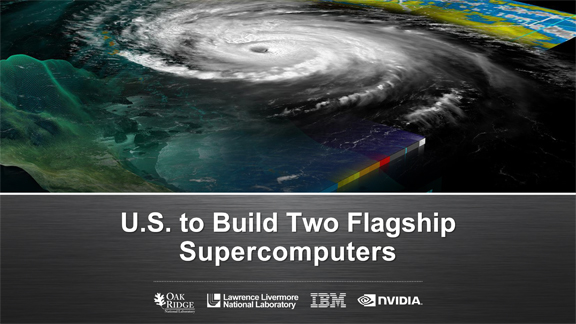
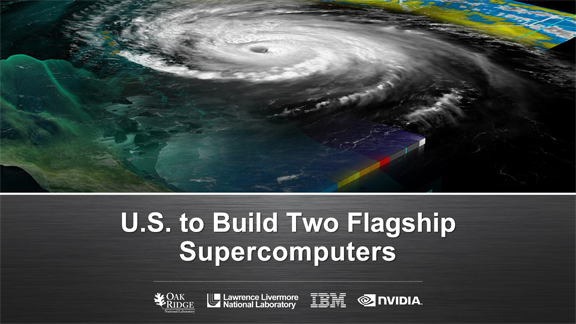 U.S. Department of Energy gets ready to build two new supercomputers: Summit and Sierra.
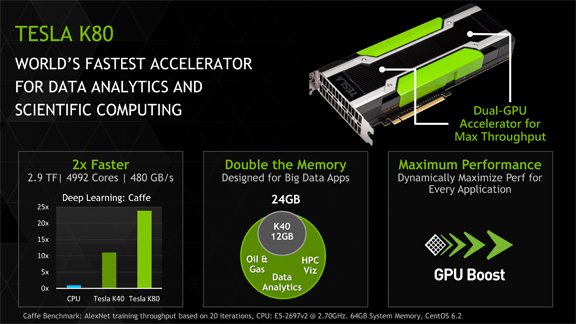 NVIDIA Tesla K80, with two GPUs on a board.
Sad news for the Titan at the Oak Ridge National Laboratory. Its days as the fastest U.S. supercomputer are numbered.
The Department of Energy (DOE) announces it has just put in an order for two new computing Goliaths. When completed, these new systems are expecte to outpaced the Titan by at least three times. The news gives IBM, NVIDIA, and Mellanox bragging rights at the annual supercomputing conference (SC2014) this week in New Orleans; they'll be supplying technologies to realize the new DOE systems
Dubbed Summit and Sierra, the two GPU-powered systems are set to come online in 2017 at the Oak Ridge and Lawrence Livermore National Laboratories, respectively. The price tag is $425 million -- $325 to build the systems, $100 for research, according to Reuters.
In a press announcement, NVIDIA says the systems are expected "to deliver at least three-times greater performance than today’s most powerful system – which will move the world closer to the long-held goal of exascale computing." Titan delivers 27 peak petaflops. Tianhe-2 in China -- currently considered the fastest in the world -- delivers 55 peak petaflops. NVIDIA predicts Summit will deliver 150 to 300 peak petaflops.
NVIDIA says, "The U.S. is investing in Summit and Sierra to achieve breakthroughs that lead to greater U.S. energy independence, new approaches to curbing climate change, dramatic improvements in fuel efficiency, natural disaster prediction, safer nuclear material storage, economic competitiveness, and more."
One of NVIDIA's contribution to the DOE supercomputers' performance will be the company's NVLink, described as "an energy-efficient, high-bandwidth path between the GPU and the CPU at data rates of at least 80 gigabytes per second, or at least five times that of the current PCIe Gen3 x16, delivering faster application performance." NVLink will serve as the interconnect between nodes in Summit and Sierra. This, NVIDIA believes, will let "NVIDIA GPUs and CPUs such as IBM POWER to access each other’s memory quickly and seamlessly."
At SC2014, NVIDIA also plans to highlight its Tesla K80 GPU, designed for big-data applications. The distinguishing character of K80 is, it contains two GPUs per board, for double throughput. It runs at 2.9 teraflops on 4992 cores in 480 GB per second speed, according to NVIDIA. The new accelerators are part of NVIDIA's product line for servers. The company believes K80 is ideal for oil & gas exploration, big data analysis, and real-time visualization in engineering and science.
At SC, NVIDIA plans to showcase GPU computing's power with a series of real-time, interactive visualizations. The demonstrations will include a Chromatophore, a light-reflecting organelle in cells; Milky Way formation; and HIV virus structure.


Kenneth Wong is Digital Engineering's resident blogger and senior editor. Email him at [email protected] or share your thoughts or suggestions at digitaleng.news/facebook.
Follow DE






About Us · Contact Us · Editorial Team · Advertising · Privacy Policy · Subscriber Services · © 2026 Digital Engineering 24/7 · Peerless Media