Helping design and engineering professionals discover, evaluate and specify technologies and processes that shorten the design cycle and enable success.



Digital Engineering April 2026
In the latest issue of Digital Engineering, we take a look at the latest innovations in design for additive manufacturing, including the use of natural language inputs, social media cosplayers, and AI integration. The issue also includes a feature…

January Special Focus Issue: Design for Additive
In this Special Focus Issue of Digital Engineering, learn about the latest advancements in design for additive manufacturing, including new software tools, additive in automotive, custom medical devices, and more.
nTopology, an engineering design software specializing in additive manufacturing, released its third generation lattice design tools. This update features fundamental rewrites to its core latticing software infrastructure, which the company says improves the existing product and prepares nTopology for future updates.
nTopology’s latest software update includes 37 new latticing blocks. Much of this technology has already been pushed out to existing users before the full release and tested from research through to production.
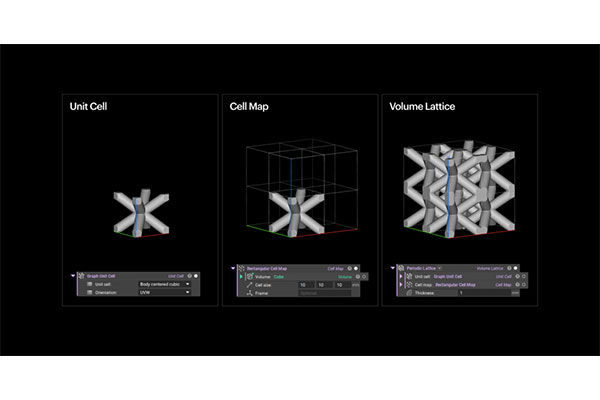
New users will find it simpler to start using the product, the company says. The lattice generation process has been simplified into three steps: select a unit cell; define the cell map; and control lattice parameters (such as thickness). nTopology says mastery of these steps makes it faster and more intuitive to learn how to apply advanced latticing and Design for Additive Manufacturing (DfAM) techniques later on.
The company says this update is “significantly” faster than previous versions. In one benchmark example, nTopology says a lattice with 50,000+ cells would take 45 to 60 seconds to generate on a well-equipped laptop. With this update, that same lattice rebuilds in 1 to 2 seconds, a 50x increase. The speed increase is dependent on your current CPU and GPU setup.
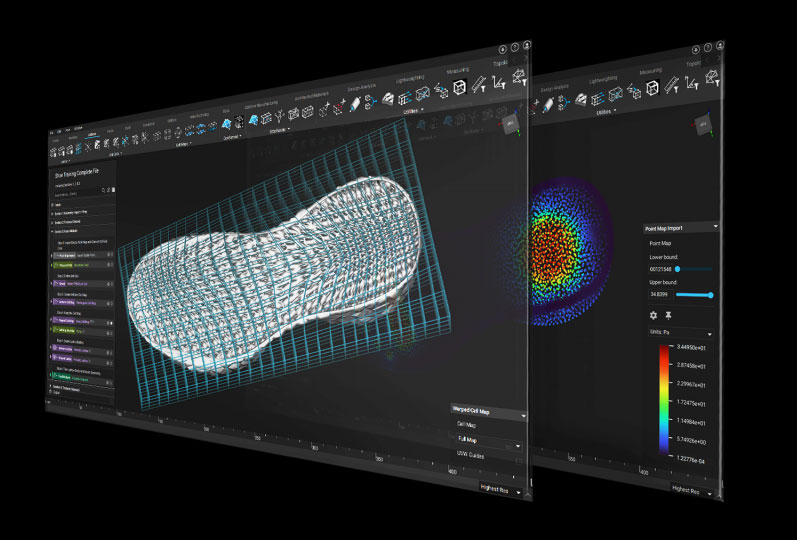
Several features have been updated or introduced for greater control over lattice generation. A new Lattice Warping tool allows the user to apply Field-Driven Design techniques to control the lattice cell map. When used with real-time visualization, nTopology says this feature allows users to finetune complex shapes, as well as offer a new way to design conformal lattices.
Lattice generation now follows a unified workflow model when working with a graph, TPMS or custom unit cell. nTopology says this feature makes it “far simpler” to rapidly iterate between different lattice types.
There are new filtering capabilities to select lattice beams based on specific criteria including length, angle, connectivity or thickness. This feature allows control over various parameters, and is a help in optimization for manufacturing.
Another updated feature is Surface Lattices. This allows the user to create cell maps that conform to the surface of a quad mesh, and to design conformal rib grids to increase the stiffness of bodies.
Chelsea Cummings is a digital applications advisor at Barnes Global Advisors. She works with clients to develop new 3D printed products and train them on the latest technologies. “Being able to edit the lattice with this level of control is a big deal,” notes Cummings. “That will elevate the output of nTop for the most sensitive additive manufacturing processes—with metal laser powder bed fusion being the most sensitive.”
The update to nTopology is now available directly from the company. For more information, click here.
Here's a video explaining this update in more detail.
Sources: Press materials received from the company and additional information gleaned from the company’s website.


DE's editors contribute news and new product announcements to Digital Engineering. Press releases may be sent to them via [email protected].
Follow DE
Join over 90,000 engineering professionals who get fresh engineering news as soon as it is published.






About Us · Contact Us · Editorial Team · Advertising · Privacy Policy · Subscriber Services · © 2026 Digital Engineering 24/7 · Peerless Media