Helping design and engineering professionals discover, evaluate and specify technologies and processes that shorten the design cycle and enable success.



May 2026 Special Focus: Artificial Intelligence in Design and Simulation
In this Special Focus Issue, learn about the latest developments in the integration of artificial intelligence into engineering workflows.

Design & Simulation Software Guide 2025
In this Special Issue, Digital Engineering presents its second annual guide to design and simulation software vendors.
 Dear DE Reader:
If you have your consultant's shingle out or if you work at a tight-budgeted joint, you always seem to need more tools and resources. Then again, even big outfits need burst horsepower to handle complex simulations. This is where the cloud is really putting the oomph into the gig economy and engineering workflows. If CFD (computational fluid dynamics) is a tool you crave or need more power to run, today's Editor's Pick of the Week has your name on it.
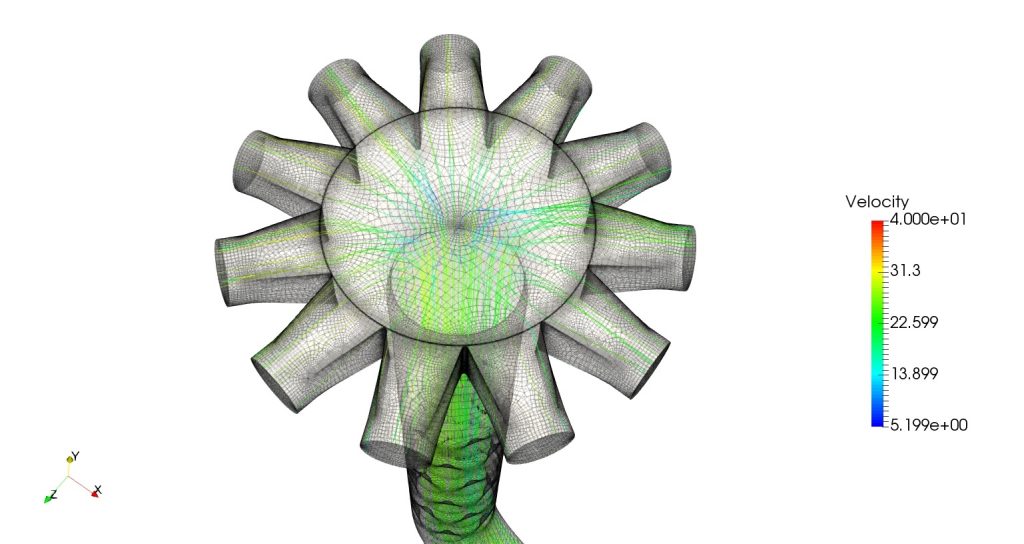
Envenio recently announced that its EXN/Aero end-to-end CFD solution is now hosted on the Google Cloud platform. This, they say, is a “cash flow friendly” way to access high-performance CFD resources on a pay-by-the-month basis. Subscriptions start at $250 a month for on-demand access and include 500GB of storage, technical support and training. Training doesn't look like it will require much if you're familiar with CFD systems.
Anyway, from your browser, you access EXN/Aero's solver and its meshing and post-processing tools. Meshing uses the Pointwise engine. It has automated meshing capabilities, and hybrid structured/unstructured mesh topology is supported. You can use your own post-processor if you prefer. EXN/Aero has an assortment of on-demand compute options, enabling you to scale your simulations on the fly.
The EXN/Aero solver has a slew of models you can work with starting with LES/DES, RANS and SST-RANS. You can do steady and unsteady turbulent flow calculations. It solves for compressible flows and buoyancy-driven flows as well as heat and conjugate transfers. Porous media, multiphase particle transport and passive scalar transport are some others. The EXN/Aero engine leverages NVIDIA GPUs (graphics processing units) and Intel CPU resources, so runs should be speedy.
Basically, how it works is that you feed EXN/Aero geometry or mesh files as input, set up your job and hit submit. Under the Platform tab on the Envenio website is one called User Manual that covers all this. Not gated. Interesting read. Aside: Under that Platform tab, CFD mavens will get into perusing another read called Theory Manual as well as working through the articles under the Use Cases and Validation tabs. Envenio did some excellent work on this material.
EXN/Aero sounds like good stuff. It could be the toolset or the horsepower extension you've been thinking about. You can set up a live demo to check EXN/Aero out for yourself. For now, hit today's link and start learning more.
Thanks, Pal. – Lockwood
Anthony J. Lockwood, Editor at Large, DE


Anthony J. Lockwood is Digital Engineering's founding editor. He is now retired. Contact him via [email protected].
Follow DE
Join over 90,000 engineering professionals who get fresh engineering news as soon as it is published.






About Us · Contact Us · Editorial Team · Advertising · Privacy Policy · Subscriber Services · © 2026 Digital Engineering 24/7 · Peerless Media