Helping design and engineering professionals discover, evaluate and specify technologies and processes that shorten the design cycle and enable success.


Sponsored
 Dear DE Reader:
 What PR flacks really meant when they began tagging notebooks as desktop replacements was that you could run office programs, surf the web, process email and play spider solitaire. CAD/CAM and related engineering applications? Not so much. And not any more. Today's Editor's Pick of the Week is Exhibit A.
Actually, it's a quadruple pick. MSI Computer recently announced four new mobile workstations of increasing power that, from the low- to high-end, are ready to go for CAD, CAM and most of the engineering toolset. Aside: MSI certifies its mobile workstations for applications from outfits like Autodesk, Siemens and SOLIDWORKS.
The quartet supports the new 7th Generation Intel Core i7 processors and professional-level NVIDIA GPU (graphics processing unit) acceleration. They run Windows 10 Pro, have ports galore for external devices and FHD (full high definition) displays with 1920x1080 resolution.
At the entry level is the new WE Series. You have two primary options here: a 15.6-in. or 17.3-in. display. They have a 4GB NVIDIA Quadro M2200 GPU. These are the mobiles to boost your CAD/CAM performance or to equip the new kid you just hired.
Next is the WS63. It sounds like a glam unit with muscles. Notable features include a 15.3-in. FHD display, 2.8GHz (3.8GHz with Turbo Boost) Intel Core i7 CPU and a high-end 6GB NVIDIA Quadro P3000 GPU. That P stands for Pascal, which is the name for NVIDIA's most advanced graphics architecture. Still, what's really fetching is that the WS63 tips the scales at a mere 3.96 lbs and folds to 0.69 in. thick. This is the one for the weary arms of road warriors.
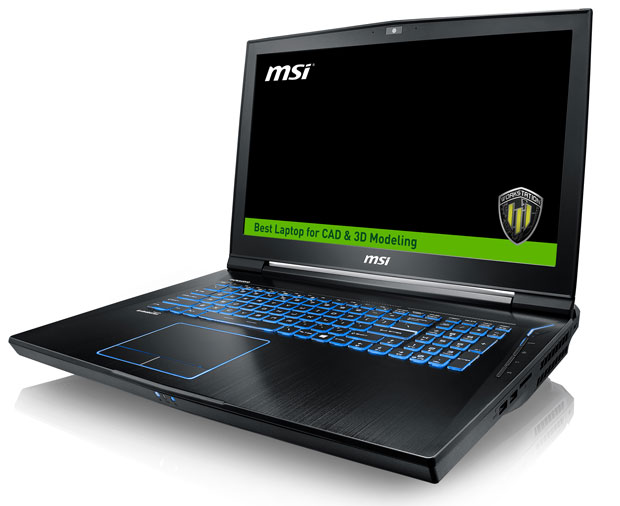
At the top is the WT73VR. VR as in virtual reality. This desktop replacement mobile workstation is slamming.
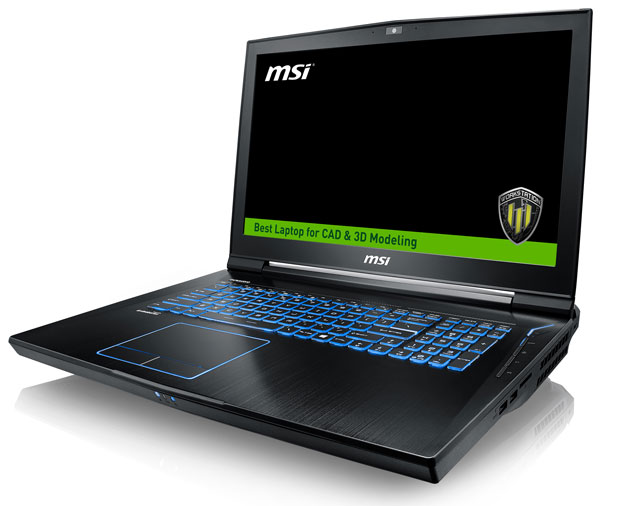 MSI's new WT73VR mobile workstation, a desktop workstation replacement, can handle demanding CAD, CAM and virtual reality applications. Image courtesy of MSI Computer Corp.
The WT73VR runs a 2.9GHz (3.9GHz with boost) Core i7 CPU, sports a very high-end 16GB NVIDIA PRO VR Ready Quadro P5000 GPU and provides 64GB of RAM. It handles 4K output and will run three external monitors. Storage capacities of up to 512GB SSD (solid-state drive) and up to 1TB hard-disk drive round off the basic specs. With this workstation, you should be able to drive your CAD/CAM applications, experience VR and create real-time design visualizations with aplomb.
That sounds like what desktop replacement for engineers should mean. You can learn more about MSI's new mobile workstation line-up from today's Editor's Pick of the Week write-up. Be sure to download spec sheets.
Thanks, Pal. -- Lockwood
Anthony J. Lockwood
Editor at Large, DE


Anthony J. Lockwood is Digital Engineering's founding editor. He is now retired. Contact him via [email protected].
Follow DE
Join over 90,000 engineering professionals who get fresh engineering news as soon as it is published.






About Us · Contact Us · Editorial Team · Advertising · Privacy Policy · Subscriber Services · © 2026 Digital Engineering 24/7 · Peerless Media