Helping design and engineering professionals discover, evaluate and specify technologies and processes that shorten the design cycle and enable success.


Alert!
Digital Engineering ceased publication on July 1, 2026. This website remains available as an archive of engineering content.
For inquiries or information, please email [email protected].
Sponsored

May 2026 Special Focus: Artificial Intelligence in Design and Simulation
In this Special Focus Issue, learn about the latest developments in the integration of artificial intelligence into engineering workflows.

Design & Simulation Software Guide 2025
In this Special Issue, Digital Engineering presents its second annual guide to design and simulation software vendors.
Dear DE Reader,
“Pain points” and “automation” are all too frequently used in the same sentence. If you are creating detailed data engineering data models, whether in CAD or simulation, the last thing you want is a pain point where information transfer hits a wall. In many companies, one of those walls lies waiting when sharing simulation results with design and release engineers. Analysts spend hours—often days—creating and updating simulation reports. Often the information shared is low fidelity—presentation slides or other static 2D views instead of actionable data models.
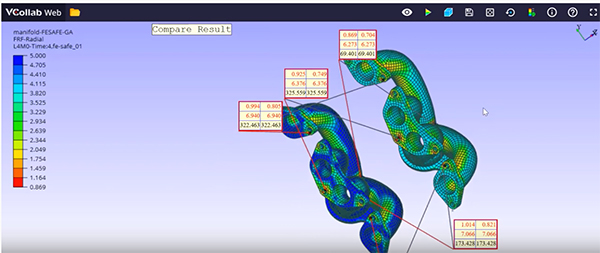
Visual Collaboration Technologies (VCollab) has a better idea. It has become a specialist in software for sharing high-fidelity 3D simulation results. VCollab V19 is out now, and its new features make it our Editor’s Pick of the Week.
VCollab is designed to overcome the organizational and performance challenges inherent in how simulation results are shared. When less than complete information is shared, engineers are either making poorly informed decisions, or taking time to retrieve the complete data set. VCollab merges information from multiple CAE and CAD sources into a single 3D file. The data is vendor-neutral and compact, making it easy to share.
New in VCollab V19 is an enhanced Python API, a powerful tool for intelligently extracting and processing simulation insights. Python is gaining in popularity as an easy-to-learn scripting tool for engineers who want as much control as possible over automation processes. The VCollab Python API makes quick work of creating high-fidelity reports that VCollabcalls Actionable Simulation Insights.
There are also many improvements to usability and performance, including what VCollab says is “significantly improved performance” for linear and Eigen animations. There is also a new option for increasing light on models, better performance when using HTML5 browsers and better performance for the VCollab WEB option.
There’s more to like, including more automation tools and new support for a variety of CAD and CAE products. Be sure to catch today’s Product Brief for details.
Thanks for reading, we’ll be back next week with another Editor’s Pick of the Week.
—The DE Editors


VCollab helps manufacturers realize the full benefits of simulation by making actionable, 3D simulation insights easily accessible to anyone in your organization or supply chain. With VCollab, simulation report generation is automated, reducing…
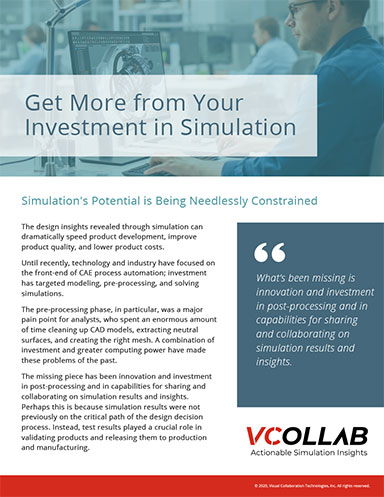
Get More from Your Investment in Simulation
Simulation's Potential is Being Needlessly Constrained.

DE's editors contribute news and new product announcements to Digital Engineering. Press releases may be sent to them via [email protected].
Follow DE
Join over 90,000 engineering professionals who get fresh engineering news as soon as it is published.






About Us · Contact Us · Editorial Team · Advertising · Privacy Policy · Subscriber Services · © 2026 Digital Engineering 24/7 · Peerless Media