Helping design and engineering professionals discover, evaluate and specify technologies and processes that shorten the design cycle and enable success.


Alert!
Digital Engineering ceased publication on July 1, 2026. This website remains available as an archive of engineering content.
For inquiries or information, please email [email protected].

Digital Engineering April 2026
In the latest issue of Digital Engineering, we take a look at the latest innovations in design for additive manufacturing, including the use of natural language inputs, social media cosplayers, and AI integration. The issue also includes a feature…

January Special Focus Issue: Design for Additive
In this Special Focus Issue of Digital Engineering, learn about the latest advancements in design for additive manufacturing, including new software tools, additive in automotive, custom medical devices, and more.
While the UAV engineering team doesn't hail from The Boeing Co., the aerospace giant is playing an active role in the development project. That's because the UAV team, made up of students from multiple university partners, is the first to participate in Boeing's AerosPACE (Aerospace Partners for the Advancement of Collaborative Engineering), a program designed to help the company educate the next generation work force and close a skills gap that threatens to undermine its future ability to compete.
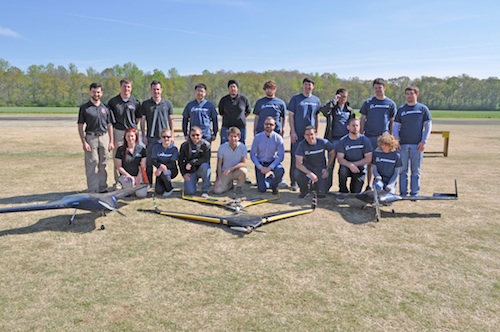
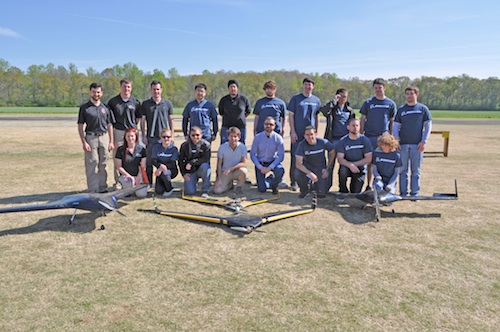 As part of the initial AerosPACE capstone project, three multi-university student teams built a UAV capable of monitoring farmland to improve crop yield. Image Courtesy of The Boeing Co.
"The pond is getting smaller and we're trying to figure out what we can do to build capacity here," says Michael Richey PhD., a cognitive scientist and associate technical fellow at Boeing, who is one of the key forces behind the AerosPACE program.
Boeing and other aerospace companies are facing a mass exodus as the number of employees hitting retirement age is projected to increase by 50% over the next five to six years. With AerosPACE, Boeing is enlisting key university partners like Georgia Institute of Technology, Brigham Young, Purdue, Tuskegee, and Embry-Riddle Aeronautical University, to create a capstone project that will help attract the best and brightest to the aerospace and defense sector while evolving the engineering curriculum to address key skills gaps, primarily in the area of system engineering.
"The system of systems is a big focus at Boeing and it's really important for our future workers," Richey explains. "With today's global business model of partners geographically dispersed and working together on whatever you are building, you have to understand how to optimize what you are working on within the context of where it fits within a system. That's a critical skill."
What is also critical to educating this new workforce, according to Richey, is real-world experiences — not just text book learning. As a result, AerosPACE is centered around "Epic Challenges," typically grounded in some sort of social context and acquainting team members with the realities of life in an engineering role, from dealing with project timelines, RFPs, and budgets to mastering modern-day design and collaboration tools, including CAD, simulation, and PLM software. Other industries such as automotive have similar industry-university partnerships, but this is the first of its scale in the aerospace sector, Richey says.
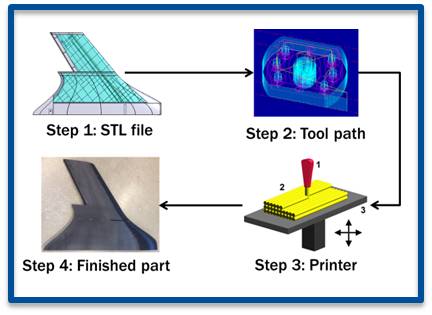 The AerosPACE team 3D printed the UAV structure in four sections reinforced with carbon fiber spars. Image Courtesy of The Boeing Co.
While the first year's program was centered on the design of a UAV, the latest AerosPACE program challenges students to create drones that can be launched into disaster areas to assist first responders with their relief efforts.
"We are anchoring a real-world social problem with a system engineering contextual model and allowing students to employ a distributed platform to collaborate," explains Richey, who says the AerosPACE challenges serve as a microcosm of Boeing. Siemens PLM Software's Teamcenter PLM platform is being leveraged as the central digital nervous system.
"This is exactly what we need our engineers to do when them come into The Boeing Co. and is no different than what we do with 170,000 people in different countries and with our partners," he says. "In a sense, it prepares them for the distributed, global, multi-design, optimization model by helping them discover what to learn, not by telling them what to learn."
Watch this video to hear Richey discuss the charter of the AerosPACE program.


Beth Stackpole is a contributing editor to Digital Engineering. Send e-mail about this article to [email protected].
Follow DE






About Us · Contact Us · Editorial Team · Advertising · Privacy Policy · Subscriber Services · © 2026 Digital Engineering 24/7 · Peerless Media