Digital Engineering 24/7

Helping design and engineering professionals discover, evaluate and specify technologies and processes that shorten the design cycle and enable success.


Alert!

Digital Engineering ceased publication on July 1, 2026. This website remains available as an archive of engineering content.

For inquiries or information, please email [email protected].
Engys Unveils New Version of Helyx Open-Source CFD

The new release also includes updates for all of HELYX's add-on solver modules, namely: Adjoint, Coupled, Marine and Hydro.

Engys Unveils New Version of Helyx Open-Source CFD
Source: Engys
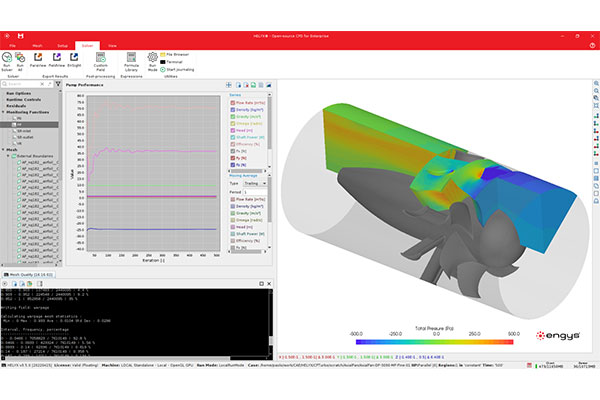
This is an open source general-purpose computational fluid dynamics (CFD) software solution for engineering design and optimization. Image courtesy of Engys.

By DE Editors  

May 9, 2022

ENGYS has released 3.5.0 of HELYX, a general-purpose computational fluid dynamics (CFD) software solution for engineering design and optimization based on ENGYS' open-source simulation engine (HELYX-Core). The new release also includes updates for all of HELYX's add-on solver modules, namely: Adjoint, Coupled, Marine and Hydro.

HELYX 3.5.0 offers a range of extended capabilities and code refinements to remove known issues found in the previous release 3.4.0. Some new features added in this version include:

  • Mesh: Enhanced performance and robustness for acute reflex snapping around sharp trailing edges.
  • Mesh: Improved near-wall layer addition, including new options to prescribe maximum layer thickness for the extrude mesh algorithm, cell splitting based on warpage criteria, and overall increased performance of single-step layer projection.
  • Mesh: Faster mesh optimisation turnaround times using relaxed settings and additional quality metrics and options for cell removal.
  • Mesh: New GUI visualisation tool to detect mesh leakage.
  • Mesh: New binary surface format for geometry entities for faster I/O performance and reduced file size.
  • Mesh: New GUI tool to export surface patches to faceted format.
  • Setup: New discrete mixing plane and cyclic periodic AMI boundary conditions for turbomachinery and other rotating-stationary sector models.
  • Setup: Extended turbo performance monitoring function to deal with sector models and additional output fields.
  • Setup: New time-varying mapped data temperature boundary condition.
  • Setup: Enhanced total pressure boundary condition for more accurate prediction of static head at the boundary.
  • Setup: New adaptive and y+ insensitive Knopp consistent rough wall function.
  • Setup: New generic monitoring function to calculate statistical quantities, including moving average, standard deviation, CoV, etc.
  • Setup: New Custom Field Calculator to create and output custom fields during or after runtime.
  • Setup: Added GUI support for new monitoring function that shows the percentage of the volume that is modelled with LES or RANS when using (I)(D)DES turbulence models.
  • View: New View modifier object to apply transformations to a selected object (i.e. mirror, translation, rotation, scale and linear/cylindrical array).
  • View: Enhanced Point Widget tool to inspect field values on selected points of mesh patches.
  • Other: Case re-load optimisation for selective loading of modified components only.

If not a user of HELYX already or if you would like to learn more about this new version, check out the HELYX product page to learn more.

Sources: Press materials received from the company and additional information gleaned from the company’s website.


From our Sponsors

Meltio Takes Metal Additive to the Next Level
Meltio's DED technology enables industries to tailor and customize their solutions to create & repair metal parts.
Easing the Transition from ETO to CTO with Configuration Lifecycle Management
Manufacturers are discovering that the Configure-to-Order (CTO) model provides significant benefits when it comes to customization.
Siemens + Altair = The Next Chapter in Design and Simulation
With its acquisition of Altair, Siemens creates a unified simulation portfolio combining generative design with high-performance computing and AI workflows.





