Helping design and engineering professionals discover, evaluate and specify technologies and processes that shorten the design cycle and enable success.


Alert!
Digital Engineering ceased publication on July 1, 2026. This website remains available as an archive of engineering content.
For inquiries or information, please email [email protected].

May 2026 Special Focus: Artificial Intelligence in Design and Simulation
In this Special Focus Issue, learn about the latest developments in the integration of artificial intelligence into engineering workflows.

April 2026 Special Focus Issue: Generative Design
In this Special Focus Issue, Digital Engineering takes a look at how generative design solutions can be used across different types of design problems and with a variety of manufacturing approaches to accelerate design space exploration, and…
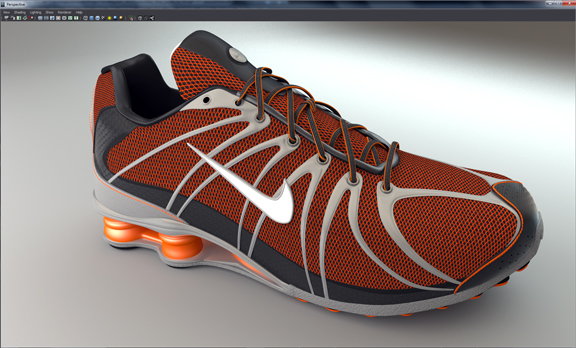
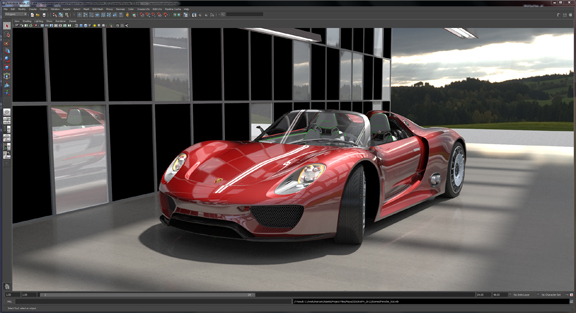
Alex Kelley, director of business development at Caustic Professional, a division of Imagination Technologies, has been waiting patiently to unleash its creation on the hardware market for quite some time. It's a processor, but neither a CPU nor a GPU. It's developed specifically for rendering. Kelley and his team call it RTU, or ray-tracing unit.
The story of the RTU began with a San Francisco start up, once called Caustic Graphics. The firm was eventually acquired by Imagination Technologies, an embedded processor developer, for $27 million. The RTU's evolution was shaped by, among others, Michael Kaplan, who previously worked on NVIDIA's professional rendering solutions. Kaplan currently oversees the RTU project as director of product management.
Last month, at Autodesk University, Kelley and his colleagues decided it was time for the RTU to make its debut. So they set up a booth and demonstrated the latest generation of their hardware, branded as Caustic Visualizer. The RTU works with the CPU to deliver optimized rendering power.
Kaplan clarified, "We're not trying to be a high-performance computing (HPC) system that happens to do ray tracing ... What [other CPU and GPU makers] are doing is to cram a lot of cores into a unit to do parallel computing. But that's not optimized for ray tracing."
It is, in Kaplan's view, inefficient because ray tracing doesn't need the volume of CPU-based general-purpose computing power provided by HPC systems. It's also more efficient than ray tracing on GPU because, Kaplan said, "We're doing as much ray tracing as multiple graphics cards, but our card takes 55 Watts -- It doesn't need a big power supply."
Currently, rendering by the RTU is made possible by a beta plug-in developed for Autodesk Maya. The plug-in would officially become available in mid-January 2013, and another plug-in for Autodesk 3ds Max is in now in development, targeted for March 2013.
Whereas Autodesk Maya is the standard for entertainment and media content, Autodesk's professional design and engineering software packages (Autodesk Inventor and AutoCAD, to name but two) are bundled with Autodesk 3ds Max in most Autodesk Suites.
It should be noted that the RTU is designed specifically to address ray tracing, a problem in high-resolution rendering. The RTU won't provide the same general purpose computing horsepower found in professional GPUs. Therefore, the RTU won't be suitable for those seeking HPC systems to run simulation and analysis programs.
According to Imagination Technologies' announcement, "Caustic Visualizer is built entirely on the Imagination PowerVR OpenRL platform. Through OpenRL’s highly optimized CPU implementation, Caustic Visualizer can deliver an interactive photorealistic viewport experience on a CPU-only desktop that was previously only possible in competitive solutions based on expensive quad-GPU hardware configurations ... When coupled with OpenRL running on the new PowerVR ray-tracing hardware reference platform, Caustic’s Visualizer software can deliver true full-frame (1,024 x 1,024) resolution imagery up to 15 photorealistic frames per second, without the need to de-res the image or add significant noise during interaction."
Currently Caustic Professional's RTUs are sold as separate hardware, which fits into standard workstations and desktop PCs. Kelley envisions that, in the long run, the RTU's technology will become part of the GPU.


Kenneth Wong is Digital Engineering's resident blogger and senior editor. Email him at [email protected] or share your thoughts or suggestions at digitaleng.news/facebook.
Follow DE






About Us · Contact Us · Editorial Team · Advertising · Privacy Policy · Subscriber Services · © 2026 Digital Engineering 24/7 · Peerless Media