Helping design and engineering professionals discover, evaluate and specify technologies and processes that shorten the design cycle and enable success.


Alert!
Digital Engineering ceased publication on July 1, 2026. This website remains available as an archive of engineering content.
For inquiries or information, please email [email protected].

Digital Engineering April 2026
In the latest issue of Digital Engineering, we take a look at the latest innovations in design for additive manufacturing, including the use of natural language inputs, social media cosplayers, and AI integration. The issue also includes a feature…

January Special Focus Issue: Design for Additive
In this Special Focus Issue of Digital Engineering, learn about the latest advancements in design for additive manufacturing, including new software tools, additive in automotive, custom medical devices, and more.
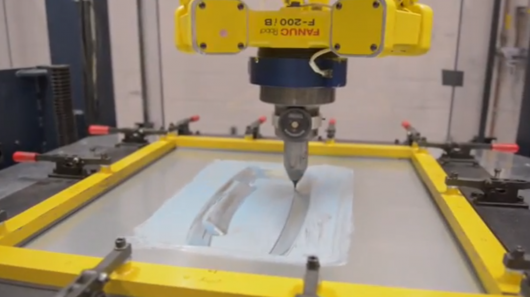
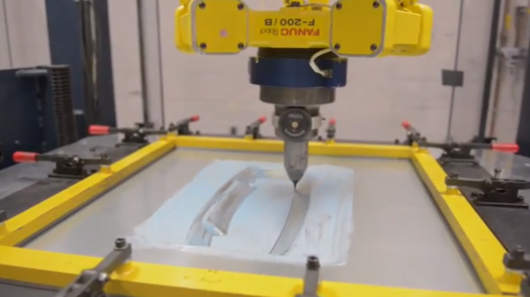
One company that seems to have a big interest in AM is Ford. The company has enthusiastically embraced the power of digital design and rapid prototyping, using off-the-shelf 3D printers. Now it seems that Ford wants a system specifically designed and built to offer the most manufacturing potential for the automotive market. The company is calling the new system Ford Freeform Fabrication Technology, or F3T. It's not AM, but it's not business as usual either.
With F3T, Ford is looking ahead to the day when 3D printing is firmly ensconced as part of the manufacturing process. Along with prototyping, Ford is investigating how it can use AM to build custom designs for its customers. At some point, instead of selecting the interior and paint color of a new car, customers may be able to select specific designs printed into the body of the car itself.
"The technology behind F3T is yet another example of Ford leading in the advanced manufacturing space," said John Fleming, executive vice president, global manufacturing and labor affairs. "As we forge ahead with cutting-edge technologies in manufacturing like flexible body shops, robotics, 3D printing, virtual reality and others, we want to push the envelope with new innovations like F3T to make ourselves more efficient and build even better products."
F3T begins with a piece of sheet metal clamped around its edges and formed into a 3D shape by two stylus-type tools working in unison on opposite sides of the sheet metal blank. Similar to a digital printer, after the CAD data of a part is received, computer-generated tool paths control the F3T machine to form the sheet metal part into its final shape to the required dimensional tolerances and surface finish.
Ford’s new process is part of a three year, $7.04 million deal with the US Department of Energy to develop next generation manufacturing processes. Other partners include Northwestern University, The Boeing Company, Massachusetts Institute of Technology and Penn State Erie. The goal is to improve competitiveness, and increase energy efficiency in advanced manufacturing techniques for US companies.
Below you’ll find a short video about F3T.
Source: Ford


John Newman is a Digital Engineering contributor who focuses on 3D printing. Contact him via [email protected] and read his posts on Rapid Ready Technology.
Follow DE






About Us · Contact Us · Editorial Team · Advertising · Privacy Policy · Subscriber Services · © 2026 Digital Engineering 24/7 · Peerless Media