Helping design and engineering professionals discover, evaluate and specify technologies and processes that shorten the design cycle and enable success.


Alert!
Digital Engineering ceased publication on July 1, 2026. This website remains available as an archive of engineering content.
For inquiries or information, please email [email protected].

Digital Engineering April 2026
In the latest issue of Digital Engineering, we take a look at the latest innovations in design for additive manufacturing, including the use of natural language inputs, social media cosplayers, and AI integration. The issue also includes a feature…

January Special Focus Issue: Design for Additive
In this Special Focus Issue of Digital Engineering, learn about the latest advancements in design for additive manufacturing, including new software tools, additive in automotive, custom medical devices, and more.
The devil is in the details. I find snippets, here and there, from companies that mention they’ve begun using AM, but not much in the way of specifics. Until recently, it almost seemed like 3D printing was something businesses were trying to keep behind closed doors. That is beginning to change, and for the better.
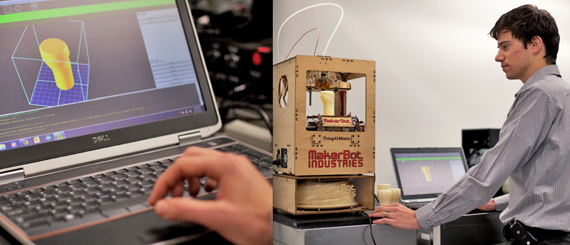
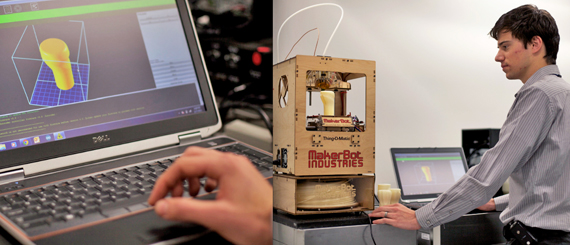
Ford has pulled back the curtain on some details of how it is using AM to speed up production in the design and prototype stages. Engineers in separate geographical locations can work on the same design, and, using AM, can see a physical prototype relatively quickly.
“We’ve been shifting from the tangible world to the computer world, and the reality is that a hybrid model works best,” says K. Venkatesh Prasad, senior technical leader, Open Innovation, and a member of Ford’s Technology Advisory Board, Research and Innovation. “There is nothing like having a tangible prototype, but it has always been time consuming and expensive to create.
Now, at the press of a button, you can have the product or component at your fingertips. With a model in one hand, you can then input your changes back into the computer model. The best decisions are made from the highest quality engineer and at the best pace. — K. Venkatesh Prasad
Ford says it made extensive use of AM when designing the 3.5-liter EcoBoost engine in its new Transit Van. The development of cast aluminum oil filtration adapters, exhaust manifolds, differential carrier, brake rotors, oil pan, differential case casting, and rear axles all benefited from AM. Engineers used selective laser sintering, stereolithography and 3D sand casting.
Sand casting, in particular, has been popular with Ford. The process allows the company to create patterns and cores more quickly (and at lower costs) than through traditional methods, which reduces time to market. So far, the Fusion Hybrid, Escape, Explorer, and F-150 have all had parts created from AM-based sand casting.
Below you’ll find a video of a Ford engineer working with a MakerBot Thing-O-Matic to produce parts prototypes.
Source: Ford


John Newman is a Digital Engineering contributor who focuses on 3D printing. Contact him via [email protected] and read his posts on Rapid Ready Technology.
Follow DE






About Us · Contact Us · Editorial Team · Advertising · Privacy Policy · Subscriber Services · © 2026 Digital Engineering 24/7 · Peerless Media