Helping design and engineering professionals discover, evaluate and specify technologies and processes that shorten the design cycle and enable success.



Digital Engineering April 2026
In the latest issue of Digital Engineering, we take a look at the latest innovations in design for additive manufacturing, including the use of natural language inputs, social media cosplayers, and AI integration. The issue also includes a feature…

January Special Focus Issue: Design for Additive
In this Special Focus Issue of Digital Engineering, learn about the latest advancements in design for additive manufacturing, including new software tools, additive in automotive, custom medical devices, and more.
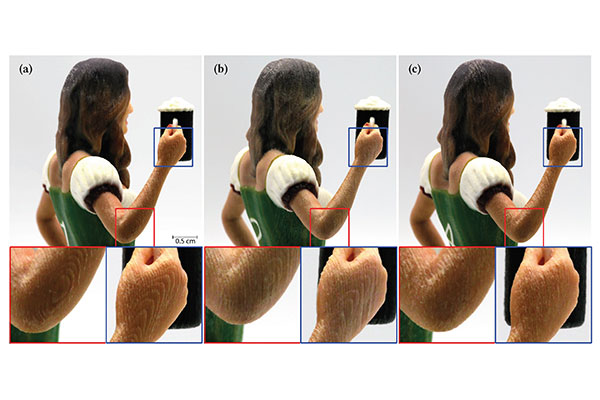
Scientists at Fraunhofer IGD have devised a geometric and algorithmic method for the elimination of stair-step artifacts in multimaterial 3D printing. To avoid quantization errors, the surface of the object is modulated with a high-frequency signal. This results in geometrically accurate and color-true surfaces.
The research team has put their findings in a paper—Shape Dithering for 3D Printing—which will be published to coincide with SIGGRAPH, a conference and exhibition on computer graphics and interactive techniques. Fraunhofer IGD will be at SIGGRAPH 2022, August 8-11, with a special Fraunhofer IGD presentation on August 9 at 10:45 a.m.
Stair-step artifacts are unavoidable in conventional 3D printing processes, according to Fraunhofer, which adds that artifacts are visually disturbing and can be structurally detrimental to the print. To generate more accurate surfaces, researchers at the Fraunhofer Institute for Computer Graphics Research IGD have developed a new process for polyjet printers. It minimizes quantization errors so that stair-step artifacts are no longer noticeable in actual printing and are at a level below the physical effects of the printing process. This results in objects with a smoother, more uniform surface.
To achieve the desired effect, the object's surface is modulated with a high-frequency signal, such as blue noise. This leads to a distribution of quantization errors to high frequencies, which are then removed by the function of the human eye and multiple printing processes. "The printing time remains the same, regardless of the process," says Alan Brunton, member of the three-author team. "The dithering process does not require additional computing time either."
The process is used, for example, in the entertainment industry. Figures and objects are printed for animated movies, video games and board games.
The dithering process can be used as an algorithmic method independently of the hardware, that is, with different polyjet 3D printers. The solution presented in the research paper is used with the Cuttlefish 3D printer driver developed by Fraunhofer IGD. Based on the results now published, in the future, scientists will investigate the further hypothesis of whether the smoother surface of the printed objects also makes them more resilient.
The paper—Shape Dithering for 3D Printing—has been accepted for presentation at SIGGRAPH 2022, a trade fair for computer graphics. The conference will be held as a hybrid event, virtually and in person in Vancouver, Canada. iMostafa Morsy Abdelkader Morsy, lead author of the paper, will be presenting it on behalf of the research team.
For more information, the paper and supplemental materials can be found here and here.
Sources: Press materials received from the company and additional information gleaned from the company’s website.


DE's editors contribute news and new product announcements to Digital Engineering. Press releases may be sent to them via [email protected].
Follow DE
Join over 90,000 engineering professionals who get fresh engineering news as soon as it is published.






About Us · Contact Us · Editorial Team · Advertising · Privacy Policy · Subscriber Services · © 2026 Digital Engineering 24/7 · Peerless Media