Helping design and engineering professionals discover, evaluate and specify technologies and processes that shorten the design cycle and enable success.


Alert!
Digital Engineering ceased publication on July 1, 2026. This website remains available as an archive of engineering content.
For inquiries or information, please email [email protected].

Digital Engineering April 2026
In the latest issue of Digital Engineering, we take a look at the latest innovations in design for additive manufacturing, including the use of natural language inputs, social media cosplayers, and AI integration. The issue also includes a feature…

January Special Focus Issue: Design for Additive
In this Special Focus Issue of Digital Engineering, learn about the latest advancements in design for additive manufacturing, including new software tools, additive in automotive, custom medical devices, and more.
The density determination of additively manufactured parts is neededl due to its impact on the structural integrity and performance of the components. Accurate density assessment enables manufacturers to ensure the quality and reliability of the parts. It also helps to identify defects, porosity, or voids within the material, which could compromise the strength and durability of the final product.
By measuring density, manufacturers can verify if the additive manufacturing (AM) process has been executed optimally, guaranteeing that the parts meet the desired specifications and adhere to industry standards. Precise density determination plays a role in quality control, enabling efficient detection and rectification of any issues, leading to enhanced product performance and safety.
Noting the importance of density, the Fraunhofer IAPT, Hamburg, Germany, commissioned an independent study of the various AM density determination technologies available, and found that the automated density determination from Dimensionics Density is particularly recommended in areas where a statement on the density has to be made quickly or frequently, and the company’s solution allows machine approvals to be simplified.
The Fraunhofer report, entitled “Analysis of measurement methods for density determination in additive manufacturing,” in addition to the Dimensionics Density technology, also reviewed the use of micrographs, computed tomography, and the manual Archimedes method.
Though all methods are capable of determining the relative density of AM parts and components, the Fraunhofer IAPT report found that there are substantial differences in accuracy, resolution, repeatability and the possibility of defect detection. Micrographs destroy the AM specimen, and while they can provide partial insight into the actual condition of pores in a part, the process is characterized by much manual work.
Computed tomography requires use of expert operators, and while it can provide a realistic 3D image of the internal porosity of a part, it is restricted in the pore size that it can detect, and the price of CT equipment can be expensive.
The Archimedes method, though easy to use, can be the least accurate as it can be negatively impacted by changing environmental conditions, the accuracy of the balance, as well as the precision of the experimental procedure. It is difficult to reproduce the results, influenced by human factors. Test specimens are never placed exactly the same on the balance, and the manual operation of the balances leads to measurement deviations.
“We are extremely encouraged that the Fraunhofer IAPT report recognized the advantages of the automated density determination process that we produce," says Philipp Pruesse, head of sales at Dimensionics Density. "Our process uses the Archimedes method mentioned above, but in combination with modern automation technology."
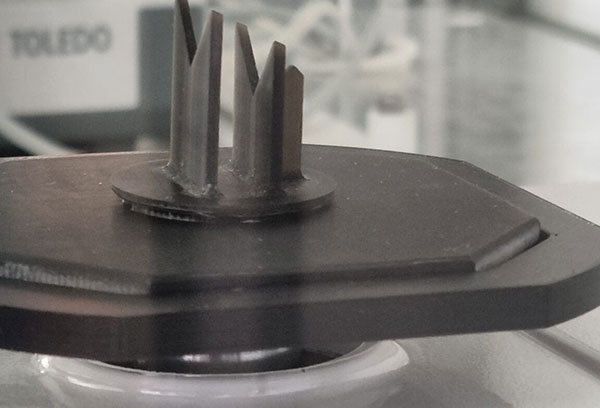
Pruesse explains that in the process, the samples to be measured are placed in a component carrier,provided with openings on the underside. These component carriers are transported through the system by an axis robot and lowered centrally and precisely onto the scales. On the scales, a lift-out rack with pins is placed, which lifts the component over the openings in the component carrier and thus lifts the component out of the carrier. The automated handling has the parts always placed identically onto the scales. The scales are designed to be insulated from vibration. All ambient conditions such as temperature, air pressure and water temperature, are recorded via climate sensors, and their influence on the measurement result is factored directly in the evaluation algorithm when determining the density.
The Fraunhofer IAPT benchmarking report states that Dimensionics Density’s automated density determination removes the user from the Archimedean measurement and has a higher repeatability and lower fluctuations. It states that this method is the only one that is traceable, so it can be referenced to a recognized standard via a measurement chain. Compared to micrographs and CT scans, the measurement time is shorter, making it easier to take multiple measurements for statistical confidence, and this makes this method suitable for evaluating the process capability of machines, according to Fraunhofer.
Establishing the process capability of machines is needed for the production of series components via AM. It is continuously determined by external influencing factors, such as temperature. These influencing factors are included and compensated for in the density calculation, which means that operation in environments without laboratory conditions is also possible.
Pruesse adds, “Dimensionic Density’s automated density determination solution is poised to revolutionize the analysis of component density, and we are delighted that the Fraunhofer IAPT report recognizes its importance in the critical area of AM production part / process validation. Its unparalleled accuracy and efficiency will help identify and mitigate porosity-related issues, bolstering the mechanical integrity, durability, and resistance of AM parts against external stressors and environmental challenges."
Sources: Press materials received from the company and additional information gleaned from the company’s website.


DE's editors contribute news and new product announcements to Digital Engineering. Press releases may be sent to them via [email protected].
Follow DE






About Us · Contact Us · Editorial Team · Advertising · Privacy Policy · Subscriber Services · © 2026 Digital Engineering 24/7 · Peerless Media