Helping design and engineering professionals discover, evaluate and specify technologies and processes that shorten the design cycle and enable success.


Alert!
Digital Engineering ceased publication on July 1, 2026. This website remains available as an archive of engineering content.
For inquiries or information, please email [email protected].

May 2026 Special Focus: Artificial Intelligence in Design and Simulation
In this Special Focus Issue, learn about the latest developments in the integration of artificial intelligence into engineering workflows.

April 2026 Special Focus Issue: Generative Design
In this Special Focus Issue, Digital Engineering takes a look at how generative design solutions can be used across different types of design problems and with a variety of manufacturing approaches to accelerate design space exploration, and…
Gibbs and Associates has announced GibbsCAM VoluMill Solids, a new option for the high-speed-machining (HSM) of solid models directly within GibbsCAM.
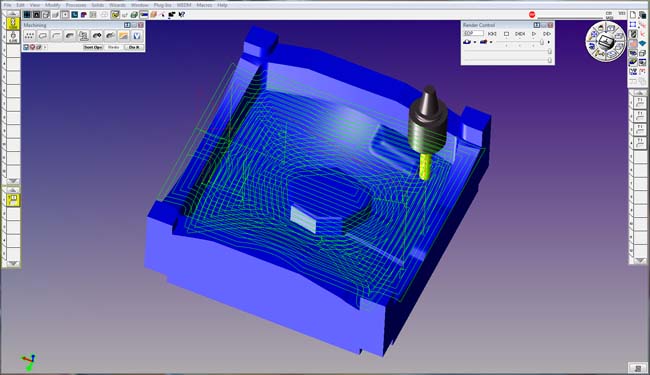 |
The VoluMill Solids option, an incremental enhancement to the GibbsCAM VoluMill Wireframe option, is integrated within GibbsCAM. As such, it allows GibbsCAM users to select solids, surfaces, and facet bodies to generate HSM toolpaths.
Typically, traditional roughing toolpaths are generated as parallel offsets (with sharp corners and transitions), which require stops, starts, and variable speeds for optimizing motion to reduce tool wear and excessive tool loading, according to the company. In contrast, VoluMill develops toolpaths optimized for volumetric material removal, based upon desirable material removal rates, by using continuous tangential motion, specialized contour ramping, and adaptive feed rates.
The GibbsCAM VoluMill Solids option provides users the ability to directly machine solid models, whether they are created in GibbsCAM, SolidWorks, Inventor, CATIA, Pro/ENGINEER Wildfire, Siemens NX, or many other CAD systems.
VoluMill Solids is available for GibbsCAM 2010 and subsequent releases.
For more information, visit GibbsCAM.
Sources: Press materials received from the company and additional information gleaned from the company's website.


DE's editors contribute news and new product announcements to Digital Engineering. Press releases may be sent to them via [email protected].
Follow DE






About Us · Contact Us · Editorial Team · Advertising · Privacy Policy · Subscriber Services · © 2026 Digital Engineering 24/7 · Peerless Media