Helping design and engineering professionals discover, evaluate and specify technologies and processes that shorten the design cycle and enable success.



Cut Retrieval-Augmented Generation (RAG) Hallucinations by 50%
Most teams hit the same wall with enterprise AI: LLMs that hallucinate, pipelines that don’t scale, and infrastructure that’s harder to design than the models themselves.

What Is Intelligent BOM Management? A Guide to Smarter Product Development
Learn how intelligent Bill of Materials (BOM) management helps teams collaborate, reduce errors, and bring innovative products to market faster with cloud-based PLM tools.
One of the key stories behind the continued expansion of simulation software has been the adoption of GPU acceleration for simulation solvers (as well as in other types of CAE and CAD applications). GPUs offer between a 5x to 20x speedup compared to CPU compute, along with using less power, generating less heat, and lowering the cost of simulation operations.
GPUs will have a CAGR of 1.5% through 2029 and reach an installed base of nearly 3 billion units at the end of the forecast period, according to Jon Peddie Research. Over the next 5 years, the penetration of discrete GPUs (dGPU) in the PC will be 25%. Other forecasts put the global GPU market at nearly $80 billion in 2025, reaching $549.3 billion by 2033 (with a CAGR of 27.32%).
Meanwhile, improved simulation software performance is helping accelerate the adoption of CAE solutions, with Cambashi estimating the total CAE software market at $11.6 billion in 2025.
According to an ebook published by JPR and NVIDIA, GPUs have sparked a major transition in CAE.
“The major jobs of CAE are massively parallel processes. CAE evaluates a model by creating a mesh of nodes on the model and then applies forces and conditions to the nodes to evaluate suitability of the design for its use. The denser the mesh, the more reliable the simulation. That’s an obvious application for GPUs, and software vendors and hardware developers have recognized that early in the history of GPUs. Simulation approaches designed to run on CPUs have had to make allowances for the CPU’s capabilities. They’ve had to reduce the size of the model, simplify the design, and manage the mesh size, and as a result, evaluate an entity that might be substantially different than the real thing being analyzed. GPUs have the advantage of having many more processing units on one chip than CPUs.”
Since 2014, all of the major CAE software vendors have added GPU acceleration either directly in their solvers, or via their rendering and visualization operations. That uptake has not been easy; many of these vendors had to significantly re-architect their software to transition from CPU to the GPU.
So while some engineering solvers have been built to offload core numerical computations to the GPUs to increase speed, not every solution has done so for every solver.
The increased availability of advanced GPUs from NVIDIA (which owns more than 90% of the market) and AMD in workstations has also expanded GPU support, along with GPU compute in HPC appliances and in cloud-based services. In the case of cloud, users can ramp up access to hundreds of GPUs simultaneously for large, complex problems.
According to Rescale, there are three key elements when looking for GPUs that support CAE. The GPUs must support double precision FP64; they need high memory and bandwidth (at least 24G of memory and bandwidth in excess of 600 GB/s); and CUDA support, as most CAE software relies on NVIDIA’s CUDA for GPU acceleration.
Ansys, Dassault Systèmes, Siemens, Cadence, Hexagon and other vendors have gradually expanded GPU support in their simulation products. In November, COMSOL became the latest simulation software vendor to fully embrace GPU acceleration across its product suite with the expansion of GPU support in its COMSOL Multiphysics 6.4 software. Previously, GPU acceleration had only been available in a few workflows. Thanks to the NVIDIA cuDSS (Cuda Direct Sparse Solver), the company has improved the performance of its multiphysics simulations.
According to Bjorn Sjodin, vice president of product management at COMSOL, users can expect up to 5x speed improvements compared to CPU-based solvers. GPU support also extends to COMSOL Application Builder apps.
“NVIDIA has released a solver (NVIDIA cuDSS) that they have developed for GPUs that is a matrix algebra solver, which is exactly what we need for our multiphysics simulations in COMSOL,” he says. “The nice thing for us then is that these types of solvers they have added can be used for any type of physics. We have seen benchmarks where it performs up to 5X faster than our current CPU-based solvers.”
NVIDIA has been a key partner in the simulation space for a number of vendors. Ansys, for example, integrated the cuDSS library in its HFSS electromagnetics solver.
Siemens recently announced an expanded partnership with NVIDIA that will complete GPU acceleration across its entire simulation portfolio and expand support for NVIDIA CUDA-X libraries and AI physics models. The companies plan to advance toward generative simulation by using NVIDIA PhysicsNeMo and open models to provide autonomous digital twins that deliver real-time engineering design and autonomous optimization.
Synopsys also announced it would integrate the strengths of NVIDIA’s AI and accelerated computing with its own engineering solutions to “deliver capabilities enabling R&D teams to design, simulate and verify intelligent products with greater precision, speed and at lower cost,” according to a press release.
“As AI expands into the physical world, the engineering complexity of designing such systems is massive, because you are dealing with multiple engineering domains that need to come together at the systems level,” said Sassine Ghazi, president and CEO of Synopsys, during a press conference. “That cannot happen in a tactical way without accelerating at the stack.”
AMD has also established partnerships with Ansys, Autodesk, Maya HTT, Dassault SOLIDWORKS, and others, and several of the CAE vendors either support both NVIDIA and AMD GPUs, or plan to do so in the future. Intel has also entered the discrete GPU market, but has not yet made a significant dent in the market.
Altair (now part of Siemens) recently unveiled new GPU benchmarks measuring the performance of Altair One on Microsoft Azure using multiple GPUs. The benchmarks focus on the performance benefits of scaling ultraFluidX from a single GPU to an eight-GPU configuration on Azure ND v5 VMs. The company saw runtimes reduced by 5x to 6x across Altair CFD and Altair EDEM test cases by moving to multiple GPUs.
According to Altair: “Highly granular EDEM particle simulations achieved a relative speedup of up to 5.31x across eight H200 GPUs, compressing simulation runtimes from hours to minutes.”
In the JPR ebook, the company noted that Ansys has estimated that four GPUs “can outperform over a thousand CPU cores for certain CAE applications, at 16% of the cost and with one-fourth less power consumption.”
As new and more powerful GPUs are announced for both desktop and data center applications, improvements to CAE performance are only going to continue.
According to JPR, “the GPU’s role in off-loading the CPU in these resource-hungry applications like simulation ensures the entire system is more efficient. For all these reasons, GPU acceleration, once a nice-to-have component for design and engineering, is becoming a linchpin for companies interested in advancing their practices. The CAD industry is changing rapidly as the idea of digital twins captures the imagination of the industry. We expect to see the technology improvements enable faster, cheaper iterations on the desktop and more sophisticated analysis (and bigger geometries) taking advantage of powerful HPC appliances.”

Jon Peddie Research (JPR) is a technically oriented computer graphics marketing and management-consulting firm based in Tiburon, CA. We provide specialized services to senior and middle management in computer companies and companies that are major…
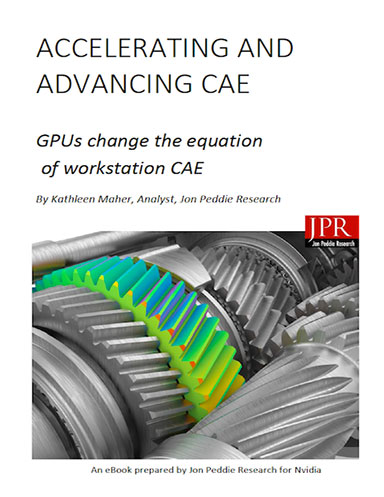
Accelerating and Advancing CAE
GPUs are changing the nature of engineering simulation, according to a new ebook from Jon Peddie Research (JPR). It explains how GPU acceleration is improving CAE workflows.

Brian Albright is the editorial director of Digital Engineering.
Contact him at [email protected].

Join over 90,000 engineering professionals who get fresh engineering news as soon as it is published.






About Us · Contact Us · Editorial Team · Advertising · Privacy Policy · Subscriber Services · © 2026 Digital Engineering 24/7 · Peerless Media