Helping design and engineering professionals discover, evaluate and specify technologies and processes that shorten the design cycle and enable success.


Sponsored

Digital Engineering April 2026
In the latest issue of Digital Engineering, we take a look at the latest innovations in design for additive manufacturing, including the use of natural language inputs, social media cosplayers, and AI integration. The issue also includes a feature…

January Special Focus Issue: Design for Additive
In this Special Focus Issue of Digital Engineering, learn about the latest advancements in design for additive manufacturing, including new software tools, additive in automotive, custom medical devices, and more.
 3D scanners have long been used by large players in industries like aerospace, defense and automotive, but their large, fixed footprints have limited their uses and kept the technology out of reach for small- and mid-sized companies.
The introduction of new handheld 3D scanners is challenging the limited use case scenario, opening up the technology and helping to transform several key engineering processes for mainstream companies. Handheld 3D scanners can deliver benefits for a variety of core design tasks, including reverse engineering and quality control, while having broad applicability for industrial applications as well as for the manufacture of orthopedics and prosthetics. Given their smaller and mobile footprint, they can also be used alongside tablet devices to do scanning work in the field.
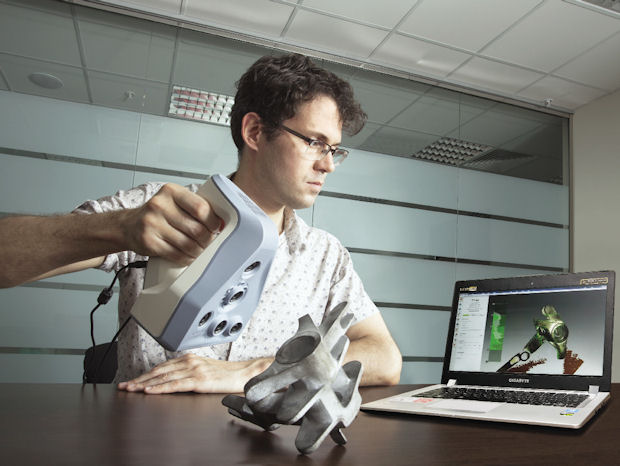
Consider the role of a handheld 3D scanner in the reverse engineering process, for example. In the automotive sector, companies create physical models in styrofoam or clay, which are then recreated in 3D CAD software -- a time-consuming effort that requires a fair degree of 3D modeling expertise. Deploying a handheld unit to capture a quick 3D scan of a prototype can jumpstart this process, redirecting the time and energy devoted to recreating models in CAD to the actual iterative design work. Handheld 3D scanners are also being tapped to recreate documentation and in some cases, finished parts, for retired systems -- a scenario made much more difficult with stationary 3D scanning technology.
Leveraging handheld 3D scanners in quality control applications can have similar advantages. Here, handheld 3D scanners can be put to work directly on the shop floor to compare production goods with their 3D CAD model counterparts, helping to eliminate manufacturing errors and automating the process of detecting measurement deformations. In another quality control example, handheld 3D scanners can be used to scan industrial objects in the field, analyzing the results of changes over time and harnessing that data to correct degradation problems in subsequent designs.
At the forefront of advancing handheld 3D scanning technology into such mainstream applications is Artec, a leader in 3D scanning technology. Through its unique software approach and proprietary algorithms, Artec is able to deliver a line of handheld, high-precision 3D scanners that are cost effective for smaller companies.
The company’s Spider and Eva models deliver high resolution, high accuracy scanning of objects, making them a fit for a wide range of industrial applications. Spider, which offers a more limited field of view compared to its Eva counterpart, is best suited for mass production and rapid prototyping applications that require higher-precision scanning (0.05 millimeter point accuracy) of objects with sharp edges and intricate details. In comparison, the Eva 3D scanner trades slightly less precision (its 3D point accuracy is 0.1 millimeter) for a wider field of vision, making it ideally suited for shop floor applications or quick-turn rapid prototypes.
As Artec and others continue to push the envelope on price/performance, handheld 3D scanning is poised to become an integral part of mainstream engineering practices -- not just a competitive edge for the big guys. To find out more about Artec’s line of high-precision, affordable handheld 3D scanners, go to www.artec3d.com/scanners.


DE's editors contribute news and new product announcements to Digital Engineering. Press releases may be sent to them via [email protected].
Follow DE
Join over 90,000 engineering professionals who get fresh engineering news as soon as it is published.






About Us · Contact Us · Editorial Team · Advertising · Privacy Policy · Subscriber Services · © 2026 Digital Engineering 24/7 · Peerless Media