Helping design and engineering professionals discover, evaluate and specify technologies and processes that shorten the design cycle and enable success.



Digital Engineering April 2026
In the latest issue of Digital Engineering, we take a look at the latest innovations in design for additive manufacturing, including the use of natural language inputs, social media cosplayers, and AI integration. The issue also includes a feature…

January Special Focus Issue: Design for Additive
In this Special Focus Issue of Digital Engineering, learn about the latest advancements in design for additive manufacturing, including new software tools, additive in automotive, custom medical devices, and more.
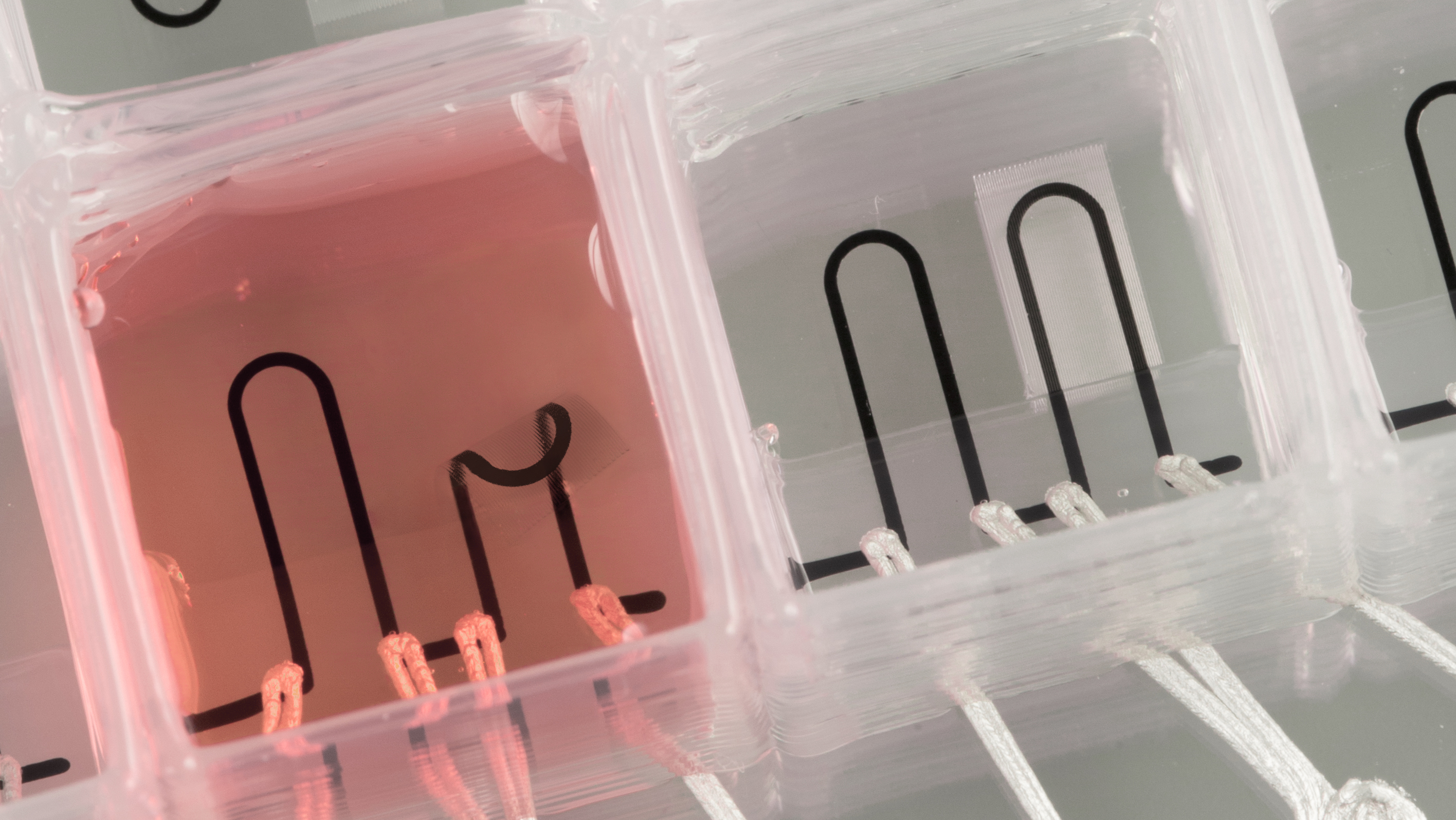
 The heart-on-a-chip is entirely 3D printed with built-in sensors that measure the contractile strength of the tissue, providing scientists with new possibilities studying the musculature of the heart. Image: Harvard University
The team developed six inks that integrate soft strain sensors. The materials were printed into a cardiac microphysiological device with integrated sensors in a single procedure.
According to Harvard, this manufacturing approach “may one day allow researchers to rapidly design organs-on-chips, also known as microphysiological systems, that match the properties of a specific disease or even an individual patient’s cells.”
These digital organs can mimic the function of actual tissue and can be used as an alternative to animal testing. Researchers have also developed microphysiological systems that mimic the function of lungs hearts, tongues, and intestines. Traditionally, they have to be built in clean rooms using multi-step lithographic processes. Data collection entail the use of microscopy and/or high-seed cameras.
“We are pushing the boundaries of three-dimensional printing by developing and integrating multiple functional materials within printed devices,” said Jennifer Lewis, Hansjorg Wyss Professor of Biologically Inspired Engineering, and coauthor of the study. “This study is a powerful demonstration of how our platform can be used to create fully functional, instrumented chips for drug screening and disease modeling.”
By using digital manufacturing and 3D printing, the researchers were able to automate the fabrication process and increase the complexity of the devices. Data collection is also easier.
“This new programmable approach to building organs-on-chips not only allows us to easily change and customize the design of the system but also drastically simplifies data acquisition,” said Johan Ulrik Lind, first author of the paper and postdoctoral fellow at the Harvard John A. Paulson School of Engineering and Applied Sciences.
The research was published in Nature Materials.
Source: Harvard


Brian Albright is the editorial director of Digital Engineering.
Contact him at [email protected].

Join over 90,000 engineering professionals who get fresh engineering news as soon as it is published.






About Us · Contact Us · Editorial Team · Advertising · Privacy Policy · Subscriber Services · © 2026 Digital Engineering 24/7 · Peerless Media