Helping design and engineering professionals discover, evaluate and specify technologies and processes that shorten the design cycle and enable success.



Digital Engineering April 2026
In the latest issue of Digital Engineering, we take a look at the latest innovations in design for additive manufacturing, including the use of natural language inputs, social media cosplayers, and AI integration. The issue also includes a feature…

January Special Focus Issue: Design for Additive
In this Special Focus Issue of Digital Engineering, learn about the latest advancements in design for additive manufacturing, including new software tools, additive in automotive, custom medical devices, and more.
As additive manufacturing (AM) continues to mature, it may be wise to view it as more than just a substitute for various other established manufacturing methods, such as injection molding or CNC machining. It can be a trusted tool in the toolbox that becomes even more valuable when combined with other technologies as part of what some call a hybrid manufacturing plan.
Experts in the industry weigh in on how the so-called hybrid manufacturing approach can positively impact production strategies now and in the future, and whether there’s a need to even view it as “hybrid” manufacturing or just simply matured industrial manufacturing.
DE: How does your company use or view additive manufacturing as part of a hybrid manufacturing process?
Eric Utley, Protolabs 3D Printing Applications Engineering Manager: For us, combining additive and subtractive manufacturing on a single component is very common. The part will be printed to ~95% near net shape and we will use secondary machining for the critical features. These are typically features and surfaces that need either a tighter tolerance or a smoother finish as-printed, or both.
Gert Brabants, Business Line Manager Series Manufacturing, Materialise Manufacturing: AM is not merely a replacement, because it has its own unique benefits, such as complex designs, small-batch production, fast cycle times, etc. AM excels at complex geometries, lightweight structures, custom parts, or small-batch runs; while subtractive or traditional methods may be better for simple, high-volume parts. If you don’t make use of these benefits, you’re indeed just doing a straightforward replacement of traditional manufacturing. And your business case will (almost) always fail.
The real value of hybrid manufacturing lies in combining the strengths of both approaches. AM offers efficiencies in terms of material use and enabling complex geometries compared to traditional machining. Traditional methods like CNC machining can then deliver the precision where it’s needed. When you combine these strengths in one product, the result is greater than the sum of its parts.
Take jet engines, for example, where complex design optimizations are essential. Or consider drainage parts or air ducting, where we can replace aluminum by polymer, for weight saving, cost savings, and part integration. In semiconductor manufacturing, weight saving and complex geometries are equally critical.
Andre Wagner, CEO, Authentise: At Authentise, we see hybrid manufacturing as starting well before anything is printed.
The DFAM [design for additive manufacturing] and engineering steps such as support strategy, orientation, nesting, and toolpath generation are not ‘prep work.’ They are first-class steps in the manufacturing flow and just as critical as printing, machining, or finishing. Treating them separately is one of the reasons hybrid environments break down.
Our digital thread is designed to enable end-to-end, in-process control across both digital and physical steps. That includes using real manufacturing data to influence downstream operations. For example, in a project with Holdson, printer sensor data is used to dynamically adjust parameters for a post-processing surface-finishing step. The goal is a single, connected workflow rather than isolated optimizations.
In that sense, additive manufacturing is not a discrete stage but part of a continuous, adaptive process that spans design intent, execution, and post-processing.
DE: What tools does your company view as most successful when used in combination as part of a hybrid manufacturing process?
Brabants, Materialise: We’ve seen the greatest success when additive manufacturing is paired with precision CNC machining and thorough inspection processes. For example, we’ll produce complex, lightweight structures via metal AM, then use CNC milling to finish critical interfaces. NDT [nondestructive testing] tools, such as CT [computed tomography] scanning, help verify internal integrity before assembly. This hybrid workflow ensures we get the design freedom of AM while maintaining the repeatability and precision that traditional methods are known for.
Within our own company, we have access to traditional manufacturing capabilities alongside our AM operations, which allows us to manage this hybrid workflow end to end. But the most powerful tools are still related to design optimization and simulation. They are what unlock the full potential of combining these manufacturing methods in the first place.
Wagner, Authentise: The most successful hybrid environments combine three layers:
1. Design and intent capture: CAD and simulation tools that explicitly define which features are additively produced and which are finished conventionally; and early visibility into downstream constraints like machining access, inspection requirements, and certification.
2. Manufacturing execution and orchestration: MES-style workflow tools that coordinate AM builds, post-processing, machining, inspection, and rework as a single process, not disconnected steps; and scheduling and routing that can adapt as real data comes back from machines.
3. Data, traceability, and feedback: Unified digital thread across AM and non-AM steps, including material history, environmental data, machine parameters, and inspection results; and closed-loop feedback so lessons from machining or inspection inform future designs and build strategies.
The key is not any single tool, but how well data flows between them without manual rework.
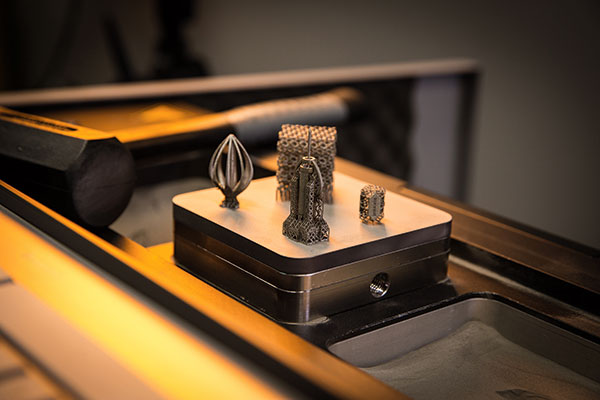
Protolabs combines additive and subtractive manufacturing, using secondary machining for critical features. Image courtesy: Protolabs
Utley, Protolabs: Most common is combining additive and subtractive manufacturing, particularly with metal components. Less common is combining injection molding with additive or CNC machining, such as overmolding over a 3D printed substrate or custom CNC machined substrate.
DE: What are the impacts of hybrid manufacturing on product design?
Wagner, Authentise: Hybrid manufacturing fundamentally changes how design intent should be expressed.
Today, CAD models tend to lock a part into a specific machine type, material, and process path. That rigidity works against hybrid environments, where flexibility across machines, materials, and processes is exactly where the value lies. As new equipment and processes emerge, those locked designs become a bottleneck to adoption.
We believe hybrid manufacturing works best when generative design algorithms are directly connected to intent rather than fixed geometry. Instead of designing for one process, engineers define functional requirements, constraints, and priorities, and allow the manufacturing system to resolve the optimal combination of additive and conventional steps.
The impact is designs that are more future-proof, easier to adapt to new machines or materials, and better aligned with real manufacturing capabilities as they evolve, rather than freezing decisions too early.
Utley, Protolabs: Hybrid manufactured parts are typically high-value parts, and the hybrid manufacturing is done because it is required or adds a lot of value. Otherwise it is cheaper to keep to a single manufacturing process. It is very common for aerospace components. Using additive, the part can be made with minimal material to keep weight down, but then secondary machined to get the necessary tolerances and surface finish for assembly. Typically a good rule of thumb is where the part touches other parts in the assembly is where secondary machining will be performed. Without hybrid manufacturing, these components would typically be heavier and made of several machined or cast components that are welded together.
Brabants, Materialise: Hybrid manufacturing changes how we design products by expanding what’s possible geometrically while maintaining the precision and scalability of traditional methods.
Designers now work with dual constraints: optimizing the portion of the product for additive to leverage complexity and part consolidation, while ensuring conventionally produced features are machinable and meet tight tolerances. We see greater functional integration and smarter tolerance strategies.
Take automotive heat exchangers as an example: AM enables highly intricate internal channel geometries that would be impossible to produce through casting or machining alone, while traditional finishing ensures the mating surfaces meet the precision required for assembly and sealing.
DE: How can hybrid manufacturing advance engineering workflows going forward?
Utley, Protolabs: Hybrid manufacturing should be considered where complexity brings value to a component and precision is required for key features. It is not a great fit for low-value or simple components that can likely be manufactured more cost effectively via a single manufacturing process. It can enable the consolidation of assemblies by printing the main mass and using secondary machining to improve tolerances where it hooks up to the rest of the assembly.
Brabants, Materialise: It’s worth challenging the term ‘hybrid manufacturing’ itself. From an engineering workflow perspective, adding an AM step to a production process is no different from adding any other manufacturing step. If you do metal casting followed by CNC machining, nobody calls it hybrid. It’s simply manufacturing. The same should apply when an AM step is part of the flow. Calling it ‘hybrid’ creates an artificial separation that can hold us back from treating AM as what it truly is: another mature, industrial manufacturing method.
We’ve seen this kind of language evolution before in our industry. Rapid prototyping became prototyping, 3D printing became additive manufacturing, and now industrial manufacturing. The shift from prototyping to production is a sign of maturity. The next step is to drop the hybrid label entirely and simply integrate AM into the broader manufacturing ecosystem.
What will truly advance manufacturing is not redefining how we label these processes, but building integrated management platforms that take the complexity out of coordinating different manufacturing methods and post-processing services. When AM workflows can seamlessly plug into existing production systems, tapping into the same planning, quality, and logistics infrastructure, the distinction between additive and traditional becomes irrelevant. That ecosystem integration is where the real progress lies.
Wagner, Authentise: Hybrid manufacturing enables workflows that are more adaptive, data-driven, and resilient.
Looking forward, we see:
Longer term, hybrid manufacturing is a foundation for agent-assisted and autonomous engineering workflows, where decisions about process selection, routing, and trade-offs are increasingly informed by real operational data rather than assumptions.
In sharing some closing thoughts, Brabants of Materialise adds: “The industry is maturing, and our perspective is that the sooner we stop treating additive manufacturing as something separate or special, the sooner we unlock its full industrial potential. It’s not about additive versus traditional but about choosing the right manufacturing method for each part of the product, managing it all within one connected ecosystem, and delivering the best result for the customer.”


Proto Labs is the world's fastest source for custom prototype and low-volume parts. Our 3D printing, CNC machining and injection molding services utilize proprietary computing technology and automated systems to produce quality parts in a…
Designing for Automotive/Transportation
The automotive industry is past the point of talking about the disruption coming from demand for electric vehicle powertrains or the potential of autonomous vehicles, and well on its way to responding to those disruptions thanks to advanced engineering technologies. Download this special digital edition.

Stephanie is the Associate Editor of Digital Engineering.
Follow DE
Join over 90,000 engineering professionals who get fresh engineering news as soon as it is published.






About Us · Contact Us · Editorial Team · Advertising · Privacy Policy · Subscriber Services · © 2026 Digital Engineering 24/7 · Peerless Media