Helping design and engineering professionals discover, evaluate and specify technologies and processes that shorten the design cycle and enable success.


Alert!
Digital Engineering ceased publication on July 1, 2026. This website remains available as an archive of engineering content.
For inquiries or information, please email [email protected].

May 2026 Special Focus: Artificial Intelligence in Design and Simulation
In this Special Focus Issue, learn about the latest developments in the integration of artificial intelligence into engineering workflows.

Design & Simulation Software Guide 2025
In this Special Issue, Digital Engineering presents its second annual guide to design and simulation software vendors.
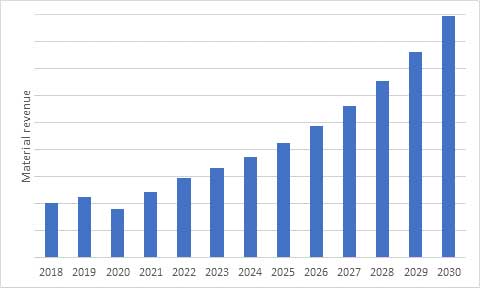
3D printing offers a means to improve current manufacturing limits across economic sectors such as transport, construction, and medical and dental industries allowing rapid prototyping and on-site production and repairs, according to IDTechEx. Progress in 3D printer development has led to faster, larger and more accurate printers, but these require more functional materials, IDTechEx adds. The company has released a new report, "3D Printed Materials Market 2020-2030: COVID Edition."
3D printing use in the medical industry is restricted by the lack of biocompatible and biodegradable materials suitable for the 3D printing of medical devices with silicone-like mechanical properties. Korean researchers have recently 3D printed a more affordable and customizable artificial testicle for patients in need of a testis transplant. The researchers’ novel silicone artificial testicle can be 3D printed to match specific patient anatomies, making them more comfortable and lifelike. With the aim of producing 3D printing materials that are biocompatible and non-toxic, researchers in Australia have developed a ceramic-based ink for 3D-printing bone parts complete with living cells that could be used to repair damaged bone tissue.
US Navy has partnered with Xerox to focus on advancing additive manufacturing research that has the potential to dramatically transform the way the military supplies its forces using the Xerox ElemX Liquid Metal Printer.
“Global supply chains leave industries like aerospace, automotive, heavy equipment, and oil and gas vulnerable to external risks,” says Tali Rosman, vice president and general manager, 3D Printing, Xerox. “Our goal is to integrate localized 3D printing into their operations, and the real-time feedback from NPS gives us actionable data to continuously improve the ElemX.”
Researchers in the US have discovered they can influence and increase the electrical performance of composites infused with graphene nano-platelets in a study that could change the way materials are designed and manufactured.
“The combination of epoxy resins and graphene nano-platelets is of interest in several applications for the Air Force, such as thermal interface materials, heat sinks, and electromagnetic shielding materials,” according to Subramanian Ramakrishnan, a professor at FAMU-FSU College of Engineering.
Growing global trends toward using sustainable materials and manufacturing processes lead to challenges and opportunities. There is progress toward a sustainable building material to 3D print houses made from local on-site soil, using a 3D printer to create a load-bearing structure. In New Zealand, a 3D printed replica of a 230-year-old Hawaiian outrigger (canoe) is in progress, using shavings and wood chips to mix a polymer paste that is being adapted for use in a large robotic printer.
3D printing produces parts layer-by-layer by melting and fusing powder materials allowing the manufacture of complex geometry and reduced manufacturing time and material waste. Manufacturers see value in improved materials that are reliable and cost-effective.
For a detailed, post-COVID-19 analysis of the 3D printed materials market, please see the IDTechEx report “3D Printed Materials Market 2020-2030: COVID Edition,” or for the full portfolio of 3D printing research available from IDTechEx, please visit www.IDTechEx.com/Research/3D.
Sources: Press materials received from the company and additional information gleaned from the company’s website.


DE's editors contribute news and new product announcements to Digital Engineering. Press releases may be sent to them via [email protected].
Follow DE
Join over 90,000 engineering professionals who get fresh engineering news as soon as it is published.






About Us · Contact Us · Editorial Team · Advertising · Privacy Policy · Subscriber Services · © 2026 Digital Engineering 24/7 · Peerless Media