Helping design and engineering professionals discover, evaluate and specify technologies and processes that shorten the design cycle and enable success.



Cut Retrieval-Augmented Generation (RAG) Hallucinations by 50%
Most teams hit the same wall with enterprise AI: LLMs that hallucinate, pipelines that don’t scale, and infrastructure that’s harder to design than the models themselves.

What Is Intelligent BOM Management? A Guide to Smarter Product Development
Learn how intelligent Bill of Materials (BOM) management helps teams collaborate, reduce errors, and bring innovative products to market faster with cloud-based PLM tools.
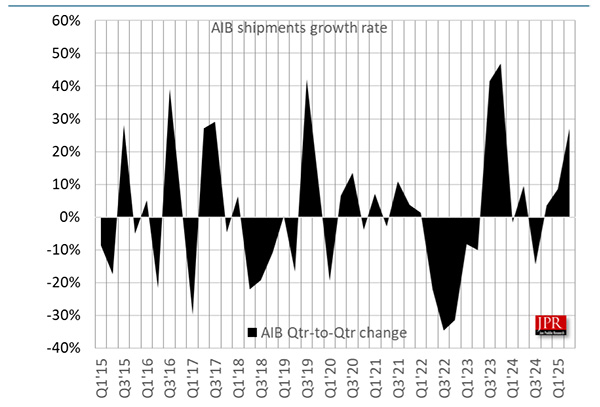
Computer graphics analyst JPR recently published a report on the growth of the global PC-based graphics add-in boards (AIBs). The market reached 11.6 million units in Q2 2025.
JPR report shows AIB shipments for the quarter increased by 27.0% from the last quarter. It also went up 22.2% from last year. In the breakdown, the report reveals GPU maker AMD’s overall market share decreased by -2.1% from last quarter, while rival NVIDIA’s market share increased by 2.1%. Intel’s market share stayed unchanged.
JPR refers to boards with GPUs as graphics AIBs. Note that notebooks typically do not have AIBs, but professional-class notebooks, called mobile workstations, usually come with GPUs.
JPR estimates that overall AIBs will have a compound annual growth rate (technically a decline rate) of -5.4% from 2024 to 2028 and will reach an installed base of 163 million units by the end of the forecast period.
Dr. Jon Peddie, president of JPR, said, "PCs are shifting to notebooks that use integrated graphics (iGPUs) and although the sales of AI GPUs get a lot of headlines, it is because of their ASP ($5,000 - $30,000) and not the volume (<1m units)."
Over the next five years, the penetration of AIBs in desktop PCs will be 87%.
“AIB prices dropped for midrange and entry-level, while high-end AIB prices increased, and most retail suppliers ran out of stock. This is very unusual for the second quarter,” said Peddie. “We think it is a continuation of higher prices expected due to the tariffs and buyers trying to get ahead of that.”
Previously leading chip makers were banned from selling AI processors to China, but in August, NVIDIA and AMD made a deal with the U.S. government, by agreeing to pay 15% of the China revenues to the government to secure export licenses. Buyers may be rushing to secure GPUs in volume before the higher tariffs go into effect and give up the prices.
PC Mag observes, "Unfortunately, prices have increased across the board for NVIDIA’s more powerful RTX 5000 cards and AMD’s Radeon 9070 XT. GPUs have long been assembled in China, which faces huge import tariffs."
Peddie explained, "The first AI processors were available around 2015, and we called them VPUs then -- visual processing units -- because they were associated with image processing. The functionality of the VPU got absorbed in SoCs (like Qualcomm’s and Apple’s) ... GPUs however, were just coming into their own as AI processors around 2019. So, when one door closes anther opens, and we found ourselves talking about graphics GPU (I know, that’s redundant) and AI GPUs ... The GPUs are a subset of AI processors."
JPR report also shows desktop PC CPU market decreased -4.4% year to year, and increased 21.6% quarter to quarter, reaching 21.7 million units. The AIB overall attach rate in desktop PCs for the quarter increased to 154%, up 2.3% from last quarter.
Recently JPR also published a report on the increasing competition in the AI processor market. While the U.S. chipmakers are currently in the lead with 59 firms, JPR warns, "China’s DeepSeek and Huawei continue to push advanced chips, India has announced an indigenous GPU program targeting production by 2029, and policy shifts in Washington are reshaping the playing field. In Q2, the rollback of export restrictions allowed US companies like NVIDIA and AMD to strike multibillion-dollar deals in Saudi Arabia."


Kenneth Wong is Digital Engineering's resident blogger and senior editor. Email him at [email protected] or share your thoughts or suggestions at digitaleng.news/facebook.
Follow DE
Join over 90,000 engineering professionals who get fresh engineering news as soon as it is published.






About Us · Contact Us · Editorial Team · Advertising · Privacy Policy · Subscriber Services · © 2026 Digital Engineering 24/7 · Peerless Media