Helping design and engineering professionals discover, evaluate and specify technologies and processes that shorten the design cycle and enable success.



Digital Engineering April 2026
In the latest issue of Digital Engineering, we take a look at the latest innovations in design for additive manufacturing, including the use of natural language inputs, social media cosplayers, and AI integration. The issue also includes a feature…

January Special Focus Issue: Design for Additive
In this Special Focus Issue of Digital Engineering, learn about the latest advancements in design for additive manufacturing, including new software tools, additive in automotive, custom medical devices, and more.
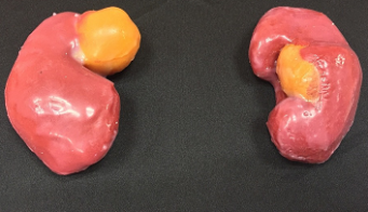 These kidney models help Baylor students prepare for actual surgeries. Image: Lazarus 3D
Baylor College of Medicine is using 3D models of patient kidneys to help students visualize tumors and practice difficult surgeries prior to the actual procedure. So far, a dozen patients have had copies of their kidneys printed prior to an operation.
The 3D printing program was enabled by the work of Jacques Zaneveld, a graduate of Baylor’s Molecular and Human Genetics Program, who launched the printing company Lazarus 3D to provide just such surgical models.
“I was fascinated by 3D printers and I quickly realized their potential for use in healthcare, and specifically for training – however, it took years to develop the technology to create realistic human anatomy models,” Zaneveld said.
Zaneveld worked diligently to find a material that could be 3D printed and that would also mimic the texture of human kidney tissue. Last year, he began creating models using silicone. He sent an initial model to the Baylor urology department, where doctors practiced removing the synthetic tumor with a Da Vinci robot.
After that success, Zaneveld launched Lazarus 3D. The company can create a model of the kidney and tumor, along with the vasculature and other structures. Surgeries near the renal hilum are often very difficult, because of the presence of arteries, veins and the ureter. Having a model helps reduce the likelihood that the entire kidney will be lost.
“There is no realistic way to practice the complex process of removing kidney tumors while sparing normal kidney function,” said Baylor’s Dr. Friedrich-Carl Von Rundstedt. “Even with state-of-the-art facilities, urologic surgery trainees find this procedure difficult to master.”
Lazarus 3D works with the Texas Medical Center and other facilities to provide overnight models of human tissue. The company has also produced liver models and digestive tract models.
Baylor’s Department of Obstetrics and Gynecology is also using 3D printing to produce custom vaginal stents. You can read more about Baylor’s 3D printing efforts here.
Source: Baylor College of Medicine


Brian Albright is the editorial director of Digital Engineering.
Contact him at [email protected].

Join over 90,000 engineering professionals who get fresh engineering news as soon as it is published.






About Us · Contact Us · Editorial Team · Advertising · Privacy Policy · Subscriber Services · © 2026 Digital Engineering 24/7 · Peerless Media