Helping design and engineering professionals discover, evaluate and specify technologies and processes that shorten the design cycle and enable success.


Alert!
Digital Engineering ceased publication on July 1, 2026. This website remains available as an archive of engineering content.
For inquiries or information, please email [email protected].

Digital Engineering April 2026
In the latest issue of Digital Engineering, we take a look at the latest innovations in design for additive manufacturing, including the use of natural language inputs, social media cosplayers, and AI integration. The issue also includes a feature…

January Special Focus Issue: Design for Additive
In this Special Focus Issue of Digital Engineering, learn about the latest advancements in design for additive manufacturing, including new software tools, additive in automotive, custom medical devices, and more.
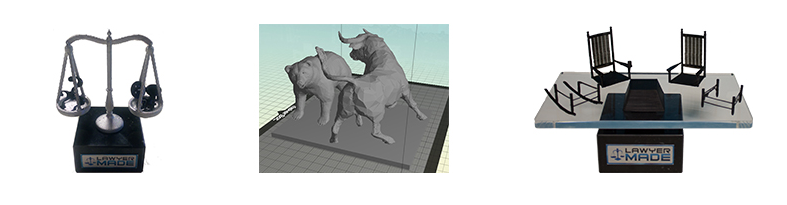 Lawyer Made provides outsourced 3D printing services for law firms. Image courtesy Lawyer Made
The firm, Fennemore Craig, uses the printers to create improved prototypes of allegedly defective products. That involves hiring a team of engineers to "fix" the faulty products, produce the prototypes and then present them as admissible evidence to show that the defective product could have been designed more safely. (Please, insert your own joke here about "manufacturing" evidence.)
According to the article, when the firm bought its first MakerBot printer two years ago they weren't sure how they'd use it.
“After buying one, we quickly found a lot of applications for it, especially in product liability cases. That’s because one of the main questions in those cases is whether the product was properly designed," said attorney James Goodnow, a partner in the firm.
While that sounds expensive, it can be useful in pre-litigation where those 3D models can help the firm reach settlements more quickly, without the expense of a trial.
"It’s one thing to tell a decision-maker or opposing lawyer how your product should have been designed. But it’s much more convincing to show them and letting them actually see and hold a 3D-printed prototype makes it much easier to sell the idea," Goodnow told Above the Law.
This isn't an isolated case, either. In fact, there's enough demand in the legal profession that there are even third-party 3D printing service bureaus just for law firms, like Lawyer Made in San Rafael, CA.
Of course, there's also the emerging industry of 3D printer-focused legal practices that help firms with intellectual property issues and contract drafting, but as far as we know they are still manufacturing their legal briefs the old fashioned way.
Source: Above the Law


Brian Albright is the editorial director of Digital Engineering.
Contact him at [email protected].






About Us · Contact Us · Editorial Team · Advertising · Privacy Policy · Subscriber Services · © 2026 Digital Engineering 24/7 · Peerless Media