Helping design and engineering professionals discover, evaluate and specify technologies and processes that shorten the design cycle and enable success.


Alert!
Digital Engineering ceased publication on July 1, 2026. This website remains available as an archive of engineering content.
For inquiries or information, please email [email protected].

Digital Engineering April 2026
In the latest issue of Digital Engineering, we take a look at the latest innovations in design for additive manufacturing, including the use of natural language inputs, social media cosplayers, and AI integration. The issue also includes a feature…

January Special Focus Issue: Design for Additive
In this Special Focus Issue of Digital Engineering, learn about the latest advancements in design for additive manufacturing, including new software tools, additive in automotive, custom medical devices, and more.
Today we’ll take a look at LPKF’s new system, the ProtoLaser U3, which will be shown off at the IEEE International Microwave Symposium (IMS). For those interested in attending IMS, it’ll be running June 17-22 inMontréal,Canada.
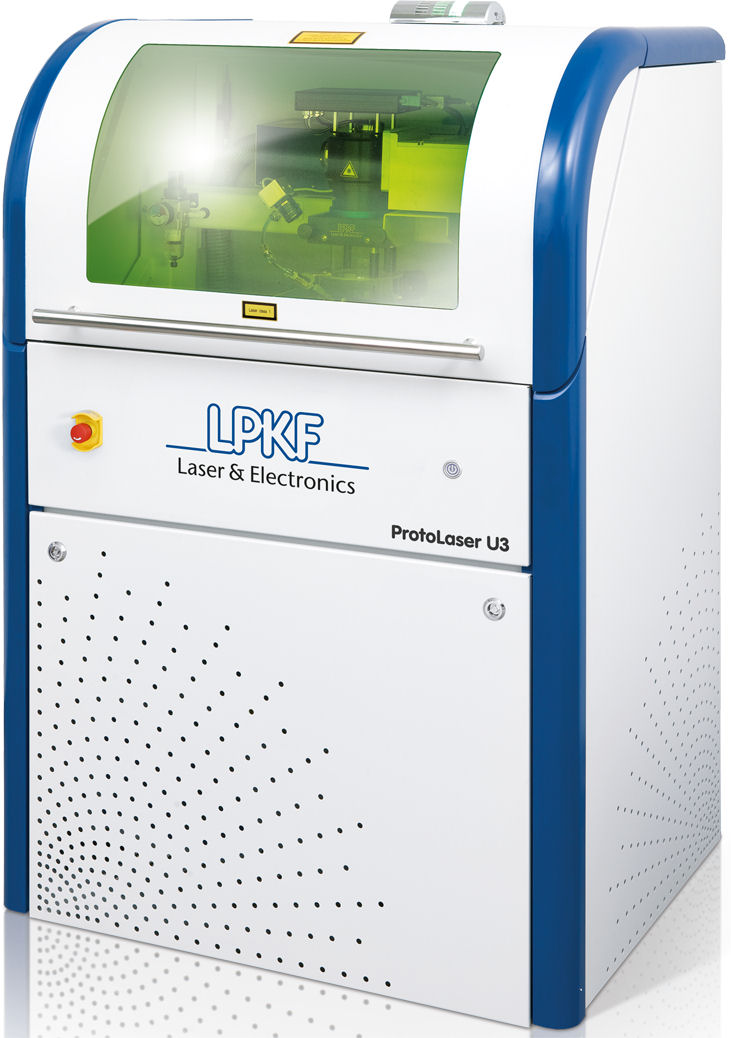
LPKF calls the ProtoLaser U3 a, “Multipurpose UV Laser System,” capable of working with a range of materials including ceramic, LTCC (green tape), FR4, Rogers, protective sheets, and metal foils along with flexible or flex-rigid materials. The system also includes automatic tool change, solder paste dispensing and automatic milling depth adjustment.
According to the company, the use of a laser makes the ProtoLaser U3 a safe choice for use in a laboratory:
"The laser process itself stands out from competing processes due to its high flexibility and fast processing. The laser uses no environmentally hazardous chemicals, requires no masks and keeps outlay for tool production to a minimum. The laser works contact-free and therefore can also be used with sensitive materials."
The ProtoLaser U3 can also be used to separate individual circuit boards from large printed boards, cut LTCC and prepregs, drill holes and microvias or structures FR4 substrates. According to the company, the new system is the only UV laser machine that can structure laminated substrates.
LPKF says it has designed the ProtoLaser U3 to be compact, with a footprint of 875 x 1,430 x 750 mm (34.5 x 56.3 x 29.5 in.). The maximum material size and layout area is 229 x 305 x 7 mm (9 x 12 x 0.27 in.), with a resolution scanfield of 2 µm and repeatability of ± 2 µm.
Although I don’t have a video of the ProtoLaser U3 to show you, below you’ll find a presentation of the ProtoLaser S to give you some idea of what the laser system looks like.
Source: LPKF


John Newman is a Digital Engineering contributor who focuses on 3D printing. Contact him via [email protected] and read his posts on Rapid Ready Technology.
Follow DE






About Us · Contact Us · Editorial Team · Advertising · Privacy Policy · Subscriber Services · © 2026 Digital Engineering 24/7 · Peerless Media