Helping design and engineering professionals discover, evaluate and specify technologies and processes that shorten the design cycle and enable success.




Digital Engineering April 2026
In the latest issue of Digital Engineering, we take a look at the latest innovations in design for additive manufacturing, including the use of natural language inputs, social media cosplayers, and AI integration. The issue also includes a feature…

January Special Focus Issue: Design for Additive
In this Special Focus Issue of Digital Engineering, learn about the latest advancements in design for additive manufacturing, including new software tools, additive in automotive, custom medical devices, and more.
LulzBot is one company that has gone the other direction with its products. The company uses open source software – such as Slic3r – to run their AM systems, and has stuck with what is essentially a highly tuned RepRap style of 3D printer. Open source development or no, improvements on the basic design do continue, leading to the launch of the TAZ 2.
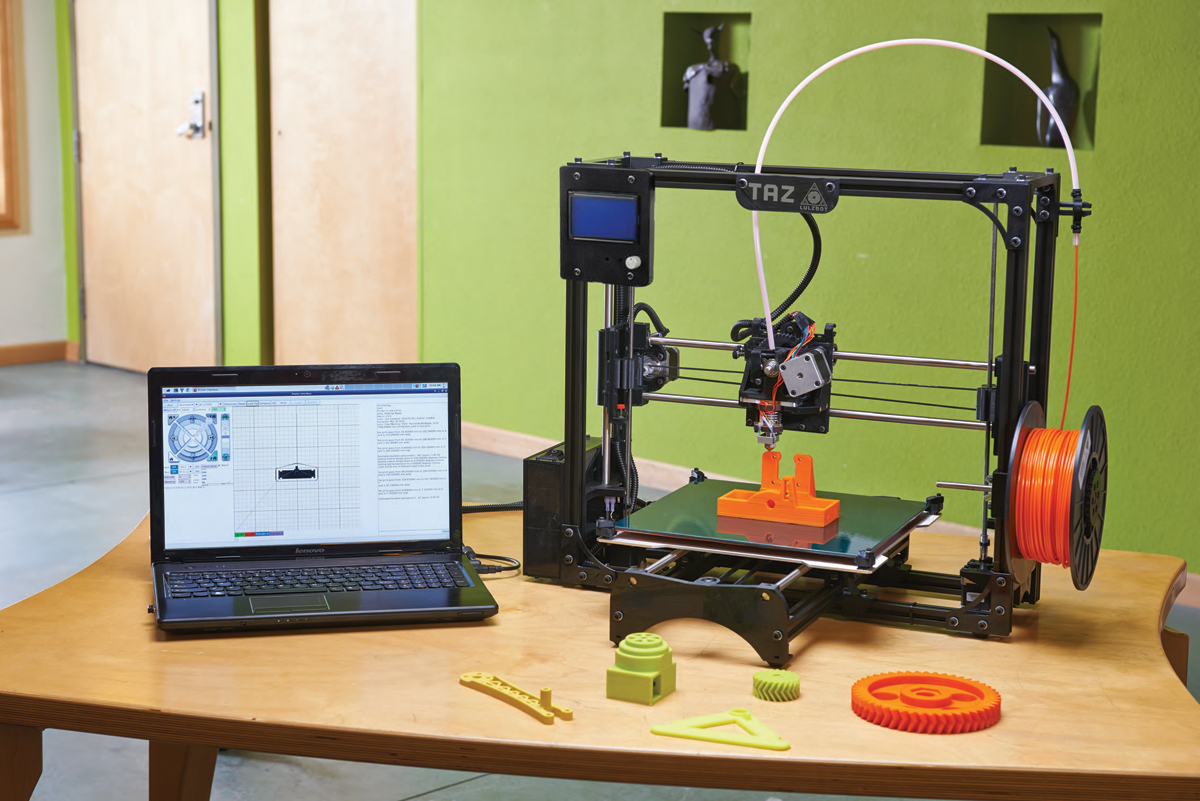
“At Aleph Objects, we’re continually evolving our LulzBot 3D printers to not only meet marketplace needs in real-time but to raise industry standards for 3D printing as a whole,” said Jeff Moe, president and founder. “Our latest printer, the TAZ 2, represents our community-driven approach by capturing the best-of-class in ideas from engineers and innovators around the world.”
One benefit to open source development is a reduced R&D price tag, which leads to lower priced 3D printers. For an AM system with a build envelope of 12 x 11 x 10 in. (30.48 x 27.94 x 25.4 cm), the LulzBot TAZ 2 is reasonably priced for the Maker crowd or small businesses at $2,395. LulzBot also returns the open source favor by releasing its plans online, making its products highly customizable.
Other than the build envelope, the TAZ 2 shares the same basic specs as its predecessor. The new 3D printer has a print speed of 7.9in/sec (200mm/sec), with a 75µ resolution and a print tolerance of 0.1mm (0.0039in) in the X and Y axes.
Another new feature is an LCD display with an SD card reader that allows the TAZ 2 to print objects without being attached to a computer. The system can print in ABS, PLA, PVA, high-impact polystyrene, and wood filament, and can be (theoretically) modified to print in nylon and polycarbonate. As you would expect for its price, the TAZ 2 is shipped completely assembled, rather than as a kit.
Below you’ll find a video about LulzBot’s TAZ systems.
Source: Aleph Objects


John Newman is a Digital Engineering contributor who focuses on 3D printing. Contact him via [email protected] and read his posts on Rapid Ready Technology.
Follow DE
Join over 90,000 engineering professionals who get fresh engineering news as soon as it is published.






About Us · Contact Us · Editorial Team · Advertising · Privacy Policy · Subscriber Services · © 2026 Digital Engineering 24/7 · Peerless Media