Helping design and engineering professionals discover, evaluate and specify technologies and processes that shorten the design cycle and enable success.


Alert!
Digital Engineering ceased publication on July 1, 2026. This website remains available as an archive of engineering content.
For inquiries or information, please email [email protected].

Digital Engineering April 2026
In the latest issue of Digital Engineering, we take a look at the latest innovations in design for additive manufacturing, including the use of natural language inputs, social media cosplayers, and AI integration. The issue also includes a feature…

January Special Focus Issue: Design for Additive
In this Special Focus Issue of Digital Engineering, learn about the latest advancements in design for additive manufacturing, including new software tools, additive in automotive, custom medical devices, and more.
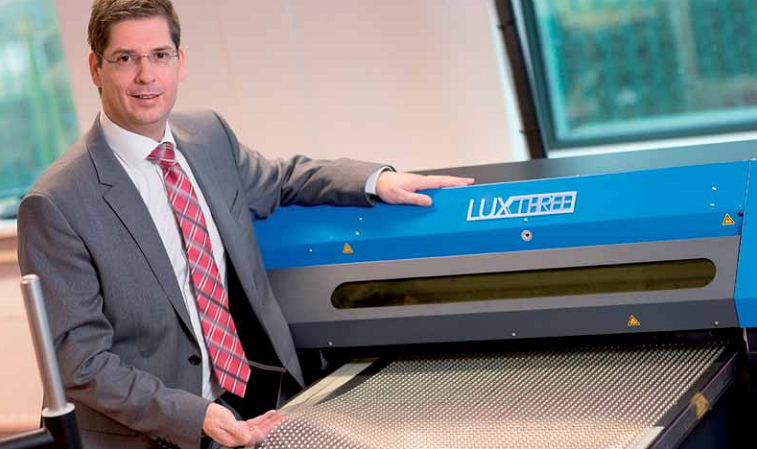
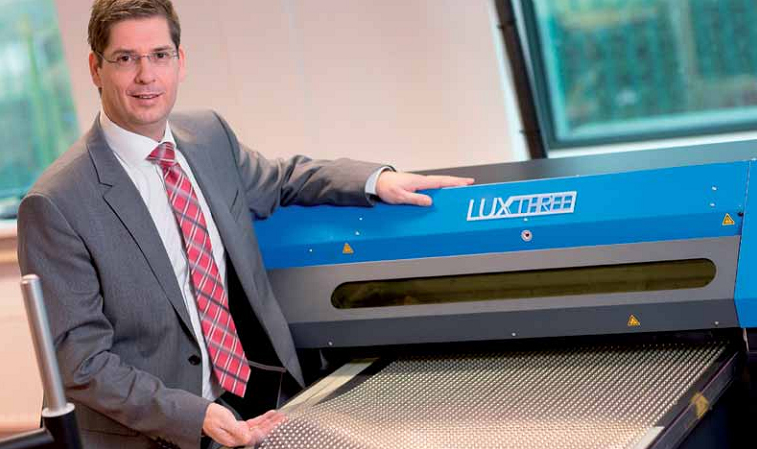
Demonstrating innovation has no boundaries, LUXeXcel has managed to make AM a core part of optics manufacturing. The company’s development of what calls the Printoptical Platform highlights the flexibility of AM for nearly any industry. As is the case with many 3D printed breakthroughs, LUXeXcel turned to AM to solve the problems of speed and cost.
“We looked for a process that didn’t need expensive and inflexible tooling like injection molding,” said Richard van de Vrie, LUXeXcel CEO. “A process that supported volume manufacture, as well as rapid prototyping and that could deliver clear, smooth surfaces.”
The Printoptical Platform is a fast, wide-format printer that can produce optically smooth surfaces without requiring post-processing. The ability to print out optics reduces much of the costs typically involved with optics manufacturing, including the creation of specific molds and tools for each project.
LUXeXcel’s AM system is based on wide-format industrial ink-jet equipment. A piezoelectric controllable print head jets transparent droplets of a UV-curable polymer. The polymer is then cured by UV lamps which are integrated into the print head. The delay in time between when a droplet is formed and when a UV lamp passes overhead is long enough to allow the droplet to flatten out and lose its spherical form.
With a resolution of 1,440 dpi or greater, the print head is extremely accurate, allowing for the creation of complex optics patterns. The system can also produce transparent prisms or lenses and full color 3D graphics and textures, all without requiring post-processing.
Designing for the Printoptical Platform is similar to the manner in which any other object is designed with AM in mind. Designers work in CAD to (LUXeXcel prefers Autodesk) specific requirements, then the digital file is dashed off to the AM system to be built. Digital design for AM offers much more creative freedom than for older manufacturing processes, giving LUXeXcel the ability to develop nearly any kind of optic required by a customer.
“With our new technology for additive manufacturing, we’ve digitalized the process of optics fabrication,” said Marco de Visser, LUXeXceL’s marketing communications manager. “In doing so we’ve eliminated the expenses of molds and tooling, made just-in-time manufacturing possible and enabled lighting and optics designers to be creative and have more freedom than they’ve ever had before.”
LUXeXcel’s version of 3D printing joins other uses of AM that might not be quite so obvious, such as using the technology to build a surfboard or snowboard. I’d bet most people wouldn’t think AM would be used to build a marine habitat, either.
Below you’ll find a video about LUXeXcel and its Printoptical Platform.
Source: LUXeXcel


John Newman is a Digital Engineering contributor who focuses on 3D printing. Contact him via [email protected] and read his posts on Rapid Ready Technology.
Follow DE






About Us · Contact Us · Editorial Team · Advertising · Privacy Policy · Subscriber Services · © 2026 Digital Engineering 24/7 · Peerless Media