Helping design and engineering professionals discover, evaluate and specify technologies and processes that shorten the design cycle and enable success.


Alert!
Digital Engineering ceased publication on July 1, 2026. This website remains available as an archive of engineering content.
For inquiries or information, please email [email protected].

Digital Engineering April 2026
In the latest issue of Digital Engineering, we take a look at the latest innovations in design for additive manufacturing, including the use of natural language inputs, social media cosplayers, and AI integration. The issue also includes a feature…

January Special Focus Issue: Design for Additive
In this Special Focus Issue of Digital Engineering, learn about the latest advancements in design for additive manufacturing, including new software tools, additive in automotive, custom medical devices, and more.
I yammer on here a lot about how 3D printing could be the next transformative technology. The ability to print out everyday use items, like lamp shades, iPhone covers, laundry clips or flyswatters, makes a home 3D printer really useful. That isn’t even taking into account all the other cool stuff you can find CAD files for on the web, or the ability to print out custom objects for your kid’s science fair project, etc.
One of the biggest hurdles for this vision of the near-future becoming a reality is price. Unless you go the DIY route, most 3D printers intended for the hobbyist or home use are still kind of expensive. That $1,000-$3,000 you’d spend for a system can pay a fair number of bills or can be spent on your next vacation. Most people that spend that much on something want to know it’ll be useful now, not in five years from now.
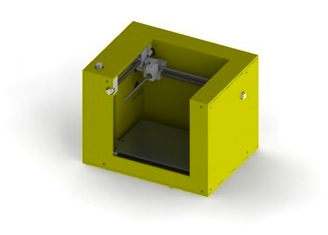
A new startup company named MakiBox (blog here) is taking the idea of creating a 3D printer for home use seriously. Beginning with a sort of Kickstarter donation page, MakiBox has accrued enough capital to begin production of its home 3D printer as early as next month, and, as Bob Barker might say, the price is right.
The company’s first product is called the MakiBox A6 and it “sells” (on the donation site) for $350 for a kit you are required to put together yourself. The kit doesn’t require any soldering or tools you might not have at home and has been designed with the average customer in mind, rather than the mechanical engineering hobbyist. If you are still wary about having to put the thing together yourself, a fully assembled printer runs for $550.
Those prices are pretty darn good. You could get two MakiBox printers for the cost of a single home system offered by other companies. Further, that $350-$550 range is starting to come in line with how much other frequently used tech costs. You can get a cheap PC for $250. The iPad starts at $500 and even the relatively inexpensive Kindle Fire clocks in at $200.
The MakiBox A6 measures 280 x 210 x 210 with a build envelope of 150 x 110 x 110 (or 5.9 x 4.3 x 4.3 in. for people who don’t think in metric). That isn’t quite as large a build area as offered by the MakerBot Replicator which is 8.9 x 5.7 x 5.9 in. (and covered by Rapid Ready here). MakiBox uses fused deposition modeling to build objects, employing 1mm ABS filament.
On the software front, MakiBox uses ReplicatorG, an open source program that is probably part of how the company keeps prices low. ReplicatorG is capable of handling standard STL files and is available for both Mac and PC. The printer is attached to a computer through a USB cable.
Below you’ll find a video that features the MakiBox A6 and its creator Jon Buford.
Source: MakiBox


John Newman is a Digital Engineering contributor who focuses on 3D printing. Contact him via [email protected] and read his posts on Rapid Ready Technology.
Follow DE






About Us · Contact Us · Editorial Team · Advertising · Privacy Policy · Subscriber Services · © 2026 Digital Engineering 24/7 · Peerless Media