Helping design and engineering professionals discover, evaluate and specify technologies and processes that shorten the design cycle and enable success.


Alert!
Digital Engineering ceased publication on July 1, 2026. This website remains available as an archive of engineering content.
For inquiries or information, please email [email protected].

May 2026 Special Focus: Artificial Intelligence in Design and Simulation
In this Special Focus Issue, learn about the latest developments in the integration of artificial intelligence into engineering workflows.

Design & Simulation Software Guide 2025
In this Special Issue, Digital Engineering presents its second annual guide to design and simulation software vendors.
Maplesoft announced its collaboration with Engineered Arts Limited, a company that designs and produces the RoboThespian robots. The current RoboThespian is a life-sized, programmable humanoid robot designed to be used for entertainment and communication. The next generation RoboThespian robot will be a full size humanoid dynamic robot that walks, runs and jumps.
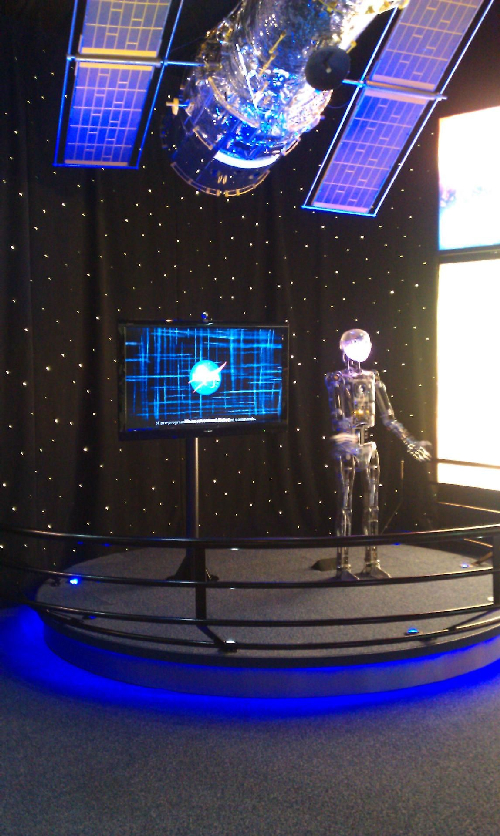
The goal of the RoboThespian project is to make humans think more deeply about humanoid robotics and artificial intelligence, the company says. RoboThespian robots are used by science centers in 14 countries
The walking robot prototype will also be used as an advanced research platform that explores verbal and non-verbal communication, human-robot social interaction, object tracking and recognition, and many other areas.
"The next generation RoboThespian has a full-sized, dynamic humanoid design which presents complex challenges," said Will Jackson, director, Engineered Arts Limited. "With it, we will take robotic engineering to levels of complexity and performance not seen before. MapleSim significantly simplifies the task for us with its unique but highly efficient modeling and simulation platform. The capacity to simplify, solve and interact directly with differential equations was a big enabler in modeling and analyzing physical interactions of the robot components. The complex interaction between interdependent variables could be relatively easily modeled because of MapleSim's system-level approach to modeling."
The design engineers at Engineered Arts are currently using MapleSim to design a biologically analogous humanoid robot leg integrating a novel actuator, studying its static and dynamic stability, and building the designed leg to determine strategies for its control. The design is analogous to the human musculoskeletal system. A MapleSim model of the leg and actuators was built to verify the relationship between actuators under pressure, their contraction and the equivalent joint angles in static states. MapleSim's custom component template was used extensively to model the robot's pneumatic actuators. The leg model was created by a chain of multibody components, and the compliant foot was modeled with real-time feedback from the 3-D view.
Engineered Arts aims to have a full-body MapleSim model of the next generation RoboThespian by early 2013, and a working prototype later in the year.
For more information, visit Maplesoft.
Sources: Press materials received from the company and additional information gleaned from the company's website.


DE's editors contribute news and new product announcements to Digital Engineering. Press releases may be sent to them via [email protected].
Follow DE
Join over 90,000 engineering professionals who get fresh engineering news as soon as it is published.






About Us · Contact Us · Editorial Team · Advertising · Privacy Policy · Subscriber Services · © 2026 Digital Engineering 24/7 · Peerless Media